

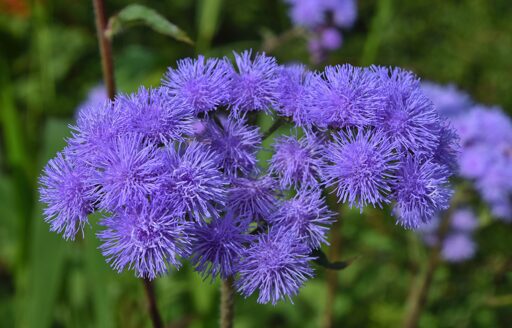
KATHMANDU — Until a few decades ago, botanist Bharat Babu Shrestha observed abundant growth of Indian pennywort (Centella asiatica) across large areas of Kathmandu. But the low-growing herb, distinguished by its kidney-shaped leaves and medicinal properties in the traditional Ayurveda, is now gradually vanishing from Nepal’s capital. Its disappearance has been attributed to shrinking open spaces, and largely due to the spread of another plant species creeping across Kathmandu: Crofton weed (Ageratina adenophora), locally known as kaalo banmara. The various species within the family of banmara — meaning “forest destroyer” in Nepali — the dense shrub with multi-colored flowers, with roots in Central and South America, is displacing many native species. “There has been no qualitative assessment in Kathmandu, but our observations show that our native vegetation has been dominated and displaced by many invasive species,” said Shrestha, a botany professor at Tribhuvan University, Nepal. “Our research in Nepal’s Parsa and Shuklaphanta national parks have concluded that invasive species have reduced almost half of the native species in those regions, indicating similar impacts in Kathmandu.” In Kathmandu, Crofton weed; the common lantana (Lantana camara), locally called kaade banmara; Santa Maria feverfew (parthenium weed, Parthenium hysterophorus), known as pati jhaar in Nepali; and blue billy goat weed (Ageratum houstonianum), locally called neelo gandhe, are said to be the dominant invasive species, according to experts. Shrestha said that species such as the common lantana or the polka dot plant (Hypoestes phyllostachya), which is native to Madagascar, have become popular ornamental plants in…This article was originally published on Mongabay
From Conservation news via This RSS Feed.