

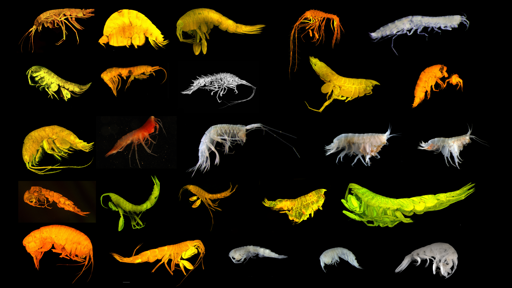
Researchers pulled 24 tiny new creatures from a deep abyss in the central Pacific Ocean, some with long, spindly legs and others with more squat, compact bodies. Some appeared to feed on the sediment itself, while others had large claws suggesting they prey on other creatures living in the mud. The discoveries, published in ZooKeys, come from the Clarion-Clipperton Zone (CCZ), a roughly 6-million-square-kilometer (2.3-million-square-mile) expanse of seabed between Hawai‘i and Mexico. The newly described species are all amphipods, a diverse group of crustaceans. The shrimp-like creatures, most about a centimeter long, or less than half an inch, have evolved in the deep sea, some 4,000 meters (13,100 feet) below the surface, over millions of years. Among the finds was a completely new superfamily, Mirabestioidea, and a new family, Mirabestiidae, representing previously unknown evolutionary lineages. “If you imagine that on planet Earth, we know about carnivorous mammals, we know that bears exist and we know that the families of cats exist, it would be like finding dogs,” Tammy Horton, a researcher at the U.K.’s National Oceanography Centre and co-lead of the study, told Inside Climate News. Collage of the 24 new Amphipod species identified in Clarion-Clipperton Zone, CC BY, National Oceanography Centre, Southampton Scientists collected the specimens by extracting large cubes of mud from the seabed, known as box cores, and hauling them up to a research ship. After washing and sieving the cores, researchers found a variety of amphipods nestled among the mud and metallic nodules. During a weeklong…This article was originally published on Mongabay
From Conservation news via This RSS Feed.