

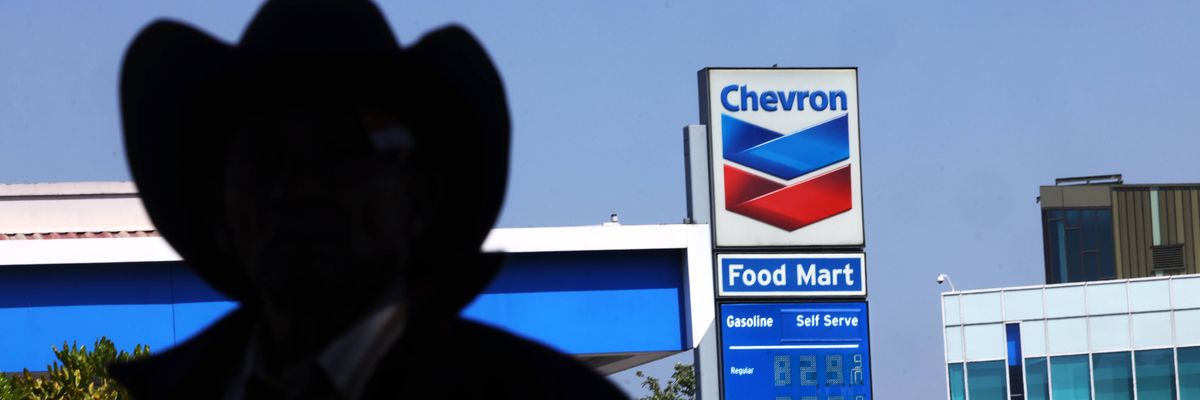
After pouring money into President Donald Trump’s successful campaign to take back the White House, US fossil fuel industry executives cashed in on his and Israel’s war on Iran with record-setting stock sales, according to a VerityData analysis reported on Wednesday by The Wall Street Journal.
“Much of the selling for the first quarter began before the US and Israel began bombing Iran on February 28,” and some “were prearranged under plans that allow executives to sell stock automatically at specific times or share prices without making in-the-moment decisions that could leave them open to allegations of improper trading,” the newspaper acknowledged.
However, as share prices for the industry skyrocketed—Iran responded to the US-Israeli assault by shutting down the Strait of Hormuz, a key trade route for fossil fuels—executives at Chevron, ConocoPhillips, Diamondback Energy, and other oil and gas companies collectively sold $1.4 billion in stock.
“At nearly a dozen companies, the number of executives selling in the quarter reached or surpassed 10-year records, and in some cases set all-time records,” the Journal detailed. “The sales hit a 15-year peak, with nearly six executives selling for every one that bought shares in the first quarter—well over double the usual ratio.”
“CEOs stood out as big sellers in many cases,” the newspaper highlighted, noting that “Chevron chief executive Mike Wirth sold some $104 million worth of shares between January and March. ConocoPhillips’s Ryan Lance netted about $54.3 million in share sales in March alone. Lorenzo Simonelli, CEO of oil field services company Baker Hughes, sold about $33 million worth of stock that same month.”
VerityData’s head of research, Ben Silverman, said that “it speaks to the opportunistic behavior of everyone involved—it could be opportunistic set months earlier, it could be opportunistic in the moment… There was a breathlessness to the selling, and the message they sent was to cash in now because the ride won’t last forever.”
Who’s profiting from ridiculous and unnecessary wars? Big Oil CEOs, to name one obvious group. @emorwee.bsky.social heated.world/p/chevrons-c…
[image or embed]
— Ross Macfarlane (@rossmacfarlane.bsky.social) April 8, 2026 at 5:04 PM
In her Heated newsletter, climate journalist Emily Atkin pointed out that “this isn’t the first time a small group of extraordinarily wealthy oil CEOs used a war to make themselves richer. In the weeks after President Joe Biden said that he was ‘convinced’ Russia would invade Ukraine in 2022, Big Oil CEOs sold almost $99 million worth of shares, according to an analysis by Friends of the Earth and BailoutWatch.”
According to Atkin:
What really makes this story remarkable is not simply that oil executives got rich from a war. It’s how perfectly legal and normal it all is, and what that legality reveals about who wins and who loses when America goes to war.
When America goes to war, the costs are distributed broadly, onto every American who drives a car or heats a home. The benefits are distributed narrowly, flowing to a small group of men whose compensation is designed to capture exactly this kind of windfall.
And the cash windfall these oil executives make from the war won’t go primarily toward yachts and private jets (they already have those). It will go toward political campaigns and lobbying organizations dedicated to fighting climate regulation, blocking clean energy policy, and fueling authoritarianism.
The Journal reporting came on the heels of Trump and Iran agreeing to a fragile two-week ceasefire negotiated by Pakistan late Tuesday. While Israel is supposedly on board, it escalated attacks on Lebanon on Wednesday.
As a Pakistani official publicly reiterated that Lebanon is still part of the deal and Iran threatened to back out altogether, Janet Abou-Elias, a researcher with the Democratizing Foreign Policy program at the Quincy Institute for Responsible Statecraft, told Common Dreams that Israel’s assault “appeared to be a direct attempt to blow up the ceasefire, and it worked.”
Meanwhile, although oil prices dropped after the ceasefire announcement, “‘fossilflation’—or inflation caused by volatile and rising prices of oil and gas—is still likely to continue,” the global climate group 350.org warned on Wednesday.
“Even if the Strait of Hormuz reopens and the ceasefire holds, oil and gas prices will stay above pre-war levels, and consumers will pay,” said Andreas Sieber, 350.org’s head of political strategy. “Volatility remains high, and supply will stay tight due to infrastructure damage and inventory rebuilding.”
The group said last week that war-related spikes in oil and gas prices “have already cost consumers and businesses an additional $104.2-$111.6 billion” globally, and an analysis from Democratic members of the congressional Joint Economic Committee found that Americans spent an extra $8.4 billion at the fuel pump during the first month of Trump’s war.
Throughout the conflict, 350.org and other green groups have advocated for a windfall profits tax targeting oil and gas giants, as well as renewed calls for a swift and just international transition away from climate-wrecking fossil fuels.
From Common Dreams via This RSS Feed.