

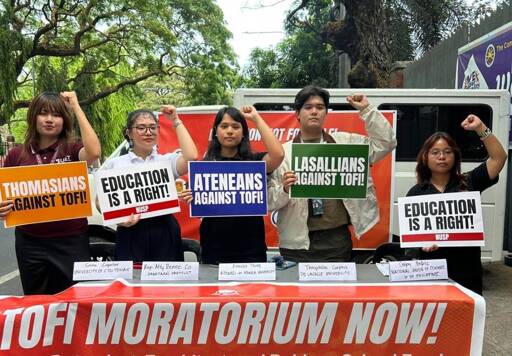
MANILA – The National Union of Students of the Philippines (NUSP), a broad alliance of student councils from various universities, is demanding that the Commission on Higher Education implement a moratorium on tuition fee increase and abolish “redundant, questionable, and excessive school fees” as the country grapples with rising fuel prices.
“Amid worsening economic crises, an increase in tuition and other fees will only burden students and their families more,” NUSP president Sofia Jan Trinidad said in a statement. “While the ordinary Filipinos carry the burden, big businesses continue to earn large sums of profits from public services, including education.”
The union, together with Kabataan Party-list Rep. Renee Co and student leaders from private universities Ateneo de Manila, University of Santo Tomas, and De La Salle University, submitted a position letter to the CHED and held a press conference on Tuesday, April 7, 2026.
“Access to education should not come with a price,” Co said in Filipino. “Every year, tuition fees are increasing, along with additional, often arbitrary and overlapping school charges. As a result, many young people are forced to stop or take on side jobs to continue their studies. They are being left behind.”
CHED has the mandate to regulate tuition and other school fees.
CHED Memorandum No. 3 states that all higher education institutions (HEIs) – public and private – that plan to increase their tuition and other school fees must conduct consultations with their student councils, faculty, non-teaching personnel and alumni not later than February 28 of the academic year.
On February 27, NUSP reported that some consultations were marred by last-minute notices, lack of avenues for open and proper dialogue, disempowerment of student councils and governments, and even threats of disciplinary actions against students demanding consultation.
Annika Torres, a student leader from Ateneo de Manila University, argues that even if a consultation was conducted in their university, the process was not transparent and students’ grievances were not heard by the university administration.
“An increase in the tuition fee would mean that one student will be priced out from the education they deserve,” Torres said in Filipino. “The six-percent tuition fee increase [in our university] would mean many of us will be forced to look for jobs or take leave of absence for a semester or year because of the compounding expenses.”
The submitted position paper compiled a partial list of tuition fee increases gathered from various universities.
- Ateneo de Manila University – 6 percent
- Adamson University – 6 percent
- Mapua University – 3 percent
- National Teachers College – 3 percent
- University of Asia and the Pacific – 5 percent
- Saint Louis University – 5 percent increase for other school fees
- University of Baguio – 10 percent increase for incoming first years and transferees
- Holy Angel University – 2 percent
- Ateneo de Naga University – 4 percent
- University of La Salle – 3 percent
- Silliman University – 8 percent
- University of San Carlos – 6.7 percent
- Ateneo de Zamboanga University – 4 percent
- Xavier University – 4 percent
- Ateneo de Davao University – 3 percent
- Assumption College of Davao – 4 percent
- Mapua Malayan Colleges Mindanao – 2 percent
“We call on CHED to side with the students and not serve as mere TOFI stamp pads,” said Trinidad. “Despite the pronouncements of Marcos Jr. that education is their priority, his inaction now proves that he is nothing but performative.”
The average range of compiled TOFI proposals from universities amount from P1,500 ($24.90) up to Php 8,000 ($132.82) per semester.
NUSP added that some students have no choice but to go to private institutions because only 14 percent of the higher education institutions in the Philippines are public universities.
They also reported that for every 10 individuals who entered primary education, only one was able to successfully finish their college studies.
The estimate comes from 2024 data of the Department of Education and CHED.
Of approximately 10 million students enrolled in primary education, only 812,000 graduate from college.
In response to the rippling effect of oil price hikes, CHED gives the HEIs the full flexibility to implement 100 percent online classes on April 6, according to its Chairperson Shirley Agrupis.
“We are encouraging them for now. But it should not sacrifice the intended outcome of the program. But this is just a stepgap. If they want after the crisis or even within the crisis, if they see it more fitting for them to transform into online, we have a set of guidelines,” said Agrupis to the media, referring to the online distance education learning (ODEL) program.
But this is not enough for the students and even the youth representative in the House of Representatives.
“We are told: Don’t go to school, just attend online classes (to lower costs). But online learning does not work—it does not provide holistic development. It should only be a last resort,” said Co.
“We do not accept band-aid solutions,” she added, calling on the government to deregulate the oil industry, remove regressive taxes, and condemn the US-Israel aggression on Iran that prompted the oil price hikes. (RTS, JDS)
The post CHED urged to pause tuition fee increases as oil prices surge appeared first on Bulatlat.
From Bulatlat via This RSS Feed.