

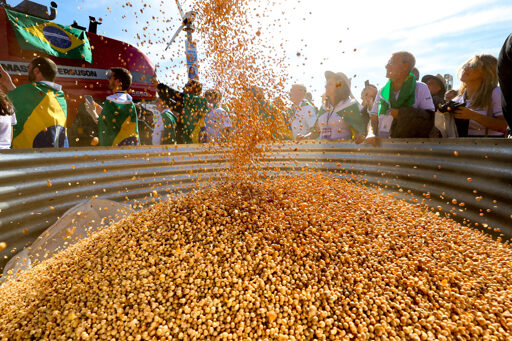
In March, after decades of negotiations, the free trade agreement between Mercosur nations and the European Union (EU) was ratified by Paraguay, the last founding member of the Latin American bloc to give the green light to the deal. Already in its final stage, the document will be provisionally implemented in May, 2026, according to the European Commission. The agreement is being hailed as an economic boon for both EU and Latin American nations. However, it may cause a series of environmental impacts. According to various NGOs and environmental advocates, major problems for Latin America could include expansion of deforestation, mining, and pesticide imports and use. Other experts argue that the agreement could impose a series of environmental rules on already existing global trade – in addition to facilitating knowledge exchange among the parties. Good for trade, bad for the environment? Mercosur, as it’s known in Spanish, and Mercosul, in Portuguese, has been dubbed the Southern Common Market. It represents one of the world’s leading economic blocs, and its fifth-largest economy. It is composed of five member countries (Argentina, Brazil, Paraguay, Uruguay, and Bolivia) and seven associate members (Chile, Colombia, Ecuador, Guyana, Peru, Suriname, and most recently Panama). In general terms, the treaty between Mercosur nations and the European Union provides for gradual reduction of import tariffs between the two continental blocs. In late February, the Brazilian government stated that the EU “commits to eliminating import tariffs on approximately 95% of goods that account for 92% of the value of…This article was originally published on Mongabay
From Conservation news via This RSS Feed.