

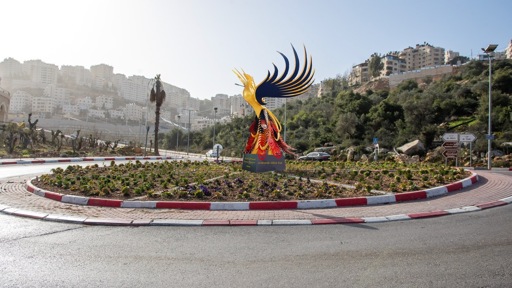
A statue of a phoenix was recently erected in one of Ramallah’s upscale neighborhoods, inhabited by senior officials of the Palestinian Authority (PA).
For Palestinians, the legendary bird, which (according to their ancestors) rises from its ashes, not only holds historic significance, but also symbolizes their resilience and unbreakable resistance against the Israeli occupation.
What makes the erection of the statue in the PA’s political and administrative hub ironic, is the fact that its leaders and security apparatus have, for decades, spared no effort to break the will of the Palestinian people and push them towards capitulation.
The PA has made relentless efforts to eradicate armed resistance against the Israeli occupation, in order to maintain its political interests and stay in power, with the support of the United States.
It has also implemented arbitrary political and economic measures that have made living in the West Bank unbearable.
Read more: In collaboration with the US, Israel, Palestinian Authority escalates crackdown on resistance in West Bank
While the sculpture shows the mythical creature standing tall with flapping wings, the PA’s repressive policies, alongside the surge in Israeli violence, have in reality trapped the Palestinian phoenix with no way out, at least in the short-term.
Today, the efforts by both Israel and the PA to subjugate Palestinians in the occupied West Bank are only expanding amid the ongoing US-Israeli aggression on Iran and other parts of West Asia.
Israel intercepts missiles over the heads of Palestinians
Since the beginning of the current regional war, Israeli air defenses have deliberately intercepted missiles launched from Iran directly above densely populated areas within the occupied West Bank.
Four Palestinian women were killed last month, on the eve of Eid al-Fitr holiday, when shrapnel from a missile fell on a beauty salon in the southern West Bank governorate of Hebron.
The interception of other missiles also caused material damage to some buildings and properties across the occupied territory, including the central city of Ramallah.
The Palestinian Civil Defense said in a report published on March 26, that its teams, alongside the concerned police personnel, dealt with 270 incidents related to falling missile shrapnel in different areas of the West Bank.
The report added that those incidents resulted in the death of five people, including the four women killed in Hebron, without giving further details about the fifth fatality.
Israel’s continuous interception of missiles has considerably paralyzed daily life in the West Bank, after schools and universities were forced to transition to remote education.
Moreover, the IOF has tightened the restriction on movement, and intensified its arrest campaigns and deadly attacks on Palestinians. The last few weeks also saw an increase in lethal assaults waged by illegal Israeli settlers on Palestinian towns and villages.
Read more: Twelve Palestinians killed in Israeli attacks across the West Bank
Israel closes houses of worship during Muslim and Christian holidays
The apartheid nature of the Israeli regime has once again been exposed with the closure of Al-Aqsa Mosque and the Church of Holy Sepulchre in the Old City of Jerusalem for over one month.
Netanyahu’s government claimed that the arbitrary measure has been implemented due to security concerns related to the ongoing war against Iran.
Yet, the closure coincided with Muslim and Christian holidays, which according to analysts aims to provoke the indignation of the Indigenous population and enhance their sense of helplessness by restricting their right to practice their religious rites in their sacred places.
PA cracks down on activists voicing support for Iran
The PA has adopted a hostile position towards Iran in recent years, accusing the Islamic Republic of trying to spread chaos in the West Bank by providing financial and military support to armed resistance groups.
The PA’s anti-Iran rhetoric only grew in the aftermath of the October 7 attack. A narrative that aims to convince the public that Operation Al-Aqsa Flood was planned and directed by Tehran has been promoted ever since.
Instead of putting all the blame on Israel for committing the genocide against the Palestinian people in Gaza, the PA has launched propaganda focused on criticizing the Palestinian resistance and the Iran-led Axis of Resistance.
Its media outlets and social media mouthpieces have relentlessly attempted to hold resistance movements in the region accountable for the death of at least 72,302 Palestinians killed by Israel in Gaza, since October 2023.
During the ongoing US-Israeli regional war, the PA’s security apparatus even resorted to arresting activists voicing support for Iran.
Palestinian political activist, freedom fighter, and former prisoner in Israeli jails, Omar Assaf, was arrested by the PA’s Preventive Security Services on March 25, for leading the drafting of a statement, denouncing some Arab states for their involvement in the ongoing aggression on Iran.
Although Assaf was bailed out and released a couple of days after he was arrested, he has been later subjected to a smear campaign by the PA’s mouthpieces on social media. These mouthpieces have also been fomenting the Sunni-Shia sectarian strife, to incite hostility against Iran.
Many Palestinians are disappointed in the PA’s security apparatus, arguing that they only function against their own people while being unable to protect them from Israeli violence.
Another aspect that deepens their frustration is the fact that this apparatus is even unable to protect itself. Whenever Israeli forces deploy in areas, presumably under the control of the PA, all Palestinian security personnel and vehicles stay in their headquarters in accordance with the regulations set out in the security coordination agreement with Israel.
Unprecedented economic crisis
Besides the deteriorating security situation and lack of a political horizon, the economic crisis in the West Bank has drastically worsened during the US-Israeli war on Iran due to the substantial hike in commodity prices.
The Palestinian Ministry of Finance announced in early March that fuel prices increased by 20-40%. The increase has consequently affected prices in other sectors, including public transportation and construction.
Peoples Dispatch spoke to a number of Palestinian nationals to learn how the current economic crisis has affected their quotidian life.
A driver of a public transportation van expressed his concern about the possible increase in grocery and poultry prices if the economic crisis continues.
“People who have invested in farming and livestock would be more capable of overcoming this problem if it happens.”
The driver’s argument sounds valid but it applies only to some cases. Many Palestinians who invest in these sectors may incur great losses due to Israel’s pastoral settlement policy.
Read more: Paradise lost: a Palestinian farmer on settler violence and dispossession
Meanwhile, a taxi driver voiced his discontent with the Palestinian government’s new decision to impose monthly fees on citizens using solar energy for electricity production.
The decision, which was issued at the beginning of April, sparked outrage among Palestinians, pushing the government to reverse it a few days later.
“They want to be our partners in everything we own, even with our access to the sun, which is given to us by God,” the taxi driver said, referring to the PA.
The economic situation has also had a negative impact on the private health sector, which has suffered a stifling financial crisis caused by the outstanding debt that the government owes to some private hospitals.
A medical student from the northern governorate of Nablus clarified that the revenue of these hospitals relies largely on referrals from public hospitals. Nevertheless, the government has not paid the due expenses of the medical treatment for patients referred by its facilities.
Another crucial factor that led to the economic crisis in the West Bank is the PA’s inability to pay full monthly salaries to the public employees. For over three years, these employees have been paid only 50–60% of their monthly salaries.
The PA attributes its inability to pay full salaries to the punitive measures that have been imposed by Israel’s Finance Minister, Bezalel Smotrich, since January 2023, based on which tax revenues due to the PA have been withheld by the Israeli government.
It is worth noting that in February 2025, the PA decided to cut stipends allocated to the families of Palestinians who were killed or imprisoned by Israel. The move was described by Palestinian national movements as a submission by the PA to pressure exerted on it by Tel Aviv and Washington.
With no end in sight to the US and Israel’s brazen aggression against the Iranian people, the situation for Palestinians is likely to deteriorate even further. Yet even the difficulties faced amid the war have failed to erode the Palestinian grassroots’ support for the Islamic Republic which has proved to be the only nation capable of confronting Israel and the United States and inflicting significant damage.
The post How the US-Israeli aggression on Iran is strangling Palestinians in the West Bank appeared first on Peoples Dispatch.
From Peoples Dispatch via This RSS Feed.