

Amnesty International on Tuesday joined advocacy groups and political leaders around the world in calling for swift action to stop President Donald Trump from carrying out his genocidal threats against Iran, with the human rights group specifically putting pressure on all governments and the United Nations.
Trump gave Iran until 8:00 pm Eastern to reopen the Strait of Hormuz, which the country closed to most ship traffic after the United States and Israel abandoned diplomatic talks for war in February. The US president said on his Truth Social platform Tuesday that if the Iranian government doesn’t comply, “a whole civilization will die tonight, never to be brought back again.”
The backlash was swift, with some US lawmakers calling on Trump’s Cabinet to invoke the 25th Amendment and remove him from office, as well as reminding American forces of their duty to disobey any ordered war crimes. As critics worldwide also condemned the president’s comments, Iranian Ambassador to the United Nations Amir-Saeid Iravani pledged that Iran “will exercise, without hesitation, its inherent right of self-defense and will take immediate and proportionate reciprocal measures.”
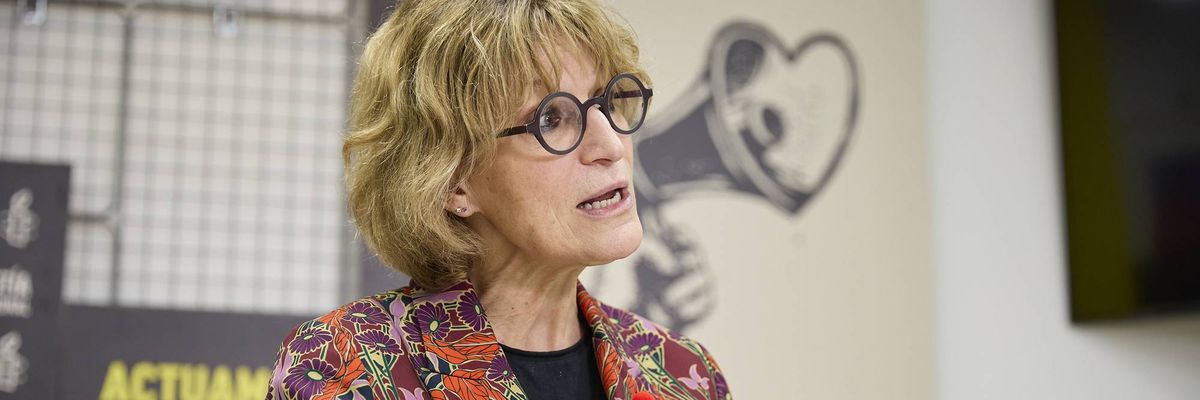
Agnès Callamard, Amnesty’s secretary general, said in a statement that “Trump’s very act of making such apocalyptic threats, including his warning of ending ‘a whole civilization,’ reveals a staggering level of cruelty and disregard for human life. It becomes all the more terrifying when coupled with his explicit threats to directly attack civilian infrastructure by bringing about the ‘complete demolition’ of Iran’s power plants and bridges.”
As Iranians put their bodies at risk on Tuesday by gathering at energy facilities and bridges in hopes of preventing their destruction, the watchdog group Beyond Nuclear warned that Trump could create a “fatal nuclear disaster” by attacking Iran’s nuclear power plant in the port city of Bushehr.
Physicians for Social Responsibility, Physicians for Human Rights, and International Physicians for the Prevention of Nuclear War similarly stressed in a joint statement that “the bombings of nuclear power plants are illegal under international law and risk harmful radioactive contamination of the environment, posing long-term danger to the health of surrounding communities and ecosystems.”
More broadly, Callamard noted that “international humanitarian law strictly prohibits direct attacks on civilians and civilian objects. The US president’s threat of extermination and irreparable destruction brazenly shreds core rules of international humanitarian law, with potentially catastrophic consequences for over 90 million people. It may constitute a threat to commit genocide, a crime defined by the Genocide Convention and by the Rome Statute of the International Criminal Court as committing one or more defined acts ‘with intent to destroy, in whole or in part, a national, ethnical, racial or religious group, as such.’”
Emphasizing that “the stakes could not be higher,” the former United Nations special rapporteur argued that “the international community, including the UN Security Council, regional bodies, and all states must urgently intervene to avert an impending catastrophe and unequivocally affirm that inciting, ordering, or committing war crimes, crimes against humanity, and genocide entail individual criminal responsibility under international law.”
UN leaders, including Secretary-General António Guterres, High Commissioner for Human Rights Volker Türk, and special rapporteurs, have demanded an end to the regional war and a return to diplomatic talks. However, the United States has veto power at the Security Council. That has impeded the body’s ability to respond to the US-Israeli threats and attacks, which, as Callamard highlighted, are already destroying civilian infrastructure and “terrorizing millions of people in Iran and their distressed relatives abroad as tens of millions of lives hang in the balance.”
As Callamard detailed:
In recent days, US and Israeli forces have attacked civilian infrastructure, including power plants, bridges, universities, steel factories, and petrochemical facilities, killing and injuring civilians, condemning the population to years, if not decades, of deepened economic hardship, inflicting serious harm on civilian health and the environment, and leaving long‑lasting damage to civilians’ lives and livelihoods…
Power plants, water systems, and energy infrastructure are indispensable to civilian life, underpinning access to clean water, medical care, hospital electricity, food supply chains, and basic livelihoods. Attacking them would be disproportionate and thus unlawful under international humanitarian law and could amount to a war crime.
“We call for immediate action to stop unlawful attacks that would plunge an entire country into darkness and deprive millions of their fundamental human rights to life, water, food, healthcare, and an adequate standard of living,” Amnesty’s leader said.
Other advocacy groups issued similar calls. US military veterans at the Council on American-Islamic Relations—CAIR-Michigan director Dawud Walid and CAIR-Florida communications director Wilfredo Ruiz—said that “declaring the Iranian people ‘animals’ and threatening to destroy their whole civilization is the sort of unhinged rhetoric we would expect from a racist, genocidal tyrant, not the president of the United States.”
“Nothing in US law, military law, or international law would authorize the president to attempt to destroy another civilization by rendering their nation uninhabitable through indiscriminate attacks on civilian infrastructure,” they continued. “President Trump must be prevented from committing a genocidal crime that would live in infamy, whether by Congress reconvening and voting to stop the war, the Cabinet invoking the 25th Amendment, or military leaders refusing unlawful orders to exterminate civilians. Refusing to take any action in the face of this open threat to commit genocide is complicity.”
DAWN’s advocacy director, Raed Jarrar, agreed that “every service member ordered to act on Trump’s unlawful dictates should refuse those illegal orders,” and warned that anyone “who carries out illegal strikes could face personal criminal liability for them.”
The group’s senior Iran analyst, Omid Memarian, added that “concerned US and international actors shouldn’t fall for the Trump trap and let the focus on an arbitrary deadline or threat of cataclysmic action distract them when there is already systematic unlawful death and destruction taking place.”
According to Memarian, “They should demand an immediate, unconditional, and permanent end to this unlawful war.”
From Common Dreams via This RSS Feed.
Just because we have a ceasefire does not mean that we stop calling for Trump to be removed.
