

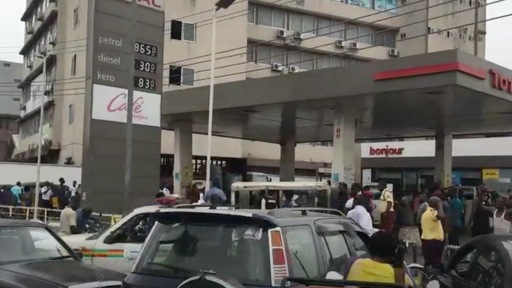
Amid the worsening cost-of-living crisis, Nigeria was hit with a 65% spike in fuel prices at pumps in March – the highest reported in Africa, despite being the continent’s largest oil producer.
“The recent rise in fuel prices in Nigeria is not primarily because” of the global oil supply disruptions caused by the US-Israeli war on Iran, President Bola Tinubu’s aide said earlier last month.
According to the aide, the more immediate factor is the removal of fuel subsidies and deregulation pursued as a part of the IMF-prescribed neoliberal restructuring by the Tinubu government.
Consequences of lifting fuel subsidies and controls over foreign exchange
Promising to slash fuel prices if elected during his campaign, Tinubu declared in his presidential inaugural speech on May 29, 2023: “The fuel subsidy is gone.” By November 2024, he had already presided over a nearly 500% rise in petrol price, and a diesel price hike of more than 70%, from just over 844 Naira per liter when Tinubu took power to over 1,446.83 Naira.
This spelled a multifold increase in electricity costs for over 40% of the population that is not connected to the national grid and relies on petrol and diesel generators.
The soaring energy costs drove up prices, including those of food, with the price of sorghum tripling and other staples like maize and beans quadrupling within a year of Tinubu’s presidency. The main reason for this food inflation was the removal of fuel subsidies, according to a study by economist Eric Otoakhia, published in the Central Bank of Nigeria’s quarterly publication.
Further exacerbating this crisis was the depreciation in the value of Nigeria’s currency after Tinubu deregulated the foreign exchange market and floated its currency in mid-June 2023, satisfying another longstanding IMF demand, within days of taking power.
About 465 Nairas equaled one USD at the time. Down to nearly 1,670 per dollar, Naira had almost 70% of its value vis-a-vis the USD by November 2024, when the UN World Food Program (WFP) warned, “Never before have there been so many people in Nigeria without food.”
Earlier that April, military police were deployed to disperse desperate residents looting food trucks and warehouses. Later that August, Tinubu’s government suppressed the ten-day-long protests against increasing hunger with mass arrests, extrajudicial executions, custodial torture, and charges of treason.
Read more: Nigerian president Bola Tinubu enforced violent crackdown on hunger protests to satisfy IMF demands
As desperate crowds scrambled to get their hands on a bag or two of groceries being distributed at Christmas charity events that December, 67 people, including 35 children and 22 women, were trampled to death in three separate stampedes.
Read more: 67 killed in stampedes at Christmas food drives in Nigeria as IMF-induced hunger engulfed millions more in 2024
The West African country recorded the world’s largest increase in acute food security that year. Praising the “progress on macroeconomic stabilization” due to the “important reforms since mid-2023”, the World Bank had nevertheless projected in a report last October that 139 million Nigerians will be in poverty by the end of 2025 – a nearly 60% increase under Tinubu’s presidency.
Read more: World Bank acknowledges poverty increase in Nigeria, but doubles down on the reforms causing it
Amid this dire situation faced by Nigerians, the US and Israel launched an unprovoked war on Iran on February 28, 2026. Iran, in turn, has imposed a cost on the US-allies hosting its military bases in the Gulf by restricting the flow of their oil on tankers through the Strait of Hormuz. This has caused a global reduction in the flow of oil.
Africa’s largest oil producer suffers its highest price rise
Nigeria, which is Africa’s largest oil producer and among the largest globally, has enough oil reserves to cater for 208 years of domestic consumption at the 2024 levels, according to the Worldometer.
However, most of the crude it produces is extracted and exported, while the refined fuel consumed at its pumps has been largely imported due to the historic underdevelopment of its refining capacity.
The operationalization of Africa’s largest refinery in Nigeria in early 2024, owned by the continent’s wealthiest man against whose monopolization the trade unions have been warning, did not help shield the country from the global oil shock.
Read more: Nigeria’s oil workers resist monopolization by Africa’s richest man
This is mainly because Nigeria’s crude oil production “is tied to oil-backed loans and pre‑export deals,” Reuters reported. As a result, the Dangote refinery has only been able to domestically source five of the 13-15 crude cargoes needed to run its refinery at full capacity, requiring it to import the rest.
While this has more than doubled Nigeria’s export of clean petroleum products from February to March, expanding Dangote’s market, it has not protected Nigerians from the oil shock.
“The reason for this is straightforward: most countries, whether they are oil-producing or non-oil-producing, maintain strategic petroleum reserves to cushion against supply or price shocks,” said Peter Obi, who contested for the opposition Labor Party against Tinubu in 2023.
“This means that when there is a disruption in the global oil market, they can release part of these reserves to stabilize supply. However, Nigeria lacks such a buffer, so the impact is felt almost immediately,” he added in his social media post earlier in March.
“The underlying issue is a lack of planning. Countries that engage in planning create buffers against shocks, while those that do not remain vulnerable to them. The old maxim remains true: when a country fails to plan, it has already planned to fail.”
Retorting against this assessment of Obi, “Sometimes the wiser thing to do is simply sit a conversation out when one does not fully understand how the system works,” remarked Dada Olusegun, special assistant to President Tinubu.
“It is also not accurate to suggest that strategic petroleum reserves are tools used to control everyday pump prices … Even countries with very large reserves, such as the United States and China, maintain them primarily for serious supply emergencies, wars, embargoes, or major disruptions to global supply chains.”
He went on to explain that the “recent rise in fuel prices in Nigeria is not primarily because the country lacks a strategic petroleum reserve. The more immediate factor is that the fuel market is now largely deregulated following the subsidy removal by the administration of Bola Ahmed Tinubu.”
The post Why is Nigeria, Africa’s largest oil producer, facing the continent’s highest reported rise in fuel prices? appeared first on Peoples Dispatch.
From Peoples Dispatch via This RSS Feed.
Price gouging?