

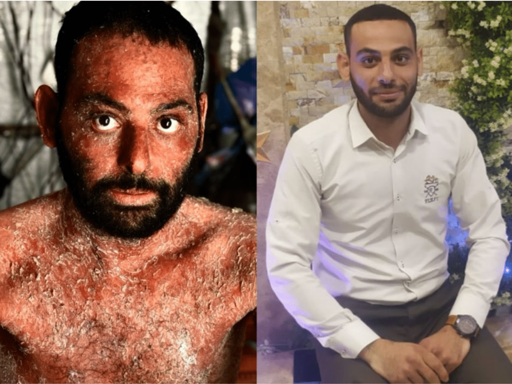

Although he held medical reports, Ministry of Health documentation and even World Health Organization (WHO) approval for evacuation from Gaza, Ibrahim Abu Aram’s requests to leave the Strip for specialised treatment were never granted, despite many months of pleading from his family.
While the Israeli occupation prevented him from leaving Gaza, his health rapidly deteriorated over the past few months and his condition became critical. He sadly died when his life support machine was switched off.
Abu Aram was a husband and father, and a forcibly displaced Palestinian living in the Gaza Strip. He suffered for years from a rare and life-threatening autoimmune disease called Pemphigus vulgaris, a skin disorder which causes painful blistering and severe physical deterioration.
In Gaza, Abu Aram’s story is not unique. Thousands of patients have been unable to receive life-saving treatment abroad because the Israeli occupation has prevented them from leaving the enclave.
Medical evacuations from Gaza take place through the Rafah crossing into Egypt, but in May 2024, the Israeli occupation seized the crossing and closed it. Medical evacuations during this time were banned.
The border crossing was partially reopened on 2 February but between 28 February and19 March, it was closed again because of the Iran war, the occupation claimed.
Gaza citizens denied access to medical treatment
While many people have medical conditions that are manageable with the correct treatment, many factors have meant that even treatable conditions have become deadly, such as the shortage of medical supplies and equipment, the manufactured state of malnutrition in the Strip and limited access to clean facilities.
Since the beginning of the genocide in Gaza, the Zionist regime has systematically and intentionally targeted and destroyed Gaza’s healthcare system. The Palestinian Ministry of Health reported that more than 1,800 healthcare facilities have been partially or totally destroyed since 7 October 2023. For this reason, it was impossible for Abu Aram to receive treatment inside the Strip.
Since the same date, 72,292 Palestinians in Gaza have been killed, with 716 of those people having lost their life since the start of the so-called ‘ceasefire’ on 11 October last year.
Israeli occupation continues to break ‘ceasefire’ agreement
The continued restrictions on the entry of medical supplies into the Strip has also had severe impacts on patients. Médecins Sans Frontières shared that almost 50% of its essential medications for chronic diseases are in “critically low stock”, and says this shortage will “inevitably lead to preventable deaths”.
There is also a shortage of essential medications, such as antibiotics and anaesthetics, and wound dressings, which are essential to prevent the spread of infection. New medical equipment or spare parts have also been banned from entry by the occupation, so any malfunctioning equipment can have severe consequences for a patient’s recovery.
According to the Gaza ceasefire agreement, 150 patients should be allowed to travel out of the Strip each day for medical treatment, but yet again, the Israeli occupation has not kept its word. Instead, less than 25 patients have crossed the border each day.
Between six and 10 Palestinians like Abu Aram lose their lives each day as a direct result of severe restrictions on medical travel and the continued near-total closure of the Rafah Crossing. A total of 1,400 patients have died since 7 May 2024, when the Rafah border crossing was seized by the Israeli army.
The situation is dire. There are thousands of patients, including those with cancer and children, who if they aren’t evacuated within weeks and their condition worsens, they could become “extremely critical”.
Medical evacuations suspended again after WHO worker, 54, shot in ‘security incident’
On 6 April, the crossing was re-closed after Israeli occupation forces opened fire on a UN vehicle traveling in Gaza.
Gaza’s Ministry of Health said the occupation targeted:
a vehicle rented for the World Health Organization (WHO) which was carrying several of its staff while they were carrying out a routine mission in areas classified as “green” in Khan Younis Governorate. This attack resulted in the killing of the vehicle’s driver.
Majdi Aslan, 54, the vehicle’s driver, was reportedly shot in the head. Following Aslan’s killing, the WHO has suspended medical evacuations of patients from Gaza until further notice. “Israel” then closed the crossing, yet again.

Speaking on the direct and deliberate targeting of health and humanitarian personnel without any justification, Gaza’s health ministry has said it:
reflects the continued policies of the occupation aimed at undermining the work of humanitarian institutions and imposing further restrictions on their operations.
Hamas has called on the international community and the UN to take urgent action. In a statement, it said “flimsy pretexts” were being used for the Rafah crossings closure that is preventing sick and wounded individuals from traveling abroad to receive vital medical treatment.
This action, Hamas claims, “constitutes a new crime against humanity”.
It reflects a fascist approach targeting our people as part of a systematic policy that violates all international humanitarian laws and conventions, in full view of the world.
Featured image via Ibrahim Mohareb
By Charlie Jaay
From Canary via This RSS Feed.
That’s the whole point of the blockade?
