

“A whole civilization will die tonight, never to be brought back again,” said US President Donald Trump, in a post on Truth Social on April 7.
The statement followed remarks a day earlier in which the president said “the entire country can be taken out in one night”, if Iran failed to make a deal by Trump’s deadline of 8pm EST on April 7.
“After that, they’re going to have no bridges, they’re going to have no power plants,” Trump said in a chaotic White House address on April 6 . “Every bridge in Iran will be decimated by 12:00 … complete demolition.”
Taken together, the comments represent a sharp escalation in rhetoric, with critics warning that large-scale attacks on civilian infrastructure and threats to wipe out a civilization amount to genocide.
Threats of total destruction raise alarm
The scale and language of Trump’s threats have gone far beyond typical US rhetoric toward Iran. Analysts and legal experts say the remarks suggest the possibility of widespread civilian harm and the deliberate targeting of infrastructure essential to daily life.
Critics have warned that such actions could violate the Geneva Conventions, which prohibit collective punishment and attacks on civilian populations.
The escalation comes as the war that the US and Israel launched on February 28 has proven more protracted, complicated, and costly than initially anticipated. With issues that did not exist before the war was launched, like the reopening of the Strait of Hormuz, now becoming key objectives for the US.
Despite earlier promises that the Trump administration was seeking to wind down the conflict, recent developments point in the opposite direction, with intensified strikes and increasingly aggressive rhetoric from the White House.
US-Israeli assault expands across Iran
Military operations have continued to escalate alongside the rhetoric.
On April 7, the US bombed over 50 targets on Kharg Island, Iran’s main oil export hub that sits off its southern coast. A day earlier, the US and Israel launched airstrikes on Sharif University of Technology in Tehran. Part of a broader pattern of attacks that Iranian officials say has included over 30 Iranian universities and educational institutions.
US forces have also surged in the region. There are now 50,000 troops stationed in West Asia. Thousands of paratroopers were deployed by the 82nd Airborne Division, alongside the amphibious assault ship, USS Tripoli, carrying around 2,5000 Marines, sent to nearby waters. Although, according to the Islamic Revolutionary Guard Corps (IRGC), it forced the ship to withdraw after missile strikes hit the ship.
In just the first month of the assault, the US-Israeli bombing of Iran has hit over 13,000 targets, killing at least several thousand civilians.
Opposition surges in the US
Trump’s remarks triggered immediate condemnation from lawmakers across the country.
House Democratic leaders, including Hakeem Jeffries and Katherine Clark, called for an urgent congressional session, describing the president’s statements as “unhinged”.
“His statement threatening to eradicate an entire civilization shocks the conscience and requires a decisive congressional response,” they said in a joint statement.
Senate minority leader Chuck Schumer described Trump as “an extremely sick person”, while Senator Chris Coons warned that the remarks amounted to “a threat to commit a war crime”.
Others echoed similar concerns. Senator Patty Murray called the comments “the rantings of a bloodthirsty lunatic”, and Representative Bonnie Watson Coleman invoked the 25th Amendment, suggesting the president should be removed from office for “threatening genocide”.
“He is clearly unstable and must be set aside.”
Anti-war movement mobilizes
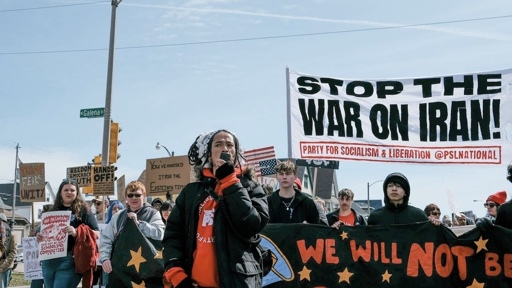
Beyond Congress, anti-war organizations and grassroots movements have begun to mobilize in response.
The ANSWER coalition has called an emergency national day of action on Wednesday, April 8, urging demonstrations to be held to “stop Trump’s war on Iran”. Activists and organizations in various cities have already picked up the call, planning protests in response to the escalating threats.
“Trump has given a deadline for genocide – either Iran surrenders by 8pm ET, or the country’s ‘whole civilization will die tonight’,” the group said in a statement. “The people of the United States need to take a stand and say – not in our name!”
Other organizations, including the Palestinian Youth Movement also condemned the threats: “It is incumbent upon the US Congress to act, and for international powers to act, to stop horrors that may be only hours away from being realized … The war on Iran and our region must end.”
Iran rejects ultimatum
Iranian officials have condemned Trump’s remarks and reiterated they will not accept US demands under threats of force. The West Asian nation has consistently called for a definitive end to the war and guarantees that such attacks will not be repeated. Tehran’s representative at the UN, Amir-Saeid Iravani said that Trump’s threats “constitute incitement to war crimes and potentially genocide.”
“Iran will not stand idle in the face of such egregious war crimes. It will exercise, without hesitation, its inherent right of self-defense and will take immediate and proportionate reciprocal measures,” he said.
Meanwhile, reports indicate that the Iranian people have begun flocking to bridges and power plants, forming “human chains” around their vital infrastructure in defiance of Trump’s genocidal threats.
Further escalation on the horizon?
As Trump’s “deadline” approaches in mere hours, the situation remains highly volatile.
While Trump has recently suggested that negotiations could still alter the course of events tonight, he warned that failure to reach an agreement would result in the follow through of his threats.
“If we get to that point,” Trump said, “there is going to be an attack like they have not seen.”
The post Trump’s threats to “end” Iran in one night spark backlash across the US appeared first on Peoples Dispatch.
From Peoples Dispatch via This RSS Feed.