

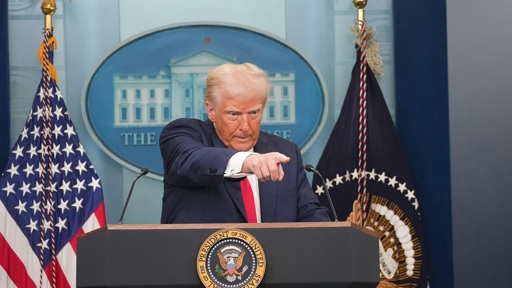
In these critical hours — as Donald Trump’s ultimatum to Iran expires — the world is witnessing a dangerous choreography of threats, reprisals, and gestures that oscillate between last-ditch diplomacy and the abyss. The scene is one of extreme drama: human chains encircling critical infrastructure in Iran, cross-attacks involving Tehran, Israel, and Saudi Arabia, and a global economy beginning to feel the tremors of every explosion in the Gulf.
Yet, behind the sound and fury lies a strategic constant that history never fails to confirm: the futility of aerial bombardment as a tool for forcing political decisions. The threat to destroy Iran’s electrical infrastructure overnight is not a sign of strength, but rather of Trump’s strategic impotence. It embodies the old illusion that mass punishment inflicted upon a society can break its will. It has never worked — not in the 20th century, not in recent wars, and it is highly unlikely to work now.
Striking power plants, bridges, or industrial complexes does not hasten an adversary’s surrender; rather, it solidifies their resistance. Populations under attack rarely rebel against their governments; instead, they hunker down, coalesce, and — above all — radicalize their perception of the external enemy. In this sense, every bomb that falls runs the risk of strengthening precisely what it aims to weaken.
The recent exchange illustrates this clearly. The attack on the South Pars complex was followed by an Iranian reprisal against the Saudi industrial heartland in Jubail — a key node in the global energy system. This is not merely a military escalation; it is a spiral that is already beginning to ripple through prices, supply chains, and global economic stability. War — even before it expands — is already going global.
The paradox is evident. While Iran sends proposals (deemed insufficient by Trump) through intermediaries, the dominant response remains the threat of total devastation. Yet, the more maximalist the military objective becomes, the more unattainable the political objective proves to be. Actions targeting civilian infrastructure run the risk of reinforcing the regime’s narrative and enabling it to frame the conflict as one directed against the Iranian nation, rather than against its leadership.
At this juncture, the central question is not who can inflict the most damage in the coming hours, but rather, who can offer a credible way out? Without minimum guarantees — regarding security and a genuine cessation of hostilities — no ceasefire will amount to anything more than a pause preceding a major escalation. Furthermore, there are no indications that Tehran — which perceives itself to be in a position of strength despite severe economic damage — is prepared to capitulate: neither regarding its enriched material, nor its regional projection, nor its strategic control over the Strait of Hormuz.
We are, effectively, facing a critical moment. Should the ultimatum be carried out, the risk of a humanitarian catastrophe and an out-of-control regional escalation becomes immediate. It is more imperative than ever to mobilize a global movement — much like the one against the genocide in Gaza — directed against those primarily responsible for this descent into barbarism, both within Iran and globally: the United States and Israel.
This article was originally published in Spanish on April 7 in La Izquierda Diario.
The post Trump’s Ultimatum to Iran Could Backfire appeared first on Left Voice.
From Left Voice via This RSS Feed.