

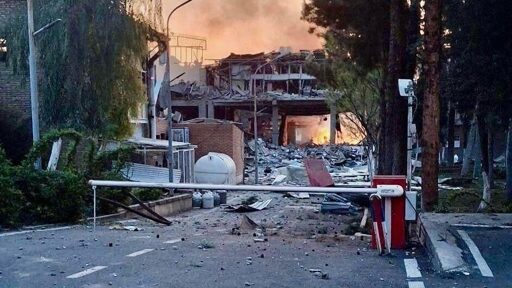
Just like in the past three years, the days leading up to World Health Day 2026 were marked by ferocious attacks on healthcare: in Sudan, Palestine, Lebanon, and Iran, to name a few. The World Health Organization (WHO) has confirmed that US and Israel have launched targeted strikes against Iran’s health infrastructure, which according to the Iranian government have destroyed hospitals, health centers, and pharmaceutical production capacities.
Between March 29 and 31, Israel and the United States attacked a psychiatric hospital – which will need months to fully resume operations – and a pharmaceutical facility producing treatments for cancer and multiple sclerosis in Iran. They also inflicted serious damage to the Pasteur Institute in Tehran, a public health institution that has played an important role in immunization drives and outbreak control across the region for more than 100 years. “This is not merely another war crime committed as part of an illegal war,” said Iranian Foreign Ministry spokesperson Esmail Baghaei, “it is a barbaric assault on basic human core values.”
The Pasteur Institute of Iran’s public health significance
Formed in the early 20th century, around the same time when Iran’s second public sector vaccine institute – the Razi Vaccine and Serum Research Institute – was founded, the Pasteur Institute of Iran supported the country “in moving from a vaccination-only program to vaccine production,” researchers Payam and Parisa Roshanfekr noted in 2022. The launch of the institute was at least in part inspired by the recognition of the importance of reducing dependence on medicine donations or imports from abroad.
From its formation, the institute’s knowledge and production contributed to several public health campaigns in the region, including the response to the 1960s cholera outbreak – when vaccination doses for Afghanistan, Pakistan, India, Iraq, Georgia, and Azerbaijan were supplied from Iran’s Pasteur Institute – and the smallpox eradication campaign in Pakistan and Syria in the 1970s. The institute also developed an application method for the rabies serum and vaccination that was adopted by the WHO, “which introduced Iran as one of the saviors of humanity,” Payam and Parisa Roshanfekr wrote.
“For more than 100 years, the Pasteur and Razi Institutes, as Iran’s two public sector vaccine institutes, have been producing the necessary vaccines to control the major contagious diseases threatening the country’s population, and have been successfully able to produce the necessary vaccines for Iran’s national immunization program,” they add.
During the COVID-19 pandemic, as Iran struggled to respond to the population’s health needs due to sanctions that obstructed essential imports, the Pasteur Institute collaborated with Cuba’s Finlay Vaccine Institute on the development and production of Soberana 02 vaccine. This act of medical and technological exchange led to the production of millions of vaccine doses – further strengthening Cuba’s health internationalism, but also emphasizing the importance of building sovereign health systems.
Read more: Cuba’s COVID-19 vaccines: A journey of collaboration and revolutionary solidarity
In this context, the Pasteur Institute was relevant as an element in the expansion and strengthening of health services in the country, including after the 1979 Revolution. Since then, Iranian health authorities made notable breakthroughs in advancing key indicators, including more than halving the neonatal mortality rate between 1980 and 2000. Maternal mortality was reduced tenfold between 1985 and 2023, when it stood at 16 per 100,000 live births – a better outcome than in the United States.
The improvement of such indicators was largely achieved by the implementation of a system based on Primary Health Care (PHC), prioritizing maternal and child health, as well as communicable disease control. Expanded in 1985, by 1989 Iran’s PHC network had close to 8,000 health houses delivering essential care in rural areas and 4,300 health centers.
In 2008, WHO’s Eastern Mediterranean Regional Office described Iran as “a pioneer in primary health care in the Region and the world.” The regional office emphasized that the country’s achievements relied, among other things, on the employment of tens of thousands of community health workers – men and women – in health houses, and the development of medical education programs rooted in the people’s real health needs.
The building of a PHC network was accompanied by nationalization of the pharmaceutical sector, dominated by foreign capital between the 1950s and 1979. Until the early 2000s, the health sector remained generally private-free, Payam and Parisa Roshanfekr note, and Iran’s pharmaceutical production was focused exclusively on generics until 2001. While the focus on state-run healthcare weakened in the past decades, with researchers noting the impact of sanctions and their economic pressures on this trend, Iran’s health achievements still figure prominently.
The “genocidal phase of global capital” confirmed
At the end of 2024, shortly after the destruction of Kamal Adwan Hospital in Gaza and the kidnapping of its director, Dr. Hussam Abu Safiya, by Israeli forces, British-Palestinian surgeon Ghassan Abu-Sittah warned that attacks on healthcare in Palestine marked a new phase of global capital – its “genocidal phase” – in which healthcare is a key point of attack. US-Israeli attacks on Iran’s health centers and public health institutes, as well as Israel’s persistent targeting of health personnel in Lebanon, prove Abu-Sittah’s point today.
“There is a great deal of self-servingly convenient labeling of such civilian (including but not restricted to public health) infrastructure as ‘dual-use’ or ‘used as shields’ across West Asia,” Dr. Satyajit Rath told People’s Health Dispatch. “The fact remains that the larger pattern of such attacks, as well as the public rhetoric associated with them, is consistent with an intentional focus on civilian infrastructure, especially public services, so as to cause long-lasting damage to both states and communities that are the targets of these so-called ‘wars’.”
People’s Health Dispatch is a fortnightly bulletin published by the People’s Health Movement and Peoples Dispatch*. For more articles and subscription to People’s Health Dispatch, click* here.
The post US-Israeli attacks on Iran’s health infrastructure threaten decades of public health advancements appeared first on Peoples Dispatch.
From Peoples Dispatch via This RSS Feed.