

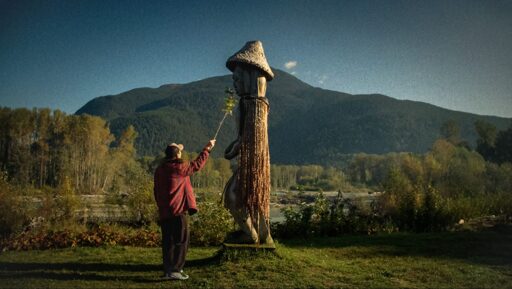

In a scene from the documentary Ceremony, Qwaxw Siwallace brushes a carved figure honouring sputc (ooligan), a vital fish for Nuxalk Nation, which he helped install in the Bella Coola River valley, part of the community’s ceremonies to restore the fishery vital to his culture. Image courtesy of Smayaykila Films
Qwaxw Siwallace remembers a time in his Youth when sputc (ooligan), and the nutritious grease Nuxalk harvested from the fish species, were plentiful.
“It was just a part of everyday life,” he told IndigiNews, “when it was in abundance.”
His favourite food was smoked ooligan, also known as eulachon.
But their grease was also added to most other foods. He loved it so much as a young child that his father had to start giving him his own bowl of ooligan grease.
“Otherwise I would just keep eating,” the co-founder of Nuxalk Radio said with a laugh.
“It was just something that was just part of everything in such abundance. You never imagined it would disappear.”
But for 28 years, his community in Bella Coola have been unable to harvest sputc from their river.
Qwaxw is one of many voices featured in a new documentary, Ceremony, a 12-year project from Nuxalk director and producer Slts’lani (Banchi Hanuse), which premiered at the South by Southwest (SXSW) film festival in “Austin, Texas” last month.
The 83-minute film centres on the sputc run in Bella Coola, a small coastal Nuxalk community with less than 1,000 residents.
The small fish, which when matured are around 15 to 20 cm long, have for countless generations been central to Nuxalk community members’ lives.
But the last time the community was able to harvest sputc was 1998. Since then, catching and processing sputc — including extracting the grease — have dwindled with the fish.
‘Asking something deeper’
Ceremony is scheduled to screen on April 30 and May 1 at the Hot Docs Festival in Tkarón:to (Toronto), its “Canadian” premiere.
The project began as a request from Nuxalk community leadership, but took Slts’lani over a decade to finish due to the important story and her search for the best way to tell it.
“There were periods when it consumed me completely, even entering my dreams,” she told IndigiNews.
“The harder I tried to force it, the more I realized the film was asking something deeper of me spiritually and personally.”
So she took many paths to figure out how to proceed — she camped alone on the land, she prayed, she meditated, and she asked “everyone and their dog” to pray for her “to understand what was being asked.”
“Slowly,” she remembered, “I came to understand that finishing the film required me to become ready for it.”
What emerged on screen was something she discovered was far “more layered” than she’d ever envisioned or planned.
She showcased the revitalization of ceremonies and traditions to help the sputc run, set amidst scenes of the lush landscape around the Bella Coola River and valley encompassing the Nuxalk community.
The scenes are accompanied by a score that includes music performed by the beloved local group Nunusyamlh.

Nuxalk filmmaker Slts’lani (Banchi Hanuse), whose new documentary Ceremony will premiere in ‘Toronto, Canada’ on April 30. Photo by Evangeline Hanuse, courtesy of Smayaykila Films
Slts’lani’s vision was to transport viewers into Nuxalkulmc (Nuxalk Territory) and into the world of Nuxalkmc (Nuxalk people) — “to be able to feel the moss on the ground and the milky green river in front of you,” she explained.
“The goal was to have the film to feel vibrant and alive, which is why even the images have movement and texture to them.”
She gathered archival footage to showcase Nuxalk history, including the colonization of their land — historic images Slts’lani noted took many years to sift through and organize for telling the film’s backstory.
“Overall, the process was like a spiral,” she said.
“I kept returning to material over the years, and in the end what resonated most strongly rose to the surface in the film.”
With multiple storylines which all branch off the story of the sputc, Ceremony expands to encompass the stories of a growing community.
Scenes of scientific research, learning about ancestors, and discussing colonization all merge to highlight the importance of culture and the impacts the loss of sputc has had on the community, and all beings that depend on the fish.

Ooligan, also known as eulachon, are a small fish species known in the Nuxalk language as sputc. Photo courtesy of the Washington Department of Fish and Wildlife
‘Story that needs to be told’
At the film’s premiere, the documentary’s subjects attended along with members of the film crew.
Among the interviewees to see the screening were Qwaxw and Q’umulha Rhonda Schooner, a Nuxalk hereditary chief.
In the film, Q’umulha shares her family’s extensive history and connection to ooligan, the cultural and nutritional importance of its grease, and how harvesting and processing sputc was a time of bonding between relatives.
When Slts’lani invited her to be in the film, she recalled feeling unsure about what her role in the documentary would be — until she eventually saw the film come together.
“It wasn’t until I saw the whole film in the village,” Q’umulha said, “I was like, ‘Oh that’s how she was putting it together — I get it.’”
Seeing its premiere “was really wonderful,” she added.
“I had a really good cry … I told my mom, ‘That’s our story — she really got it right. That’s the story that needs to be told.’”
Slts’lani noted the film’s participants were mostly people she grew up with in her community, who understand the importance of the ooligan and how its story needed to be told.
“There is a shared understanding of how important this story is,” she said, “so it was about telling this story together.”
But she also knew it would be essential to be thoughtful and sensitive in making a documentary about the stories and issues facing her community.
“Working with a story that contains generations of trauma is deeply emotional for community members,” she said, “and required care in how it was told.”
READ MORE: New album, recorded entirely in Nuxalk, showcases language’s fluid, living spirit
The film also highlights Qwaxw’s efforts to share community information over the radio waves through Nuxalk Radio, as well as his heavy involvement in community ceremonies, and his deep knowledge about sputc.
In fact, Qwaxw was on the team that helped finally bring back the sputc ceremony to his community, and he selected a place to erect an ooligan totem pole.
“My family’s grease camp is right where the ceremony happens every year,” he said. “So I’ve been involved in the ceremony year after year.”
As he sees it, Slts’lani captured him in his natural element.
“Just by doing what I do and being myself, she captured just me being me,” he said.
Qwaxw remembers co-founding the radio station to bring back oral storytelling, and he sees the station as especially important now the community is working to bring back the ooligan, including promoting upcoming ceremonies.
“It all ties into that history of speaking and being able to listen and learn through our ears,” he said.
In the documentary, Qwaxw’s radio announcements are woven throughout, including in transitions between scenes as community members tune in to his broadcasts in their homes and trucks.
Seeing so many viewers at the film’s premiere get to glimpse his community’s surroundings, Qwaxw said, was “incredible, amazing, uplifting, emotional.”
“Everybody is there to learn more,” he recalled, “and to pay their respects and to share their thoughts and feelings.”
Audiences were impressed by the experience, too — as the film went on to win the viewer-voted Audience Award for Documentary Spotlight at the South By Southwest Film and TV Festival.

Q’umulha Rhonda Schooner, a Nuxalk hereditary chief, is featured in the documentary Ceremony. Photo courtesy of Smayaykila Films
‘We never got tired of it’
Ooligan, and the community activities associated with the fish, were a constant presence throughout Q’umulha’s childhood, even after her family moved away from the community.
“During that time, it was always wonderful when family would bring ooligans to us,” she said.
At the time, the return of the fish every year signaled a successful journey through the winter. Getting to eat ooligan, along with its healthy grease, was for her a joyous experience.
“It was like we went through winter, and then you’d be nourishing your body,” she said.
“We never got tired of it. I remember my mom waking up and we’d have ooligans for breakfast, and then we’d have ooligans for lunch, and then we’d be smoking them.”
And as soon as the cured ooligan emerged from the smokehouse, she said, “we’d be so happy to have them and eat them.
“It was such a good time. It was so much happiness.”
The joy and family connection continues through the production of ooligan grease — a process Q’umulha describes in the documentary, as she picks red clover near her family’s grease camp along the Bella Coola River.
She reminisces on the memories of her grandmother and other family members making the grease and enjoying it together.
“That was our natural medicine, our food,” she says in the film, adding how she misses that laughter and close relationships that thrived during the time of the ooligan.
Qwaxw shared similar stories on ooligan’s role in his life back when the fish were thriving. That changed as their populations went into rapid decline.
“With the loss of it, it was a huge loss in so many different ways,” he said.
That loss wasn’t simply about the high-quality nutrition ooligan grease, nor just the prized flavour it added to many foods.
It also impacted many of the community’s social interactions related to its harvest and preparation — “the community coming together every spring after winter,” he said, “to work together, to catch and smoke and prepare grease.
“It was just a whole festivity around it, and everyone was smiling and sharing stories and laughing. And that just doesn’t happen now.”

An animated scene from the documentary Ceremony. Image courtesy Smayaykila Films
Ceremony for the ooligan revival
Throughout the documentary, Nuxalkmc can be seen taking part in their annual Sputc Ceremony, with community members drumming, singing, and some donning traditional regalia.
A constant presence in those scenes are Youth. From young children to teenagers, future generations are involved in the events.
In one scene when visiting the river edge for the Sputc Ceremony, children of all ages can be seen in line with the crowd, some wearing their button blankets and cedar hats.
The film also uses animation to explore the history of the ceremony — and the community’s longstanding commitment to honouring the fish’s journey.
“The animation is a way to move into ancestral time,” Slts’lani explained, “when humans, animals and supernatural beings were in closer communication and movement between worlds was possible.
“It showed Nuxalk worldview in a way that live action alone could not.”
As the community restored its traditional ceremonies, it commissioned a sputc totem pole to look over the river.
But in what Qwaxw described as a “mishap,” the figure was carved without a cedar hat or regalia.
The community rolled with the error — creating a new tradition of adorning the carved figure with new regalia and hat every year around their annual Sputc Ceremony. It’s one more way they keep the community involved.
“Everyone looks forward to it, and it’s a whole-valley event — it’s not just Nuxalk,” Qwaxw explained.
“The whole valley comes together for this Sputc Ceremony, all the schools come to it.”
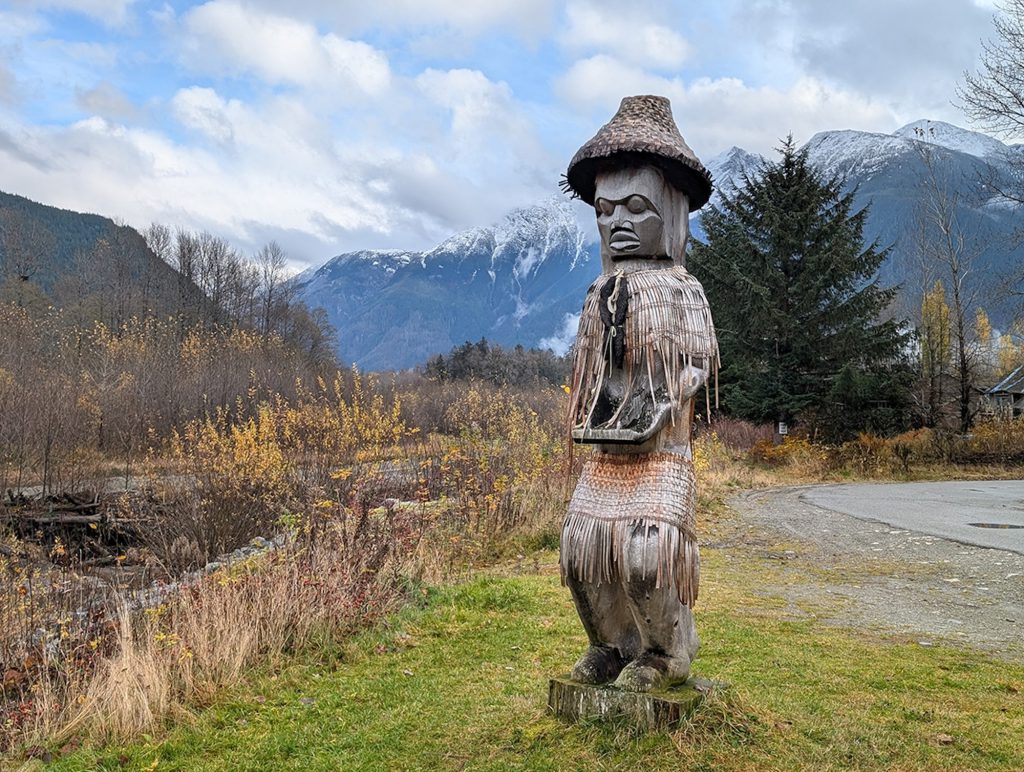
A sputc (ooligan) pole carved by Wiiaqa7ay (Lyle Mack) stands at the shore of the Bella Coola River in Q’umk’uts, waiting to be re-dressed in new cedar bark regalia to welcome the return of the fish run in March 2025. Photo by Cody Rocko courtesy of Museum of Anthropology
‘Ceremony is an integral part of stewardship’
This Sputc Ceremony is pivotal for the documentary, showing Nuxalk cultural revival, and the willingness of the community to continue to grow and build its relationship with all living things.
“Ceremony is an integral part of stewardship,” Slts’lani said.
“When that relationship is not upheld, things fall out of balance … Ceremony is part of maintaining relationship with the land, waters and to the beings who give their lives so we can live.”
With the renewed possibility of a healthy annual run of ooligan returning to the Bella Coola River, Q’umulha has faith that new leaders who will step in to teach the traditions to the younger generations, who have lived without the fish in their lives.
Qwaxw said that, even though it’s been 28 years since the last successful ooligan run, that’s only a small sliver of time compared to how long the Nuxalk knowledge has been passed down from generation to generation.
“It’s so important that this knowledge continues as it’s been passed on for thousands upon thousands upon thousands of years,” he said.
“It’ll be a little bit of a re-learning in a way, even though we know the steps and the procedures … I never had to lead the process, so that’ll be a different role for me.”

READ MORE: With the foresight of their ancestors, ‘Nuxalk Strong’ highlights a cultural revival
Over the years, Qwaxw has continued to care for his family’s grease camp which lies near the sputc pole.
He cleans the area which housed his family’s cooking box, shed, fire pit and stink box — which is used to ferment the fish before using them for ooligan grease.
“All the remnants are still there,” he said.
“So it’s just important to show that it exists — to keep the memory alive so the young ones are able to see these things.”
He added that having the camp visible shows its presence still and lets the ooligan know that they are still ready for the fish’s arrival.
“And if the ooligans show up in enough numbers, I can activate the camp,” he said. “It’s ready.”
Ceremonies have helped bring back some of the community connections and joy he said was lost for years.

Nuxalk members take part in a ceremony for sputc (ooligan) in a scene from the documentary Ceremony by filmmaker Slts’lani (Banchi Hanuse). Photo courtesy of Smayaykila Films
The decimation of the ooligan since colonization
The film explores why the ooligans, once so vital to the community, disappeared under colonialism.
Slts’lani’s documentary highlights the effects still evident in the Nuxalk community today, but also how they are working to bring back their culture in many different ways.
Multiple people and stories in the film showcase various faces of colonization.
“Many of the effects of colonialism have been normalized,” she explained, from settlers’ introduction of smallpox, which decimated the community’s numbers, to being forced onto small reserve lands.
“So it can be hard to see them until you understand how life was before,” she said.
“Then you begin to see that we are confined to a tiny reserve within a vast territory while our lives are heavily controlled and regulated.”
She said that history forms such a big part of the film because “we cannot begin to move beyond it until we can truly see it.”
Another person shown in the film reclaiming Nuxalk practices on the land is Nuskmata Jacinda Mack.
Slts’lani filmed her building a house on the site of Nusq’lst village with her son Kmalsuuncw Orden Mack.

Nuxalk Nation member Nuskmata Jacinda Mack sings in a sputc ceremony in the film Ceremony. Photo courtesy of Smayaykila Films
The area is considered “Crown land,” and the documentary explores Nuxalkmc rights to their unceded territories.
Qwaxw described how they are “starting to reverse that trend,” with the Nuxalk language appearing on street names, stop signs, and thanks to the radio station — over the airwaves too.
“Our ceremonies are back, coming back to life,” he said proudly.
“The young ones are learning things that the elders recorded on reels decades ago, and it’s all re-emerging and then coming back to life.”
Q’umulha agreed, commenting that she can see the positive changes through moments of community joy and celebration.
For instance, she mentions pride in Bella Coola after the championship basketball win by the local Acwsalcta Thunder youth team recently.
“We’re starting to work in our community to build better relationships, better communications, and the healing is slowly coming,” she said.
“We are healing and we are growing.”
As Qwaxw sees it, everyone involved in revitalizing their culture and community is doing so for a vital reason.
“My belief is we’re all here either because we volunteered to be here,” he said, “or we were chosen to be here — as we have the skills necessary or the gifts necessary for what’s needed during these difficult times.”
Many in the Nuxalk community hold onto hope for many future successful ooligan runs to sustain the people again.
Qwaxw noted community members agree that day will come once there have been four successful ooligan runs that turn the river black.

READ MORE: Nuxalk girls’ basketball team wrapped in support after championship win
Persevering through difficult times
Q’umulha spoke about her father dying without him getting to taste his beloved ooligan one last time in this life. But as soon as the fish return, she plans to offer him some.
“When the time comes and we get an abundance — and we’re allowed to take some — I will cook some and burn some for him,” she vowed.
The diverse stories explored throughout Slts’lani’s film all convey a message of love, emphasized Qwaxw.
“Our Nuxalk have survived everything we’ve been through because the strength of our love and giving and caring nature,” he said.
“If we’re going to have a good path forward from here with respects to the ooligan and the valley coming together, that’s what we need to do, is to lead with love.”
For Slts’lani, there is still much work to do to bring back the ooligan.
“Without giving away the ending, I hope the film supports the ongoing work of Nuxalkmc and the Nuxalk Nation to keep rising, rebuilding, healing and returning to our lands and waters,” she said.
“I feel the film reflects the importance of learning to love ourselves and each other again.”
Qwaxw told IndigiNews he’s hopeful when he sees his community coming together to pray for a healthy ooligan return, and how people are are connecting with each other around the fish once again, decades after their disappearance.
“We’re on the right trajectory,” he said. “The path ahead is looking good.
“It’s just waiting to re-emerge when the time is right.”
The post Film uplifts ceremonies for the return of ooligan, a vital fish for Nuxalk Nation appeared first on Indiginews.
From Indiginews via This RSS Feed.