

Bullets:
The Trump Administration has canceled new offshore wind leases, and is refunding companies hundreds of millions of dollars to instead develop oil and gas fields.
China recently deployed the world’s largest offshore turbine, each of which powers over 44,000 households.
Chinese engineers are developing massive renewable projects, at scale, in extreme environments.
Meanwhile, the cost of electricity from renewables continues to fall sharply. In the case of offshore wind, the cost has fallen more than 60% in just ten years.
Inside China / Business is a reader-supported publication. To receive new posts and support my work, consider becoming a free or paid subscriber.
Report:
Good morning.
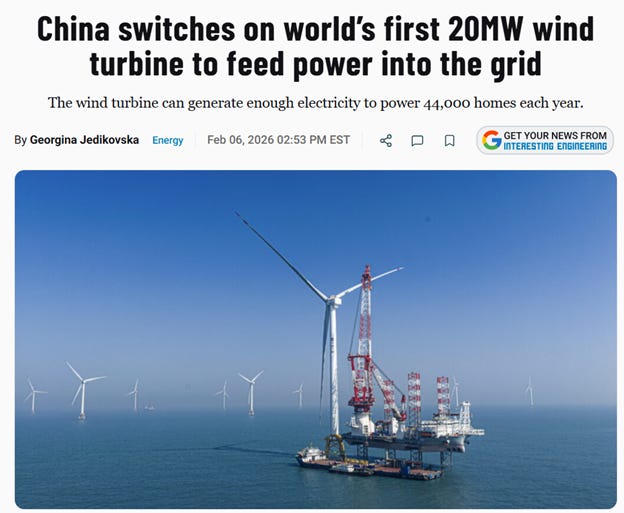
This is the world’s largest offshore wind turbine. It is off of Fujian province, in South China. It generates enough power for 44,000 households, or over a hundred thousand people. It displaces 22,000 tons of coal per year. This unit is part of a large farm 30 km offshore, where there are already a number of 16-megawatt turbines, and when those were installed, they were the world’s largest.
It’s a breakthrough in engineering, that this much output comes from a single turbine, instead of a group of them working together, and experts say that it will inform future wind farms. That’s also a region that sees frequent severe storms.
This was all hard to do, then, and we’re curious why the Chinese bothered at all. It required a ship to be specially designed and built, just to get the turbine into position. Having it out there means that China can leave 22,000 tons of coal in the ground they otherwise would have hauled to the surface and set on fire, but China has a lot of coal, and burns more of it than anyone. They could also, obviously, have just installed a bunch more of the smaller 16-megawatt units that they already have lots of experience with.
The point we’re trying to make here, is that the Chinese engineers went to a lot of trouble, in some of the most challenging and complex conditions in the world, and transformed this industry’s understanding of what is possible from now on. In contrast, consider the direction the United States is going.
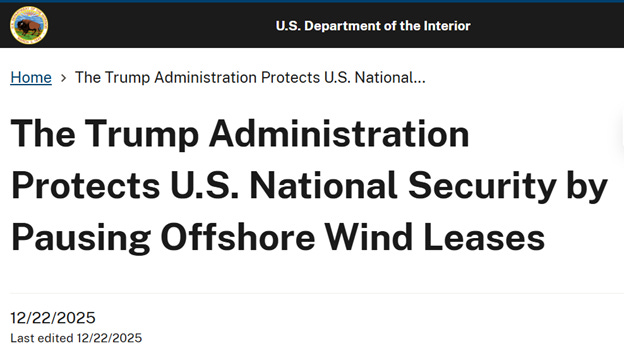
In December, the Interior Department announced an immediate pause on offshore wind projects under construction in the United States, due to national security risks identified by the Department of War. The government found that big turbine blades create radar interference, and obscure legitimate moving targets and generate false ones.
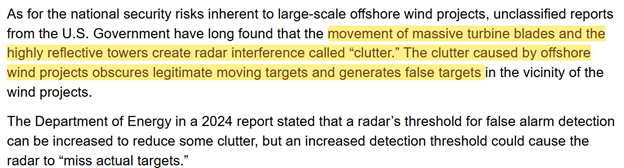
It’s not great to learn that our money-no-object Pentagon has radars that can’t tell the difference between a supersonic bomber flying toward Washington, or a windmill floating off of Long Island Sound. And it’s also not great that the White House has just told the rest of the world that our radars are that bad. This should be in a super-top-secret Pentagon report, instead of a press release from the White House.
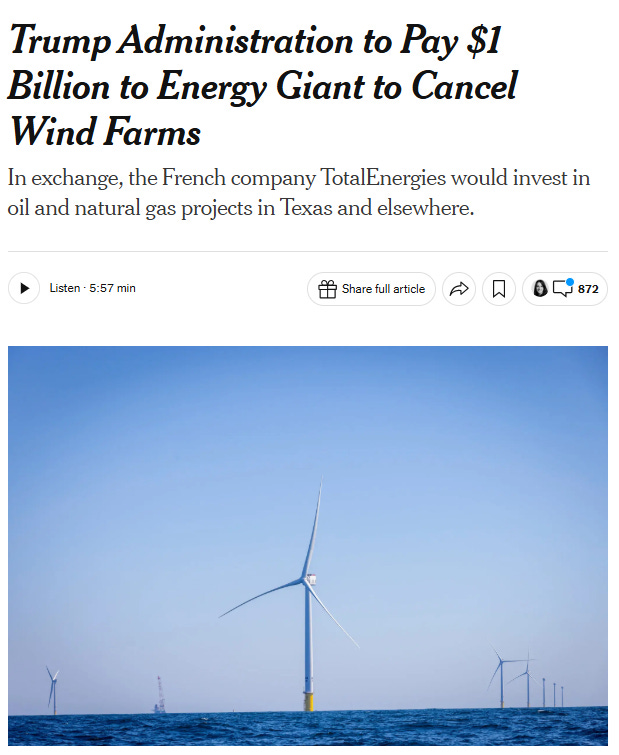
Anyway, the Trump Administration will pay a French company a billion dollars to agree not to build a wind farm off the East Coast. TotalEnergies paid $928 million on leases to develop wind power for New York and North Carolina. That project would have produced sufficient power for over one million homes and businesses in New York and New Jersey.
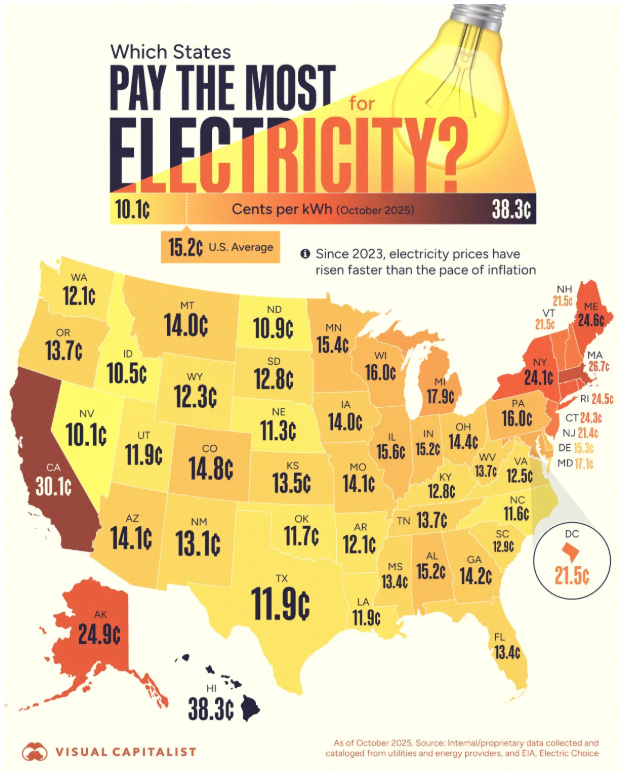
Those are in the top right of this map, and they have some of the highest electric bills in the country. A smaller project that was canceled would have powered 300,000 homes and businesses in North Carolina.
Instead, the company will get their money back, and use it to develop an LNG facility in Texas—which will produce gas for export–and produce more oil in the Gulf of Mexico. It will also develop gas-burning power plants for data centers. None of that investment, then, will do anything for electricity prices in New York or New Jersey.
That all is coming at a time when the cost of electricity generation for offshore wind is plunging. It costs less than 8 cents per kilowatt hour, which is 60% less expensive than a decade ago.
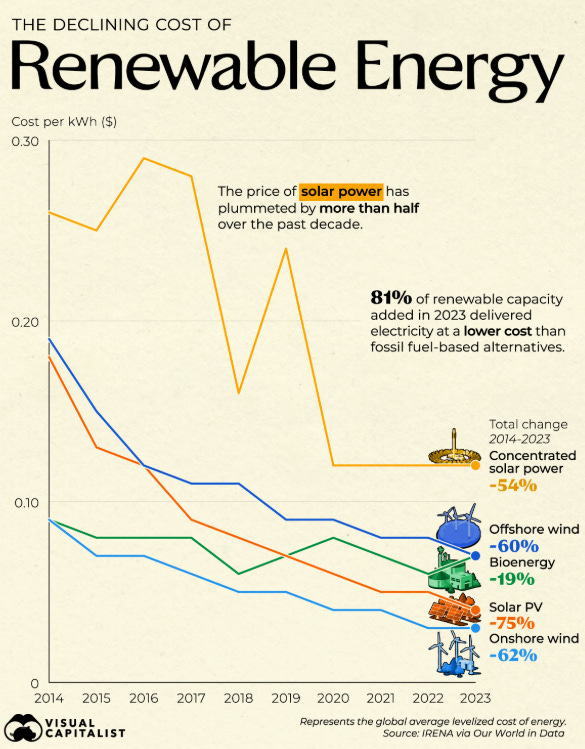
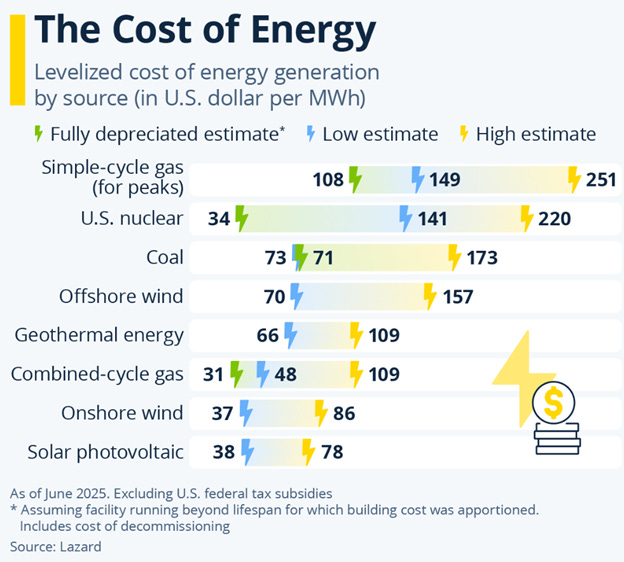
That is far less than most gas plants, nuclear, and even coal. The United States is shutting down industries, just as engineers are solving the cost problems, and learning how to deploy them, at scale. This is an entire industry, that the United States just paid a billion dollars to make go away.
There is no point for the United States to have a single university, offering engineering courses for offshore wind, because no new wind projects will happen there. They’ll be here. All the engineers, all the universities, all the cheap wind power, all the new science for the next century. All of that will be here, and none of it will be in the United States.
Be Good.
Resources and links:
Global Coal Production by Country
https://www.voronoiapp.com/energy/Global-Coal-Production-by-Country-5870
Mapped: The Average Cost of Electricity by U.S. State
https://www.visualcapitalist.com/mapped-the-average-cost-of-electricity-by-u-s-state/
Trump Administration to Pay $1 Billion to Energy Giant to Cancel Wind Farms
https://www.nytimes.com/2026/03/23/climate/offshore-wind-gas-trump-total.html
The Trump Administration Protects U.S. National Security by Pausing Offshore Wind Leases
https://www.doi.gov/pressreleases/trump-administration-protects-us-national-security-pausing-offshore-wind-leases
China switches on world’s first 20MW wind turbine to feed power into the grid
https://interestingengineering.com/energy/wind-turbine-powers-china-grid
Inside China / Business is a reader-supported publication. To receive new posts and support my work, consider becoming a free or paid subscriber.
From Inside China / Business via This RSS Feed.