


Miles Morrisseau
ICT
LONDON, Ontario, Canada — For more than 30 years, Anishinaabemowin speakers and advocates have gathered at an annual conference to share knowledge, stories and personal struggles to sustain the Anishinaabe language.
And each year, the Anishinaabemowin Language Conference has grown, attracting people from across Canada as well as south of the border from Ojibway-speaking territories such as Wisconsin, Minnesota, Michigan and more.
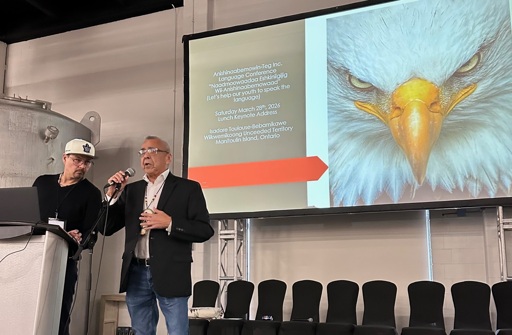
This year, hundreds of people looking for ways to support language preservation gathered March 26-28 in London, near Toronto, for the 32nd annual conference. The conference is coordinated by Anishinaabemowin-Teg Inc., a nonprofit group that started with a handful of volunteers dedicated to the language.

The 32nd annual Anishinaabemowin Language Conference was held March 26-28, 2026, in London, Ontario.
Credit: Miles Morrisseau/ICT
Isadore Toulouse, Wikwemikong Unceded Territory, is a founding member and was there at the beginning. He remembers when there was no money to support the work.
“This conference has been happening for the last 32 years in various capacities,” he recalled. “When we first started there was a group of us that started the language program and we traveled to different (communities) sharing the resources, sharing gas mileage, sharing our meals. We’d pack a lunch, and that was the beginning stages of the organization.”
The theme for this year’s conference was “Naadmowaadaa Eshkiniigjik Wii Anishinaabemowaat,” which translates to, “Let’s help our youth to speak the language.”
‘We valued our language’
The organization continues to be self-sufficient, relying largely on registration fees from the conference to support the work.
“We rely on the actual event to make our yearly resources so that’s where the registration comes in, that’s where the donations from the auction comes in, and donation of the auction goes to the children’s program,” Toulouse said. “We honor and recognize language programming in public and elementary schools and we reward the kids at banquet night. The whole idea is to bring forth language revitalization within our youth to get them to understand the importance of it and how we value our language.”
Claudette Commanda, Algonquin from Kitigan Zibi, has been coming to the conference for years. She is the CEO of the First Nations Confederacy of Cultural Educations Centers, known as FNCCEC, and also serves as chancellor for the University of Ottawa.
“We’re also dealing with the loss of language and culture not only because of residential schools, but you have the federal Indian day schools,” Commanda told ICT, “and then you have the loss of our children through the child welfare system, and then, of course, the loss of our ancestral lands. … All it just accumulates.”

Hundreds of Anishinaabemowin speakers, learners and teachers gathered March 26-28, 2026, at the Kellogg Centre in London, Ontario, for the 32nd annual Anishinaabemowin Language Conference. Credit: Miles Morrisseau/ICT
The FNCCEC funds programs across Canada that promote language preservation, and it supports programs that are community-based. Commanda believes the communities know the challenges and have the answers.
“They have the solutions,” she said. “They developed very specific programming for their respective communities based on their ancestral knowledge. Your language and the culture, it was to bring forth healing, to reconnect that spirit of the people, to their culture, to their languages, to heal self, to heal the family, the nation, the communities.”
Those who attended this year were able to share resources, such as an online language course, how to create immersion experiences for learners, and integrating fun and games into language learning. Historical and rights-based workshops were held, as well such as “Following the Fire: Language, Migration and the Making of the Anishinaabe Nations,” the “Robinson-Huron Treaty” and “Following the Star Teachings.”
Caeley Mclean Genereux, the cultural coordinator for Sheshegwaning First Nation, brought a group of about 20 from northern Ontario to the conference.
“Language is so important and it’s something that has been lacking,” Genereux said. “We have language speakers but we’re not continuing creating language speakers, there’s that disconnect. We’re trying to get as many people as possible here so that they can practice, and I think that we’re going to try and bring some immersion into our community so they can help teach us and then we can practice with our language speakers. That’s why we’re here and we’re excited to be here.”
Genereaux and other members of her group enjoyed sitting in workshops that allowed them to be completely immersed in the language, and found inspiration and connections to continue the work when she returned home.
“There’s a lot of ideas and networking and connections across communities and different projects and [we] say, ‘Why can’t we do that in our community?’” Genereaux said. “Learning from people and being re-inspired, motivated to do things. I think it’s been really helpful and I can’t wait to also chat with the rest of the folks that came so that we can see how we can bring that to our community and help our members.”
Looking ahead
The loss of language is part of the colonial efforts to destroy Indigenous identity, but despite that horrific reality, Genereaux has found hope at the conference.
“I heard that there’s a linguistic genocide, is how they put it,” she said. “I actually went to one of the workshops on silent speakers, and they were first speakers but it was taken from them. There’s still language speakers but they don’t have the confidence to speak and I thought that that was really empowering.”
For those who gathered at this year’s conference, it was uplifting to be a part of reclaiming the language, and simply hearing it spoken everywhere, all day long.
“I truly appreciate being here,” Commanda said. “I’ve learned so much from the speakers, and it’s just so beautiful and wonderful to be immersed in the language, to hear the Anishinaabe language being spoken.
“It really rejuvenates my spirit,” Commanda said, “and it also rejuvenates my language skills.”
The post Largest Anishinaabemowin Language Conference celebrates 32 years appeared first on ICT.
From ICT via This RSS Feed.