

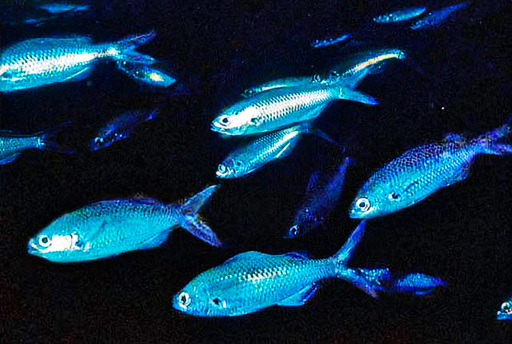
A small, blue-gray fish that once gathered in loose schools along the rocky shores of the Galápagos Islands has become the subject of a more precise question: whether it is already gone. The Galápagos damselfish (Azurina eupalama) has not been recorded since 1983. Before that, it was regularly encountered. Specimens were collected by nearly every major scientific expedition to the islands across the 20th century, and divers could expect to find it at multiple sites. Its disappearance has therefore drawn attention not only for its outcome, but for its abruptness. Azurina eupalama, engraving of type specimen from Heller & Snodgrass (1903). A recent paper by Jack Stein Grove and Bemjamin Victor revisits the evidence and concludes that the species is now likely extinct. The paper, published in the Journal of the Ocean Science Foundation, assembles historical records, ecological context, and decades of unsuccessful searches to argue that the absence is no longer plausibly explained by oversight. The timing points to a specific event. The last confirmed sighting came in the aftermath of the 1982–83 El Niño Southern Oscillation (ENSO), one of the most intense on record. During such episodes, the cold, nutrient-rich upwelling that sustains the Galápagos marine ecosystem weakens or stops. Warmer, less productive water spreads across the archipelago, reducing plankton availability and disrupting food webs. For a species like the Galápagos damselfish, this would have been consequential. It was an obligate planktivore, dependent on the steady supply of microscopic organisms that thrive under normal upwelling conditions. It…This article was originally published on Mongabay
From Conservation news via This RSS Feed.
You must log in or # to comment.