

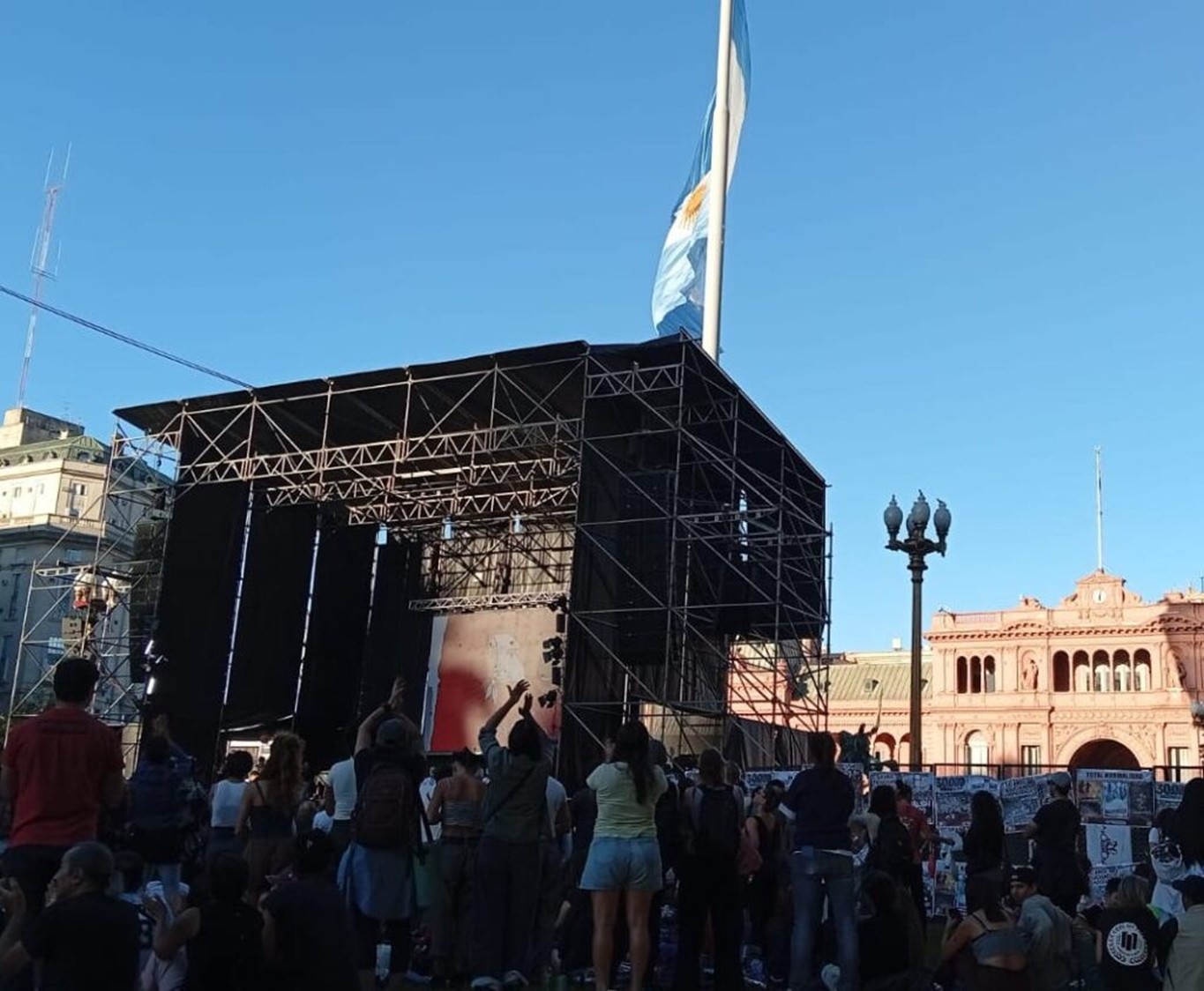
A black stage stood before the President’s palace the “Pink House” in Plaza de Mayo the day before the big event on March 24th to commemorate 50 years since the 1976 coup d’état. A younger than average audience came to listen to intimate talks on the evening of the 23rd. The next day many of them and more than a million more marched in just one of the nationwide marches in the city of Buenos Aires.
The event on the 23rd was organised by the La Poderosa journalism collective. The head of the Left Workers Front-Unity (Frente de Izquierda y de Trabajadores – Unidad) Myriam Bregman spoke, but most of the speakers work in media. Few of them appear on mainstream channels. Some work with youth in the city slums,in Argentina called Villas Miseria, where intense poverty is driving more and more youth into the arms of the cash-rich drug trade. Many speakers work in media to advance human rights and social justice. It is an understatement to say that most want to see an end to the Milei government.
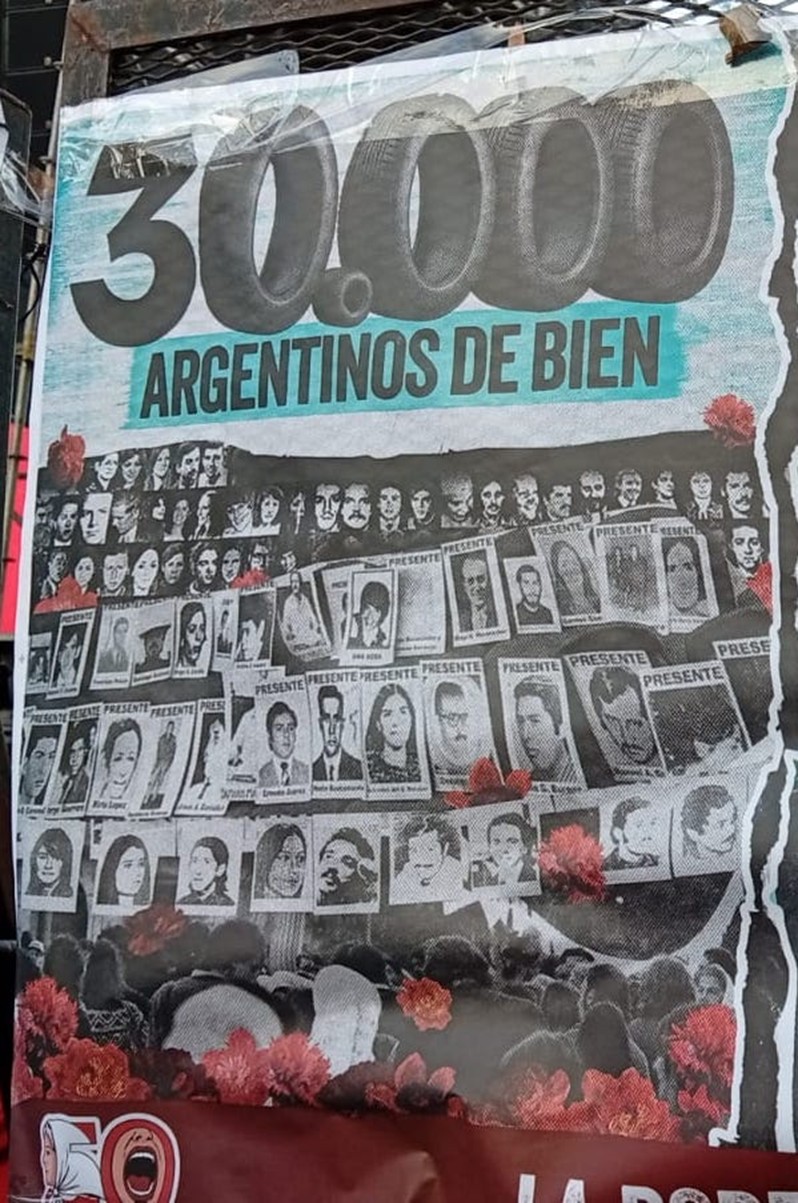
Milei openly questions the numbers of people disappeared by the Junta and has repeatedly said that 30,000 is a made-up number which is a common meme among his political and financial sponsors. Milei’s vicepresident Victoria Villarruel is even more extreme. A military brat —both her father and her uncle were officers in the military during the reign of terror of the junta-. Her uncle was convicted of crimes against humanity. Villarreal has created various organisations to reverse the Never Again judgement that convicted her uncle and other military members responsible for crimes against humanity, she too is a far right conservative but, in Victoria’s case, she prefers Tridentine catholicism to Judaeism.
Many speakers supporting working class areas with the extreme poverty brought by Milei’s structural adjustment warned of a slow crisis that is not only killing the economy, but also many people living on the edge. People in the Villas Miseria usually work in the cash economy and Milei’s adjustments have sucked all the cash out of the economy to give it to international carry-trade speculation. This slowed devaluation but crushed the local economy, bringing generalised poverty except for a select few who Milei calls “La gente de bien!” (the right kind of people). La gente de bien are Milei’s tribe that runs Argentina. They set prices. They pay for his campaigns.
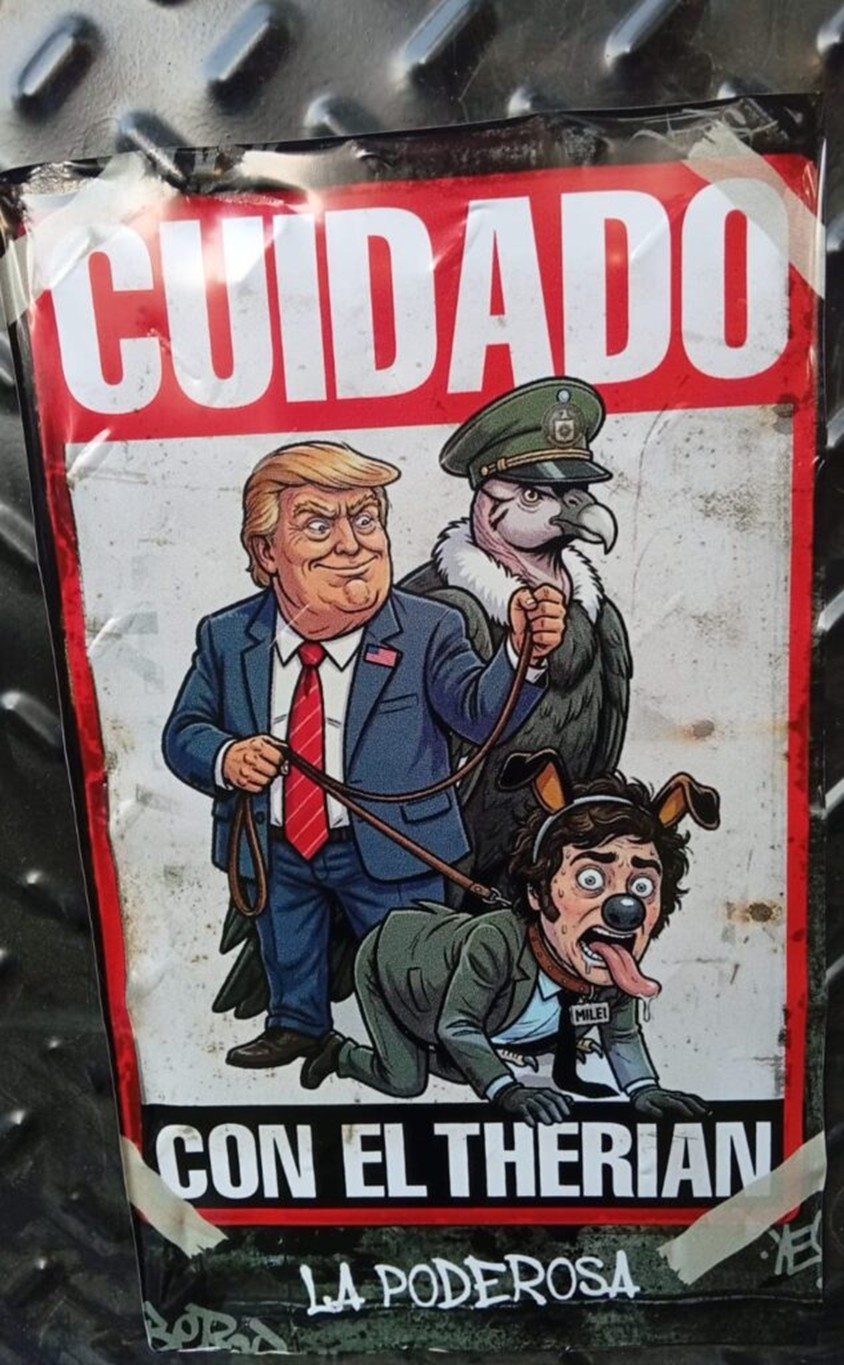
Julia Mengolini, a Patagonian feminist radio journalist and lawyer has been openly threatened by Milei for commenting on the relationships Milei has with his cloned pets and with his sister Karina. Milei’s sister came with him to the Presidential Palace, he removed anti-nepotism laws so that he could instate his sister, a former pastry cook and tarot card reader, as the Secretary General to the President also making her the President of his political party. Milei claims that “We do not hate journalists enough!”.
Mengolini alleges that Milei instigated the deepfake video with Julia and her own brother face-swapped into a pornographic video that implied intimate acts of incest. What can be corroborated is that Milei’s fans and his troll farms distributed this video widely like a thirteen-year-old schoolgirl trying to defame her schoolmate. Last year Mengolini sued Milei for “unlawful association, embezzlement of public funds, [and] coercive threats” Now she too is the subject of a court case brought against her by Milei for “defamation”. Mengolini has sorely tested Milei’s fragile male ego: “Milei has a very low tolerance threshold […] The slightest criticism of him drives him crazy.” Megolini told the NY Times.
Mengolini’s speech at the event also reminded the crowd of the journalist Pablo Grillo who barely survived after police shot a gas canister into his skull and split it like a pumpkin.
Other speakers focused on the 1976-1983 years of state terror as well as the first two years of Milei. Some warned of the alarming increase in the power of the illegal narcotics industry and their influence on Milei’s politics. Milei’s second-in-command who controlled budgets José Luis Espert, was forced to step down from his latest campaign when he received hundreds of thousands of dollars laundering cocaine money from a man who loaned him his airplane for his campaign. Villaverde, a state senator in Patagonia in Milei’s party (Liberty advances or LLA) was arrested for buying a kilo of cocaine in Florida from an undercover police officer.
In the crowd beside me, a young girl fainted while listening to the speeches. As if in slow motion, the 20-year old slowly slipped over against her neighbours who caught her body as she fell, then she lost consciousness. People laid her down carefully on her back and called for medics while we created a cordon around her. The medics came and she recovered consciousness, staring confused at the first-responder holding her. Had she fainted because of the descriptions of torture? Maybe she had family members involved? Possibly she had a panic attack or some medical condition? Very thin, maybe the young woman was just very hungry.
Whyever she collapsed the 20 year old was lucky. She fell. She was caught. She was taken care of. She was safe. Fifty years back when the terror began, government agents grabbed youth her age and even younger from the streets, from their parents’ homes, and even from schools. In clandestine detention centres they tortured them for weeks or months then tossed many from helicopters, bound with rope but still alive into the River Plate below. Their bodies would wash up weeks later on beaches. Unrecognisable, they were hurriedly buried by frightened local officials. No inquiry, no DNA tests, no investigation. Hush it up. Anonymity was the point; they had been disappeared, a state terror phrase for victims that will never be found or identified by friends and family, forcing loved ones to wait forever with futile hope.
In the capital of the province of Buenos Aires “La Plata” ten teeneagers from on secondary school classroom were tortured, imprisoned and nine eventually killed. Some were pregnant in jail. Their crime was to complain that their bus fares had increased. When pregnant prisoners gave birth the babies were given to police families for “adoption” and the teenage mothers disappeared shortly after.
The disappearances of 30,000 Argentinians by members of the armed forces or the police (often acting extra-judicially) is testament to the particular brutality of the Argentine Junta. They were partly a product of US military training in the School of the Americas, Fort Benning, Georgia, renamed the Western Hemisphere Institute for Security Cooperation. But Argentina cannot blame the U.S. for the violence of their de-facto government. The blame lies also at the feet of a thuggish and avaricious local ruling class. The elite place three military men in power as part of the Junta: Jorge Videla (Army), Emilio Eduardo Massera (Navy) and Orlando Ramon Agoto (Air Force). State terror became law in 1976 with the legislative Act declaring a “Process of National Reorganization”. El Proceso was a dictatorship.
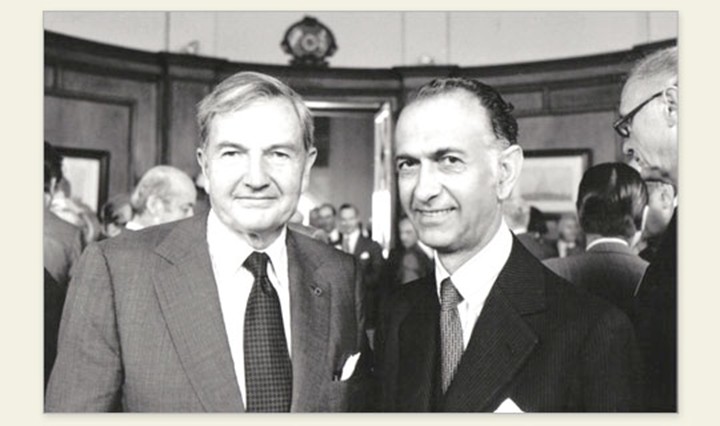
José Martínez de Hoz and David Rockefeller before selfies
History of a Deadly Junta
By 1976 there had been some bombings and various groups sought military power, but this was no war. Quite the contrary! This junta used the state first as a reverse insurgency, a cruel axe that split society into those who tried to fight or flee and the silent majority who looked the other way. The asymmetry of power led to extortion of money and property, torture, rape, death and disappearance. Almost all persons of means who were captured by authorities were extorted for money and told to bring titles for homes and vehicles then they were forced to sign them over to the “authorities”. The regime even opened a real estate office in front of one of the largest torture centres, the ESMA, in Buenos Aires, to sell these stolen properties.
After taking absolute power, the Junta stole billions from the nation and from their victims. Local business owners conducted a theft called “La estatización de la deuda privada” (taking private debt public). This created a massive bonanza of debt propped up by the special financial relationships that the Minister for Economics José Martínez de Hoz had through his connections with David Rockefeller. The 6th of August 1976 the IMF loaned the coup regime its first loan, not unlike the current illegal loan made to Milei that will likely bankrupt the next government. One man, Martínez de Hoz, planned the whole heist. He personally made more money than any other business owner, when measured in terms of the ratio of the forgiven “debt” the country paid for him compared to the size of his company, Acindar. Many other corporate owners in Argentina made out like bandits and the nation’s finances never recovered. José had inherited this company from his dad. Just before the dictatorship José helped massacre the unionised workers at Acindar, then he used the company to steal “nationalised company debt” (via exchange rate guarantees) dumping the loss on the taxpayer.
Martinez de Hoz ran the Ministry of Economics from day one in the dictatorship. He sucked the nation dry, leaving the economy for dead to Carlos Saúl Menem (with a brief period of democracy in-between plagued by military threats and hyper-inflation. Menem trusted his Minister Domingo Cavallo to finish the state off and Cavallo did not disappoint). Cavallo was run out of the country following the fiasco he created, but as a faithful agent of the neoliberal system, rewarded with a seat at Harvard. The debt crisis that resulted left the Argentine economy like the bodies tossed into the River Plate and the whole structure collapsed in 2002. The economy has been limping along ever since. Today Milei has wrapped a bag around its face called libertarian economics. It is losing consciousness.
On March. 24th 2026, one and a half million people went to the streets to commemorate the coup d’etat that initiated seven years of brutal repression and shameless looting. Many were not even born at the time yet they are still paying the debt accrued by the elites who stole it half a century before (plus the interest).
Brave families, like the Mothers of Plaza de Mayo have never stopped searching for loved ones among the thousands disappeared in this tragic era. Maybe sometime someone will investigate and prosecute the families who stole so much money from their neighbours and from the nation. But like the medic said to the fainting girl: “I wouldn’t hold my breath if I were you!”.
Tony Phillips is a researcher, author and journalist based in Buenos Aires. He writes on technology, governance, Argentine politics and human rights issues.
From MIRA via This RSS Feed.