

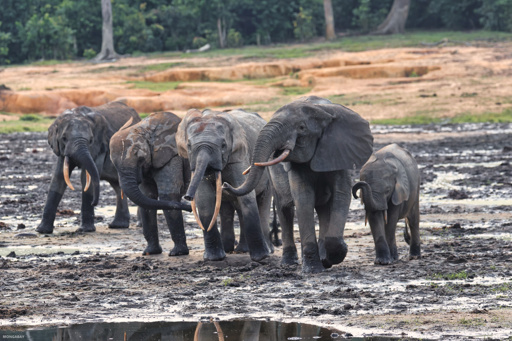
BAYANGA, Central African Republic — Throughout most of Central Africa, it’s difficult to spot herds of forest elephants all at once. They move through dense rainforest, remaining elusive, their lives obscured by thick vegetation and distance. For tourists and even researchers, direct encounters are largely a matter of chance. But Dzanga Bai is different. Often called the “village of elephants,” this mineral-rich clearing in Dzanga-Sangha National Park in southwestern Central African Republic draws large numbers of forest elephants (Loxodonta cyclotis) out of the dense forest. Here, in the Congo Basin, they gather in the open, dozens at a time, sometimes hundreds, feeding, interacting and returning again and again to a place where elephants can be seen in the open. “The Dzanga Bai is the only known clearing where you get hundreds of forest elephants,” said Ivonne Kienast, a behavioral biologist with the Elephant Listening Project at Cornell University, U.S., who has been working in Dzanga-Sangha since 2021. “You have other clearings where, if you’re lucky, the maximum number of elephants you can see will be 40 or 50. But here, the minimum is 40 or 50.” Researchers observing forest elephants in this clearing say the primary attraction is mineral-rich soil. Image by Rhett A. Butler/Mongabay. At peak instances, the numbers climb higher still. “Two hundred and eleven was the count last year in December,” Kienast said. “And that’s just at one [instance].” The forest elephants emerge from the forest edge, stepping cautiously into the open. Some wade knee-deep into pools,…This article was originally published on Mongabay
From Conservation news via This RSS Feed.