

By Ture Ment – Mar 28, 2026
From the moment Europeans began to colonize the world, drug trade was a major source of income
On Thursday March 26, Venezuelan President Nicolás Maduro –kidnapped on January 3– appeared in a US court again. He is being accused of involvement in illegal drug trafficking. Months before the US attack, Western mainstream media had been framing him as the leader of a drug cartel. Yet, the US interest in Venezuela has nothing to do with drugs. Maduro had to be replaced to secure access to raw materials – and oil in particular. This is why the trial in New York is just a show trial. A lawsuit as a cover for the illegal invasion of a sovereign country.
It is not the first time that lies about involvement in drug trafficking have been used to justify regime change. In 1989, Panamanian President Manuel Noriega was replaced by the US based on the same accusation.[1] In 2005, Maduro’s predecessor Hugo Chávez already predicted that the imperialist powers would use this trick on Venezuela as well.[2]
The war on drugs is more than just a cover for invasion; it is also a reversal of the facts. In reality, the imperialist countries closely collaborate with drug traffickers. Governments and organizations who are opposing the current neocolonial order, are framed as drug lords based on lies, while the accomplices of the West are drugslords for real.
During the same period that Maduro was portrayed as a drug criminal, the US released an actual convicted drug smuggler who was put forward as a presidential candidate to influence the elections in Honduras.[3] Likewise, former Colombian President Álvaro Uribe, a loyal Western ally, was also previously involved in drug trafficking.[4] The immediate family of current Ecuadorian President Daniel Noboa is active in drug trade as well.[5] Venezuelan Juan Guaidó –in 2019 recognized by the West as the legitimate president of Venezuela instead of Maduro– has been seen on photos with paramilitaries who are known drug dealers. [6] In Africa, Nigerian President Bola Ahmed Tinubu was formerly involved in drug smuggling and continues to obstruct investigation into his past.[7]
Besides that, the so-called ‘war on drugs’ – just like the ‘war on terror’ – is also a perfect cover for sending Western troops to foreign countries, where they defend the imperialist interests by force of arms. In Colombia, for example, the presence of American bases was presented to the outside world as part of the war against drugs, while in reality, the US mainly wanted to eliminate the FARC. Dutch military units are also deployed to the Caribbean and West Africa under the banner of drug control.[8] To make the war on drugs look credible to the outside world, they occasionally publish reports of drug seizures, however, the Western powers have never succeeded in completely shutting down the trade. This is not a failure, it is intentional.
In our time, it is no longer the imperialists themselves, but their puppets who control the drug trade. Yet, in the past, the Netherlands itself was the world’s largest drug dealer. In the seventeenth century, under the Dutch East India Company (VOC), the fight against opium smuggling served to eliminate competition, to ensure that the colonial Dutch could maintain their monopoly position.
The Dutch State Held an Opium Monopoly
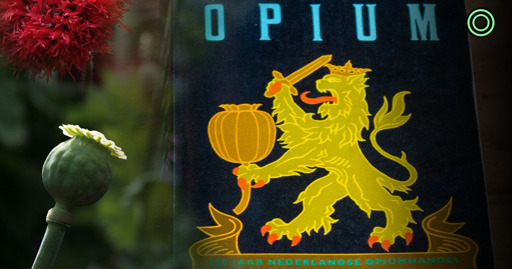
 In recent years, there is an increased attention for the Dutch colonial crimes committed in the past. Less well known is how important the opium trade was to the wealth of the Netherlands. In his book Wettig Opium. 350 jaar Nederlandse opiumhandel in de Indische archipel (Legal Opium. 350 years of Dutch opium trade in the Indian archipelago, 1985), Dutch historian Ewald Vanvugt sheds light on this part of Dutch colonial history.[9]
Almost immediately after the founding of the VOC in 1602, the Dutch began to trade in opium. In 1678, the VOC finally succeeded in securing the opium monopoly on Java. With the expansion of the Dutch occupation of the Indonesian archipelago, the drug trade also became a very lucrative business. It was not until 1942, with the Japanese takeover of Indonesia, that this came to an end. In the seventeenth and eighteenth centuries, the VOC made profits ranging from 300% to even 1000%.[10] Vanvugt writes that between 1830 and 1832, the Dutch government was able to collect 9.5 million guilders worth of opium.[11]
Between 1827 and 1833, the Dutch Trading Company (Nederlandsche Handel-Maatschappij, NHM), which was founded in 1824, made an opium profit of 3 million guilders, which saved the loss-making company from bankruptcy. Vanvugt:
Before 1834, there were serious fears for the survival of the NHM. In the first eight years of its existence, during which it had suffered losses for three years, it was saved from ruin by the large opium profits realized on Java.[12]
In the period 1876–1915, profits amounted to 703.3 million guilders.[13]
The Netherlands was not the only European power dealing drugs in Asia. The British held an opium monopoly in India and later also in Myanmar (Burma), China, and Thailand. The French held a monopoly in Indochina (Cambodia, Laos, and Vietnam). Later, the US did exactly the same in the Philippines.[14]
The colonial powers made millions through drug trafficking. This was not just a ‘shady business’ through back doors. The governments in Europe were fully aware and condoned it. The Dutch government even issued formal instructions to encourage opium trade. The monopoly could only be maintained by eliminating all competition. This was the sole reason for fighting drug smuggling. It explains why the VOC issued edicts condemning opium smuggling starting in 1677.[15]
In the early years, most of the opium came from India, particularly from Bengal, an area colonized by the British. The population, which was once self-sufficient, was forced to produce opium, leading to severe food shortages. Between 1770 and 1944, Bengal was struck by severe famines multiple times. The first famine of 1770 claimed the lives of ten million people, wiping out a third of the population.[16] From 1800 onwards, opium was also increasingly imported from Turkey.
After the Dutch India Company (VOC) was dissolved in 1799, the drug trade continued under the Dutch Trading Company (*Nederlandsche Handel-Maatschappij,*NHM). This state-owned company, which also served as a bank, was founded in 1824 at the initiative of Dutch King William I. The company is often regarded as the successor to the VOC. In the beginning, no other product was as profitable as opium.[17] This remained the case during the Cultivation System, under which Javanese farmers were forced to produce colonial products that yielded enormous profits for the Dutch treasury. Consequently, a significant portion of the capital of the Dutch royal family is based on drug trafficking. The same applies to the Dutch bank ‘ABN Amro’, which emerged from the NHM in 1964. In China, the British did exactly the same with the Hongkong and Shanghai Banking Co. (HSBC), founded in 1860. Relevant in this context is that both banks are currently being prosecuted for laundering drug money.[18]
Of course, local rulers also profited from the colonial opium trade. There is no doubt that the Netherlands would never have been able to successfully occupy the vast Indonesian archipelago without the collaboration of indigenous rulers. They shared in the colonial profits, of which opium trade was a significant part. However, some of them realized that they would retain more if the Netherlands was not there as foreign occupier. There was also a growing resistance against the violence with which the Dutch colonizer enforced its monopoly position. Although local rulers also profited from the trade, not all of them were in favor of large-scale opium use because it contributed to the weakening and destruction of their own people.
In the late nineteenth century, the Netherlands went a step further on Java by establishing an opium factory in the colonial capital ‘Batavia’ (now Jakarta). The goal was to control the trade even better and to further expand it. The colonial secret police, which later suppressed Indonesian resistance fighters, was initially established to combat opium smuggling.[19] The budget to combat opium smuggle was continually increased. This was a good investment because as a result, profits kept rising. Just as in our time, ethical arguments had to camouflage economic motives. To the outside world, they claimed that they were primarily concerned with the well-being of the population. This is the same in our time where the impression is made that the ‘war on drugs’ is about public health.
There were also Dutch critics who spoke out against the opium trade. Not only did their words have little effect, but they were silenced. In 1903, Dutch journalist Johann Friedrich Scheltema had to appear in court because of the criticism he had expressed. In his defense, he stated that the Dutch tricolor was the dirtiest flag of the civilized world and was defiled with ‘stains of opium and other blemishes’.[20] Scheltema was eventually convicted for inciting hatred against the Dutch colonial regime in Indonesia.
In addition to opium, the Dutch traded in other drugs as well. In the late nineteenth century, a Dutch company played a significant role in the rise of the international cocaine trade. The coca leaves were cultivated in Indonesia and processed in Amsterdam by the Dutch Cocaine Factory (Nederlandsche Cocaïne Fabriek, NCF), which had been established by the Dutch Colonial Bank. Up until the Second World War, the Indonesian coca leaves formed the basis of the majority of the cocaine sold worldwide.[21]
Opium Wars in China
Throughout Asia, there were leaders who opposed the introduction of opium. In both Burma and Siam (Thailand), local rulers were overthrown if they opposed the opium trade, after which the use of opium was legalized.[22] Also in China, the various colonial powers have tried to introduce opium since the eighteenth century. Due to persistent local resistance, the decision was made to enforce it through violence. This formed the basis of the Opium Wars waged by the British against China starting in 1839. All the other European colonial powers, had a collective interest in suppressing China from the eighteenth century onwards.
The communists recognized how important narcotics were to the colonial powers. This is why the fight against drugs was a central topic on the communist agenda. They viewed it as part of the broader struggle against imperialism. In 1931, when Japan occupied Manchuria, people in China began to unite in resistance against fascism. The Chinese communists formed an alliance with the Chinese nationalists, the Kuomintang, to jointly confront the Japanese occupation. After Japan was defeated in 1945, the imperialists wanted to prevent that China would become a socialist country. With Western support, the Kuomintang was incited to turn against the communists. Not coincidentally, it was precisely during that period that the Kuomintang grew into one of the world’s largest drug dealers.[23] After the imperialists and their local puppets were defeated and fled to Taiwan, the Chinese communists declared the revolution on October 1, 1949. Within two years, they managed to put an end to the widespread drug use in the country.[24] This was a huge achievement considering the fact that in 1935, twenty percent of the Chinese population was still addicted to opium, morphine, or cocaine.[25]
Capitalist governments and the mafia join forces
Western governments not only play an active role in the drug trade, but they are also outspokenly anti-communist. This aligns with the ideology of many mafia figures who also regard communism as the great evil. For example, the American gangster Al Capone said in 1929:
Our American system, whether you call it Americanism or capitalism, gives each of us extraordinary opportunities. But we must seize them with both hands and make the best of them. Bolshevism is knocking at our gates. We cannot afford to let it in. We have to organize ourselves against it and go against it shoulder to shoulder. We must keep America one indivisible and pure. We must keep the workers away from red literature and those red schemes. We must ensure that their minds remain healthy.[26]
Due to the Great Depression of the 1930s, unemployment had increased. The working class revolted against poverty and the unfair distribution of wealth. In the imperialist countries, including the Netherlands, this resistance was mainly led by communist parties. The imperialists and the mafia—both fearing the loss of money, power, and influence—did everything they could to weaken the working class and break the resistance.
Shortly after the Second World War, strikes and mass actions increased. In their attempt to suppress the growing unrest, secret services employed divide-and-conquer tactics. They managed to separate the more radical trade unions from the less radical ones. The predecessor of the current Dutch union FNV, the NVV, also played a part in this. Many of these divide-and-rule attempts were financed by secret services. The suppression of large-scale strikes that began in the French port city of Marseille is a good example of this.
In the late 1940s, Marseille served as an important transit location for the heroin trade, of which a large part ended up in the United States. In late 1947, the French trade union Confédération Générale du Travail (CGT) organized major strikes in the ports of Marseille, in which 80,000 people participated. On 14 November, they called a general strike for the whole of France.[27]
Because of the link to drug trafficking, multiple interests converged. The French secret service, in cooperation with the American CIA, did everything possible to break the strikes. Among other things, they enlisted Corsican gangsters who violently beat up the strikers. They also succeeded in sowing internal discord, causing the French left-wing labor movement to splinter. Less radical unions that opposed a general strike, such as the ‘Force Ouvrière’ (FO), were supported. Annually, the FO received over two million dollars from the CIA. One of the union leaders who had put the secret services in contact with the Corsican mafia, received an advance of 250,000 dollars from the CIA.[28]
The CGT did not give up. From December 1949 to March 1950, they organized a series of new strikes, this time aimed at preventing arms deliveries to French colonial troops in Vietnam.[29] The mafia helped the imperialist governments to suppress the strikes. Because of their excessive wealth earned through drug trade, mafia figures, like the capitalist elite, are not proponents of a fairer distribution of wealth.[30] The reason the mafia sometimes sides with imperialist governments is because they both profit from the working class.
Another side effect is that narcotics also boost the endurance of workers. Harsh conditions become more bearable. In 1911, a strike by Dutch dockworkers was broken because Chinese workers were brought to the Netherlands. They had to do all the heavy work under the most miserable conditions.[31] Because of their importance to the Dutch economy, opium use was allowed among them.
In the 1980s, the CIA encouraged drug use in poor neighborhoods of American cities where mostly Black people lived. It was an attempt to weaken this group from within, as they also had started to revolt against racism and persistent poverty.[32] Gangsters from Marseille brought the heroin to the US, which was called ‘the French Connection’.[33]
The more addicts there are, the less resistance there is. People under the influence of drugs are more inclined to accept their fate, no matter how miserable it is. This is how drug trafficking and drug use increase inequality.
What was the war in Afghanistan really about?
The war against Afghanistan brought the link between imperialism and drugs to light once again. After the Indonesian War of Independence (1945-1949) and the Korean War (1950-1953), the war in Afghanistan was one of the largest military operations in which the Dutch army was involved. In 2001, under the leadership of the US, Afghanistan was invaded by NATO under the guise of the ‘war on terror’. The narrative was that human rights had to be protected and democracy restored. It is striking that opium production had already been reduced to zero at that time. After the invasion, opium production increased again. Subsequently, after the Afghan resistance had driven out the imperialists from the country, opium production was reduced to virtually zero again.[34]
In 2002, with the help of the imperialist powers, a pro-Western puppet government was installed under the leadership of Hamid Karzai. It was not a coincidence that his connections controlled the lucrative opium trade. An article in Dutch daily NRC from 2011 admits that the opium trade, with a value of 2 billion dollars, also received US-support:
Not only has the production of opium not declined after ten years of foreign interference, but still the drug barons, with the support of the Karzai government and the Americans, earn the most of it.[35]
The drug lords in Afghanistan were tolerated because they fought the Afghan resistance.[36] In 2009, Matthew Hoh, a former captain in the US Marine Corps, resigned from the US State Department and said:
NATO forces were more or less guarding poppy fields and poppy production, under the guise of counterinsurgency. The logic was ‘we don’t want to take away the livelihoods of the people.’ But really, what we were doing at that point was protecting the wealth of our friends in power in Afghanistan.[37]
Karzai himself admitted that, over the years, he received many suitcases of cash from the CIA, for which he had worked since the 1980s.[38] Although it was not the primary reason for the invasion, the opium trade did support US-led imperialism. The proceeds from the drug trade are very useful to Western intelligence agencies for conducting covert operations.[39]
President Maduro’s Upcoming Hearing in US ‘Not an Act of Justice,’ Expert Warns
The biggest drug dealers are the imperialists themselves
In my earlier contribution to Media Mondo, I wrote that the colonial world order accuses the anti-imperialist resistance of terrorism, while they themselves are the biggest terrorists.[40] This is the same with drug trade. Since European colonial countries have dominated the world, they have enriched themselves through drug trade. Nowadays, it is mainly their accomplices who are active in the trade, but the ties remain strong and drug use in the West is widespread. Drug addiction is a huge societal problem, but, out of self-interest, the imperialists will never consistently solve the problem. [41] This is not because it is impossible. In the early 1950s, China already managed to turn the tide in two years.
Western involvement in drug trade make the accusations against Nicolás Maduro all the more hypocritical. Due to the influence of years of propaganda, many Dutch people will assume that he is a dictator and a drug lord who belongs in prison. But who knows that the Netherlands itself was the world’s largest drug dealer for a long time? Or that the wealth of the Dutch Royal family is built on opium? This is not just something from the past. Even now, the Netherlands is a de facto narco-state where drugs are not only used but also traded.[42] This stands in stark contrast to Maduro’s own achievements. Despite the wild stories that have been spread about him, drug use in Venezuela was significantlyreduced under his rule.[43] Moreover, anti-drug operations in the Caribbean proved crucial in the American war of aggression against Venezuela. As the anti-drug narrative legitimized the establishment of American military bases in the Antilles, to which The Hague gave full cooperation. Therefore, the Netherlands is complicit in the crime that the Trump administration committed on January 3rd.[44]
—
Footnotes:
[1] Silvano Solano, ‘The U.S. Annihilated Panama to Secure Imperial Control’, Telesur, (22 December 2025), see: https://www.telesurenglish.net/the-u-s-annihilated-panama-to-secure-imperial-control/.
[2] Kawsachun News on X: https://x.com/kawsachunnews/status/2008961501537952131 (7 January 2026).
[3] On the release of Hernández and his role in the international drug trade, Dutch National broadcaster NOS reported: ‘Even more remarkable was the second message from Trump, in which he indicated that he would pardon Juan Orlando Hernández, a party colleague of Asfura and president of Honduras between 2014 and 2022. Last year, he was sentenced by US prosecutors to no less than 45 years in prison for smuggling over 400 tons of cocaine into the US. During Trump’s first term, Hernández got along well with the American president. At that time, American diplomats viewed him as a necessary evil, a much-needed but far from innocent ally in the region. However, in January 2022, when Hernández’s term ended, US prosecutors decided to set an example and prosecute the notorious “narco-president.” Less than three weeks later, he was arrested and extradited. The trial against Hernández painted a damning picture of how he had functioned for years as the linchpin of a network that smuggled South American cocaine into the US via Honduras. According to prosecutors, Hernández used the millions in bribes he collected in the process, including from the notorious Mexican drug lord ‘El Chapo’, to finance his election campaigns. A striking detail of the trial against Hernández is that some of the cocaine smuggled into the US came to Honduras from Venezuela.’ Boris van der Spek ‘Gratie Honduras, sluiting luchtruim Venezuela: Trump drukt stempel op Latijns-Amerika’, NOS, (2 Cecember 2025), see, in Dutch: https://nos.nl/artikel/2592850-gratie-honduras-sluiting-luchtruim-venezuela-trump-drukt-stempel-op-latijns-amerika.
[4] Rasha Reslan, ‘War on drugs or war for trusteeship? Petro tears down US narrative’, Al Mayadeen, (10 November 2025) see: https://english.almayadeen.net/news/politics/war-on-drugs-or-war-for-trusteeship%E2%80%93petro-tears-down-us-nar.
[5] An article in Dutch daily NRC confirms that Ecuadorian President Noboa, under the guise of combating drugs, is opening all doors to American military intervention: ‘Noboa wants the US to reopen the naval base in the port city of Manta, which was closed under former President Rafael Correa, in the fight against drug smuggling. That will be quite a hurdle, as he has to change the constitution to do so. Noboa has also signed a cooperation agreement with Erik Prince, founder of the controversial American security firm Blackwater, for assistance in his fight against drug gangs.’ Arjan Meesterburrie, ‘President Noboa kan door met zijn keiharde strijd tegen drugsgeweld in Ecuador’, NRC, (14 April 2025), see in Dutch (with paywall): https://www.nrc.nl/nieuws/2025/04/14/president-noboa-kan-door-met-zijn-keihard-strijd-tegen-drugsgeweld-in-ecuador-a4889820, without paywall: https://archive.ph/nK6qA.
Read also: Revista RAYA, ‘Ecuadorean President Daniel Noboa’s family business implicated in cocaine trafficking per police documents,’ Progressive International, (31 March 2025), see: https://progressive.international/wire/2025-03-31-daniel-noboas-family-business-president-of-ecuador-is-involved-in-cocaine-trafficking-to-europe/en/.
[6] Justin Podur and Joe Emersberger, Extraordinary threat, (2021), p. 54.
[7] David Hundeyin, ‘Bola Ahmed Tinubu: From Drug Lord To Presidential Candidate’, West Africa Weekly, (7 November 2023) see: https://westafricaweekly.com/bola-ahmed-tinubu-from-drug-lord-to-presidential-candidate/. Read also: Mayowa Durosinmi, ‘Aaron Greenspan Accuses FBI, DEA of Playing Politics, Deliberately Delaying Release of Unredacted Tinubu Drug Files “As Favour To Nigerian President”, West Africa Weekly, (8 August 2025), see: https://westafricaweekly.com/aaron-greenspan-accuses-fbi-dea-of-playing-politics-deliberately-delaying-release-of-unredacted-tinubu-drug-files-as-favour-to-nigerian-president/.
[8] The Dutch Ministry of Defence posted a message in 2024 confirming the years of close cooperation with the US in combating drug trafficking: ‘Nederland en VS vangen 30 jaar drugs in Caribisch gebied’, Defensie, (10 April 2024) see, in Dutch: https://www.defensie.nl/actueel/nieuws/2024/04/10/nederland-en-vs-vangen-30-jaar-drugs-in-caribisch-gebied.
In West Africa, Dutch and other Western European imperialists are collaborating with the US under the name ‘Flintflock’, with drug interdiction supposedly at the center: ‘The goal of the military exercise is to improve the knowledge and skills of African soldiers. Armed gangs regularly attack villages in the Sahel, the region south of the Sahara Desert. Children are kidnapped in exchange for ransom, but extremist groups like Boko Haram and Islamic State live primarily from drug trafficking, such as cocaine. IS and branches of al-Qaeda need money to finance their weapons and ammunition,’ says Major General Ron Smits, commander of the Dutch troops. “They obtain that money through drug trafficking. One of the final destinations is Europe, including the Netherlands. That is why we want to take action here now as well, to prevent those drugs from eventually ending up in the Netherlands.”’ Sophie van Leeuwen, ‘Nederlandse special forces trainen militairen in Afrika: ‘Druk op Europa groeit’, RTL Nieuws, (19 June 2024) see, in Dutch: https://www.rtl.nl/nieuws/buitenland/artikel/5455132/special-forces-nederland-afrika-terrorisme-europa.
[9] Dutch historian Ewald Vanvugt wrote his book about the Dutch opium trade in 1985; years later in 2017, Dutch website De Correspondent published a summary. Source: Ewald Vanvugt, ‘Nederland runde eeuwenlang een drugskartel (en betaalde er zijn oorlogen mee)’, De Correspondent, (26 October 2017), see, in Dutch: https://decorrespondent.nl/7514/nederland-runde-eeuwenlang-een-drugskartel-en-betaalde-er-zijn-oorlogen-mee/4f949074-b9fa-0d54-055f-fbf534b43779.
[10] Ewald Vanvugt, Wettig Opium. 350 jaar Nederlandse opiumhandel in de Indische archipel,(1985), p. 84.
[11] Vanvugt, Wettig Opium, p. 166.
[12] Ibid, p. 168-169.
[13] Ibid, p. 414.
[14] Ibid, p. 358.
[15] Ibid, p. 64.
[16] Under British colonial rule in India, there were many organized famines. The last one was in 1943. About the Bengal famine of 1770, see: Rakhi Chakraborty, ‘The Bengal Famine: How the British engineered the worst genocide in human history for profit’, Your Story, (15 August 2014) https://yourstory.com/2014/08/bengal-famine-genocide.
[17] Vanvugt, Wettig Opium, p. 159-162.
[18] Various media have investigated the laundering of drug money through major financial institutions. Rasha Reslan, for example, writes: ‘The global cocaine trade, worth more than $130 billion annually based on figures referenced in the United Nations Office on Drugs and Crime (UNODC) Report 2025, cannot thrive without financial systems that launder its profits. Major Western banks, from Wachovia to HSBC, have been fined for processing drug money, yet none of their executives faced prison.’ Source: Rasha Reslan ‘War on drugs or war for trusteeship? Petro tears down US narrative’, Al Mayadeen, (10 November 2025), see: https://english.almayadeen.net/news/politics/war-on-drugs-or-war-for-trusteeship%E2%80%93petro-tears-down-us-nar.
Spencer Woodman, ‘HSBC moved vast sums of dirty money after paying record laundering fine,’ ICIJ, (21 September 2020), see: https://www.icij.org/investigations/fincen-files/hsbc-moved-vast-sums-of-dirty-money-after-paying-record-laundering-fine/.
‘ABN Amro nam 18 miljoen euro in contanten van drugscriminelen aan’, Follow The Money, (20 December 2024), in Dutch: https://www.ftm.nl/artikelen/abn-amro-nam-18-miljoen-euro-in-contanten-aan-van-drugscriminelen, without paywall: https://archive.ph/mITCT.
Researcher Peter Dale Scott writes: ‘Other institutions with a direct stake in the international drug traffic include major banks, which make loans to countries like Colombia and Mexico knowing full well that drug flows will help underwrite those loans’ repayment. A number of our biggest banks, including Citibank, Bank of New York, and Bank of Boston, have been identified as money laundering conduits, yet never have faced penalties serious enough to change their behavior. In short, United States involvement in the international drug traffic links the CIA, major financial interests, and criminal interests in this country and abroad. Antonio Maria Costa, head of the UN Office on Drugs and Crime, has said that “Drugs money worth billions of dollars kept the financial system afloat at the height of the global crisis.” According to the London Observer, Costa said he has seen evidence that the proceeds of organised crime were “the only liquid investment capital” available to some banks on the brink of collapse last year. He said that a majority of the $352bn (£216bn) of drugs profits was absorbed into the economic system as a result…. Costa said evidence that illegal money was being absorbed into the financial system was first drawn to his attention by intelligence agencies and prosecutors around 18 months ago. “In many instances, the money from drugs was the only liquid investment capital. In the second half of 2008, liquidity was the banking system’s main problem and hence liquid capital became an important factor,” he said’. Source: Peter Dale Scott, ‘Can the US Triumph in the Drug-Addicted War in Afghanistan? Opium, the CIA and the Karzai Administration’, Asia Pacific Journal Japan Focus, (5 April 2010) see: https://apjjf.org/peter-dale-scott/3340/article.
[19] Vanvugt, Wettig Opium, p. 225.
[20] Vanvugt, Wettig Opium, p. 358.
[21] Hans Bosman, ‘The history of the Nederlandsche Cocaïne Fabriek and its successors’, Maastricht University, (2012), chapter 4 and 7 see: https://cris.maastrichtuniversity.nl/ws/portalfiles/portal/33152413/672023.pdf.
[22] Vanvugt, Wettig Opium, p. 194 en 228.
[23] Chris Kaspar de Ploeg, De Grote Koloniale Oorlog deel 1, (2025), p. 242.
[24] In China, one-fifth of the land was used for the production of opium. See: Harpal Brar, Socialism with Chinese Characteristics, (2020), p. 11.
[25] Chris Kaspar de Ploeg, De Grote Koloniale Oorlog deel 1, (2025), p. 183-184.
[26] Michael Parenti, Het Vierde Rijk, (2003), p. 186 and R. Palme Dutt, Fascism and Social Revolution, (1935), p.204. And also: Art Shields, ‘Teapot Dome and Al Capone: The early days of the Daily Worker’, People’s World, (12 January 2024), see: https://www.peoplesworld.org/article/teapot-dome-and-al-capone-the-early-days-of-the-daily-worker/. And: Andrew Ward, ‘Capone & the Red Menace’, (15 September 2017), see: https://medium.com/@andrew_ward/capone-the-red-menace-4413dd526bdf.
[27] The Dutch communist newspaper ‘De Waarheid’ (The Truth) published several articles about the strike, which can be read in the online newspaper archive Delpher:
‘Gaullistische burgemeester van Marseille vlucht voor arbeiders’, De Waarheid (13 November 1947), see, in Dutch: https://resolver.kb.nl/resolve?urn=ddd%3A010852141%3Ampeg21%3Apdf.
‘Troepen naar Marseille,’ De Waarheid, (14 November 1947), see: https://resolver.kb.nl/resolve?urn=ddd%3A010852142%3Ampeg21%3Apdf.
‘Tegen de politieterreur. Algemene havenstaking in Frankrijk aangekondigd’, De Waarheid, (17 November 1947), see: https://resolver.kb.nl/resolve?urn=ddd%3A010852144%3Ampeg21%3Apdf.
‘Vitale bedrijven van Frankrijk liggen stil’, De Waarheid, (19 November 1947), see: https://resolver.kb.nl/resolve?urn=ddd%3A010852146%3Ampeg21%3Apdf
‘Driekwart millioen stakers in Frankrijk Blum belast met kabinetsformatie,’ De Waarheid, (21 november 1947), see: https://resolver.kb.nl/resolve?urn=ddd%3A010852148%3Ampeg21%3Apdf.
Quote from a newspaper report of December 5, 1947, translated from Dutch: ‘All signs indicate that wherever strikers confront police and soldiers of the French army, in most cases the clashes proceed in favor of the strikers. In numerous places, the armed forces withdrew without having used their weapons. The government is attempting to change this situation in a repugnant manner. Yesterday, it offered a gratuity of 100 francs per day to all personnel of the security services and police corps. However, wherever colonial troops, i.e., units of the Foreign Legion –riddled with fleeing SS members– are deployed, numerous casualties have fallen among the strikers.’ Source: ‘Twee millioen ambtenaren gaan staken’, De Waarheid, (5 December 1947), see: https://resolver.kb.nl/resolve?urn=ddd%3A010852160%3Ampeg21%3Apdf.
About the deliberate attempt to create division among the trade unions: ‘There is no schism in the major French trade union movement, the CGT. This was evident from a statement issued on behalf of the entire CGT board on Monday afternoon, following discussions with Minister of Labour Daniel Mayer. The entire bourgeois press, and especially the socialist Populaire, had already reported for a whole week under large headlines that a split in the CGT was imminent and that the Jouhaux group disagreed with the strikes. The aforementioned statement, for which Jouhaux is therefore also responsible, characterized these reports as completely false.’ Source: ‘Communisten verhinderen stemming over worgwetten’, De Waarheid, (2 December 1947), see: https://resolver.kb.nl/resolve?urn=ddd%3A010852157%3Ampeg21%3Apdf.
[28] In August 2025, the website ‘www.phillyfreepress.org’ published an article about the strikes in Marseille. Regarding the Mafia and their connection with the CIA and moderate trade unions, they write: ‘One part of this subversion included collaborating with groups such as the French mafia, specifically, the Union Corse, or Corsican milieu, made up of individuals native to the French island of Corsica. The Union Corse had a long criminal history in France, and even more pertinently, experience in strike-breaking. It had cracked more than a few Communist skulls for Marseilles’ fascist mayor Simon Sabiani in the 1930s, and many of its members had informed on Communist and French Resistance activities for the occupying Nazis during World War II in exchange for their criminal activities remaining unmolested.21 The syndicate was then the natural choice to help break up the strikes in 1947 and 1950, though this latest alliance would have long-lasting consequences, including helping establish Marseille as “the heroin capital of the Western World.”’ Source: ‘To Live and Die in Marseille: How the CIA Helped Get America Hooked on Heroin’, Philadelphia Free Press, (17 August 2025), see: https://www.phillyfreepress.org/p/to-live-and-die-in-marseille-how.
Another article about the link between the Mafia, the Socialists, and the CIA: ‘Through their contacts with the Socialist party, the CIA had sent agents and a psychological warfare team to Marseille, where they dealt directly with Corsican syndicate leaders through the Guerini brothers. The CIA’s operatives supplied arms and money to Corsican gangs for assaults on Communist picket lines and harassment of the important union officials. During the month-long strike the CIA’s gangsters and the purged CRS police units murdered a number of striking workers and mauled the picket lines. Finally, the CIA psychological warfare team prepared pamphlets, radio broadcasts, and posters aimed at discouraging workers from continuing the strike. Some of the psy-war team’s maneuvers were inspired: at one point the American government threatened to ship sixty-five thousand sacks of flour meant for the hungry city back to the United States unless the dockers unloaded them immediately.’ Source: ‘Political Bedfellows, “The Socialist Party, the Guerinis, and the CIA”’, Akha, (publication date unknown), see: https://www.akha.org/content/drugwar/mccoy/14.htm.
The French secret service and the CIA had come into contact with the Corsican Mafia through union leaders Irving Brown and Pierre Ferri-Pisani. The latter received an advance of $250,000 from the CIA. For more information, see: https://en.wikipedia.org/wiki/Pierre_Ferri-Pisani.
Read also: ‘Lbor: The Most Dangerous Man’, Time, (March 17, 1952), see: https://time.com/archive/6618433/labor-the-most-dangerous-man/.
[29] Minayo Nasiali writes about the anti-colonial strikes that took place in Marseille in 1950: ‘In December 1949, Marseille dockers began a major strike that lasted through March 1950. As Pacini wrote in his memoir, “our mission was clear, not one weapon for the dirty Vietnam war would leave the port.” The strike nearly paralyzed La Joliette as dockers refused to load arms onto ships bound for Indochina and sailors delayed ships transporting troops. In the early months of 1950, dockers in other ports, including Oran and Algiers, stopped loading arms in solidarity with the Marseille port workers. The strike also spread to other areas including the chemical and railway industries.48 These work stoppages culminated in a general strike on March 10, 1950.49 Pacini called it, “one of the most beautiful efforts ever organized by French workers.”’ Source: Minayo Nasiali, ‘Trouble on the Docks: Strikes, Scabs, and the Colonial Question in Marseille’s Port Neighborhoods’, (2016), see: https://www.academia.edu/28748494/Trouble_on_the_Docks_Strikes_Scabs_and_the_Colonial_Question_in_Marseilles_Port_Neighborhoods.
Quote from the previously cited article on www.phillyfreepress.org: ‘Much of the same economic conditions that led to the 1947 strike also contributed to the subsequent 1950 strike. Addit