

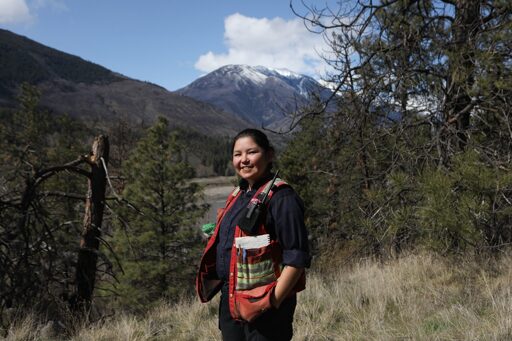

Sheresa Brown, a 31-year-old Lytton First Nation member, is a field technician and archaeology monitor with the Nlaka’pamux Nation Tribal Council. She spoke at the Salish Fire Keepers Society’s 2026 spring gathering in March. She is pictured here on her ancestral homelands in Lytton First Nation on March 30. Photo by Aaron Hemens
Aaron Hemens and Santana Dreaver, The Narwhal’s 2026 Indigenous Journalism Fellow, attended the Salish Fire Keepers Gathering on March 17 and 18. This is the first of two stories about the gathering, published in partnership with The Narwhal.
In 2022, one year after wildfire tore through the Village of Lytton, a blaze broke out at the nearby Stein Valley Nlaka’pamux Heritage Provincial Park.
The site, co-managed by Lytton First Nation and the “B.C.” government, contains pictographs, petroglyphs and culturally modified trees, along with more important cultural sites.
So the BC Wildfire Service called in Sheresa Brown, a 31-year-old Lytton First Nation member who works as a field technician and archaeology monitor with the Nlaka’pamux Nation Tribal Council. When fires happen near registered archaeological sites, Brown works with BC Wildfire Service crews and structural protection specialists to safeguard cultural heritage.
“I was all for it,” Brown says. “But I wanted to do it in the right way.”
To avoid the pictographs washing away from firefighting efforts, Brown outlined a 75 to 100 metre buffer zone around the cultural site.
Sprinklers were set up around the buffer zone, and crews watched as the sprinklers stopped the flames from reaching the pictographs.
“That really helped me confirm that this was a good idea,” she said.
In other wildfires, she has helped to determine which registered archaeological sites are within a fire’s boundaries and are along its projected path, directing crews where to work. For example, she will advise where heli-pads can be constructed to avoid cutting down culturally modified trees, and will guide where hoses can be laid to protect artifacts — such as arrowheads — on the ground.
“We make sure that everything is done in a very respectful way,” she said.

Sheresa Brown, a field technician and archaeology monitor specializing in cultural values and site preservation with the Nlaka’pamux Nation Tribal Council, is pictured in Lytton First Nation territory on March 30, in an area impacted by the 2025 Izman Creek fire. Photo by Aaron Hemens
Brown was one of more than a dozen experts and technicians drawn from the realm of Indigenous fire stewardship — from researchers to Indigenous land managers and fire practitioners — who gave panel talks at the Salish Fire Keepers Society “Reigniting The Land” spring assembly on March 17 and 18. Around 100 people attended in-person in Tk’emlúps (Kamloops) in Secwepemcúl’ecw, with more tuning in virtually.
The panel discussions ranged from protecting cultural heritage sites and values in the event of wildfire, to the experiences of Youth engaged in cultural burning and different approaches to land management post-wildfire.
While honouring the work of their ancestors and the efforts by Indigenous fire keepers in recent decades, the gathering also gave insight into the role that Indigenous Youth are having in the future of fire stewardship and emergency response.
Resources around building capacity for community-based fire stewardship and emergency response initiatives were also highlighted, and there was dialogue in bridging opportunity gaps between BC Wildfire Service and Indigenous communities.
“We need to collaborate with our people. We need to share. We gotta look at those imaginary lines and get rid of those, and work together,” said George Campbell, a Nlaka’pamux Nation member from the Boothroyd Indian Band, who is a wildfire officer for the Fraser Fire Zone for BC Wildfire Service’s Coastal Fire Centre.

George Campbell, right, a Nlaka’pamux Nation member from the Boothroyd Indian Band and wildfire officer for the Fraser Fire Zone for BCWS’s Coastal Fire Centre, is pictured during a prescribed burn in his home community in May 2024. Photo by Aaron Hemens
Fire Keepers Society brings nations together to share knowledge
Comprised of Elders, Youth, knowledge holders and fire keepers from Salish communities — including the Nlakaʼpamux, syilx, Secwepemc and Stʼatʼimc Nations — the Fire Keepers Society is a grassroots initiative that started in 2016 as a means to promote awareness around culturally prescribed burns throughout the province.
The society annually hosts a spring and fall gathering, where they aim to build connections between Indigenous nations by sharing knowledge, and promoting and supporting fire stewardship opportunities in different communities.
“We as nations, need to be working together,” said Tiffany Traverse, a Secwepemc Nation member who serves as one of the society’s board of directors.
“We have shared territories. We have shared family members and family lineages.”

Salish Fire Keepers Society founding members Craig Shintah, left, and Joe Gilchrist, were honoured with a blanket ceremony that was led by the Stʼatʼimc Bear Dancers group during the opening of the group’s 2026 spring gathering on March 17. Photo by Aaron Hemens
Fellow board director Darian Edwards, a Stʼatʼimc Nation member from Tsʼkwʼaylaxw First Nation, said that the society is looking to build support and create opportunities for Indigenous Youth around fire stewardship initiatives in their respective communities.
“Youth are going to be taking over the work. They are going to be stewarding our lands after us,” said Edwards.
A century of fire suppression
Before settler colonialism outlawed the use of fire on the land through legislation such as the provincial Bush Fire Act of 1874, Interior Salish Nations had been prescribing fire to the land for thousands of years.
Burn cycles were designed to nurture/support certain landscapes and ecosystems, often to sustain diversity for hunting areas and to promote the growth of berries and medicinal plants — which all supported various ceremonial purposes.
This work of regular burning ultimately helped to maintain the ecological health of the land by limiting overgrowth and mitigating fuels.
However, settlers and their rapid fire suppression practices effectively removed fire from the ecosystem in the last century. This has resulted in the spread of trees across landscapes that were not historically forested, all of which has led to the accumulation of wildfire fuels and debris across landscapes.
“Those managing forestry are not aware of the historical ecology of our lands and how they were changed through a century of fire suppression and how they were afforested,” said Jennifer Grenz, a Lytton First Nation member who is a restoration ecologist and assistant professor at the University of British Columbia.
In the past, she noted, “so much of our territories didn’t have trees all over them.”
“They were not meant to be these high-density, single or two species tree plantations that they were transformed into,” she said.

Jennifer Grenz, a Lytton First Nation member who is a restoration ecologist and assistant professor at the University of British Columbia, speaks at the Salish Fire Keepers Society’s 2026 spring gathering in March. Photo by Aaron Hemens
Grenz made the comments during her panel presentation on the restoration work she conducted following the 2021 McKay Creek wildfire that broke out near Lilloet in St’at’imc territory.
Last summer, four years after the fire, she and a team of researchers found that burned landscapes are at risk of invasion by fast-growing, fire-prone invasive species of grasses.
However, they also identified historic berry-gathering areas that had once been cultivated and maintained by Indigenous people.
These sites were sprouting in locations that were impacted by the fire, and did not see any human intervention efforts post-fire.
“Several areas have managed to survive being forested for tree plantations and these mega-fires to remind us of these very large areas that people created — that our people created,” she said.
While many of these areas are recovering on their own post-fire, she noted that “those are the first places that we’re seeing tree planting occurring.”
“The provincial government is going in and planting on top of these areas,” she said.
“This is where I really feel like there’s a really important piece for us to take back greater territorial land management, and find these areas and assert them, as these are our historic berry gathering areas, food areas. And we don’t want to find trees planted on top of them.”
Grenz said that Indigenous communities know that the mega-fires of today “are not our fires.”
“This is just a totally different level of trying to figure out what to do next,” she said.
‘It’s really important to expose our Youth to this work in a good way’
During a panel discussion led by three Indigenous Youth, Skuppah Indian Band member Amber Wilber from the Nlaka’pamux Nation said that there’s a lot of trauma in her community around fire, especially among Youth.
Skuppah Indian Band is located just two kilometres south of the Village of Lytton, which was the site of a devastating wildfire that swept through the area in 2021 and burned down 90 per cent of the village. Nearly five years after the fire, communities in the area, such as Lytton First Nation, are still in the process of rebuilding their homes and infrastructure.

An aerial view of the Village of Lytton in Nlaka’pamux Territory on March 30. Photo by Aaron Hemens
“I’d love to see that fear of fire shift to a respect for fire — learning that fire can be a tool that we can use to manage our land, and help bring balance to it, instead of something to be feared,” said Wilber, who is in her second year working with the BC Wildfire Service.
Wilber said growing up, she used to watch from inside her family home as her dad and grandpa burned patches of land outside to support berry harvesting. She would later help her uncle with fuel management work — it was her uncle who taught her that the practice is “an important tool that brings balance to the ecosystem.”
“Not only when it comes to fire prevention and fire management, but also, creating balance in an ecosystem for birds, for elk as well, in our local area. Making way for them to travel through our forests, and giving birds good nesting places,” Wilber explained.
“We also use fuel management and cultural burning in our area as a way to knock down the tick population, because they can be quite pesty in the spring.”

Indigenous Youth panelists speak at the Salish Fire Keepers Society’s 2026 spring gathering’s opening day on March 17. From left to right: Santana Dreaver, a Saulteaux and Plains Cree journalist who works with The Narwhal and IndigiNews; Takoda Castonguay, the assistant executive director of Oskâpêwis Gladue Services from the Sapotaweyak Cree Nation; and Amber Wilber, a Skuppah Indian Band member working with BC Wildfire Service. Photo by Aaron Hemens
She described this experience as a young person practicing and revitalizing fire stewardship knowledge in her community as “eye-opening.”
“It’s really ignited a connection to the land in a way that I don’t think I ever would’ve gotten anywhere else,” she said.
“It’s very unique, and it makes me have a lot of appreciation for traditions and cultures. It makes me feel connected to my ancestors in a big way.”
She advised Indigenous Youth to get involved in cultural burning “in any way you can” — from listening to family members, to seeking out fire keepers in their communities.
For the more seasoned fire keepers in the room, she encouraged them to involve their Youth in burns, no matter the size of the fire.
“Bring them out, even if it’s just a small job,” she said.
“It’s really important to expose our Youth to this work in a good way. And let them see your mistakes as well. … Later on, they’ll have that experience, too. They’ll have more grace for you and understanding. It’ll help them feel a little more humanized as well.”
A workbook to educate on cultural burns
Last summer, the First Nations’ Emergency Services Society (FNESS) and the Indigenous Leadership Initiative (ILI) released their “Worksheets To Create A Cultural Burn Pathway” workbook, which is both a physical and digital resource designed to guide Indigenous Nations in creating cultural burn programs within their community.
The workbook is the product of multi-years of community based-research, where more than 50 Elders and knowledge keepers were consulted, with additional input coming from gatherings and workshops.
Jaci Gilbert, a prescribed fire specialist with FNESS from the Secwépemc and Tsilhqot’in Nations, contributed to the workbook and gave a presentation about it during the Fire Keepers’ gathering.
“The aim of the workbook is to help nations navigate cultural burning with the impacts of climate change. We are not seeing the indicators that we’re used to, or seeing them at different times that don’t align with our burn windows,” said Gilbert.
“We hope that this workbook will help nations do burning in this new time.”
The workbook is divided into seven worksheets. The ILI, however, recognizes on their website that, “cultural fire is culture and location specific. So instead of a prescriptive approach, each worksheet poses a set of questions and prompts that can be answered collectively.”

Around 100 people attended in-person, with more turning in virtually, for the Salish Fire Keepers Society’s 2026 “Reigniting The Land” spring gathering in Tk’emlúps (Kamloops) in Secwepemcúl’ecw on March 17 and 18. Photo by Aaron Hemens
Amy Cardinal Christianson, a Cree-Métis senior fire advisor for ILI, helped lead the development of the workbook.
She appeared virtually at the gathering, and said that the workbook has been used by Indigenous land guardian programs, such as the Kainai Nation’s (Blood Tribe) fire guardian program.
“It’s a really easy resource to use for communities. It also talks a lot about the importance of governance,” said Christianson.
She said that Indigenous fire stewardship is not just limited to culturally prescribed burns.
“Yes, culturally burning – but it can also be firefighting; emergency response; post-fire recovery,” she said.
“It’s any activity where Indigenous people are asserting their jurisdiction and exercising their rights related to fire on the land.”
The post Before wildfire season begins again, Indigenous fire keepers gather to share knowledge appeared first on Indiginews.
From Indiginews via This RSS Feed.