

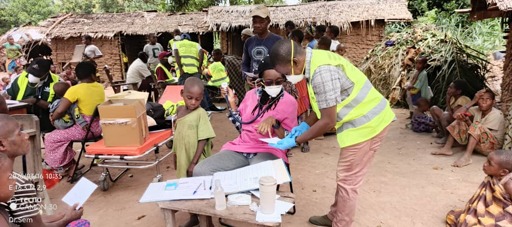
BAYANGA, Central African Republic — Before the consultations, screenings and discreet discussions about disease, a makeshift enclosure is set up in the middle of the village, where residents gradually gather to the sound of music playing — at first they are curious, then attentive. Here, in the heart of the forests of southwestern Central African Republic, Alphonsine Colombe Irahali, a Rwandan medical doctor, spends much of her time traveling from village to village to provide care to communities that rarely have access to it. “What we do is go from village to village to make a significant impact,” she told Mongabay during a recent mobile clinic mission. “In the morning, when we arrive, we start by playing music. Then we raise awareness: What signs to watch for? When to go to the hospital? What to expect?” At 36, Irahali could have chosen a different path. Many medical practitioners across Africa are drawn to cities or leave the continent in search of better pay and working conditions. But Irahali chose instead to work in Bayanga, a remote post near Dzanga-Sangha National Park, where the dense forest meets a fragile health care system, and where access to basic care is difficult. Irahali said she applied for the position at least three times before she was finally selected. “I am committed to caring for underserved communities,” she said. “I believe this work is in line with my oath.” For her, it was a conscious choice, as she seized the opportunity to work in…This article was originally published on Mongabay
From Conservation news via This RSS Feed.