

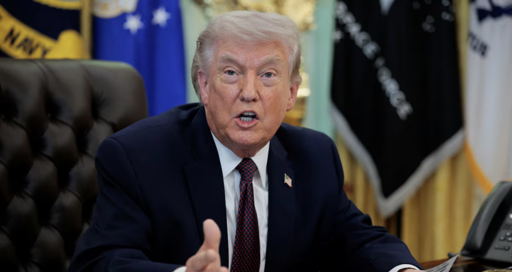
The war against Iran has placed Donald Trump in an unprecedented situation: For the first time, he is not facing a swift, limited operation that can easily be sold as a victory, but rather a protracted, uncertain campaign with no clear exit strategy.
What was supposed to be a show of force has turned into a trap. Not only is the fate of the military operation at stake, but something far more fundamental: the very credibility of U.S. hegemony.
The War Trump Doesn’t Know How to End
The central problem with the war in Iran is political, rather than tactical. Neither Trump nor Defense Secretary Pete Hegseth have managed to explain how this war will end. And they have deliberately avoided setting clear objectives, relying instead on a dangerous logic of declaring victory when it suits them.
That approach has worked in specific operations. But when facing a state that refuses to collapse, it becomes a dead end. Iran did not fall “in three days,” and by failing to do so, the war became everything Trump detests: long and with no clear path to victory.
Escalation, like gambling in a casino, creates its own internal logic. The more you invest, the harder it is to walk away without losses. As a result, strategic decision-making is subordinated to the immediate political pressure to avoid appearing defeated.
Repeating Mistakes They Promised to Avoid
Trump came to power promising not to repeat Iraq and Afghanistan: no nation-building projects, endless wars, or vague objectives. The U.S. military, freed from “stupid rules of engagement,” as Hegseth put it, would use overwhelming force to achieve quick and decisive results.
But the real core of that approach was the deliberate ambiguity of the objectives. Trump reserved the ability to redefine them on the fly, so that victory would depend on a political decision, rather than on concrete transformations of the battlefield.
Trump’s approach worked in Operation Midnight Hammer, last summer’s campaign to strike Iran’s nuclear facilities. This approach also produced quick results in what Trump described as the “perfectly executed” raid to capture Venezuelan President Nicolás Maduro.
However, the war in Iran has exposed the structural flaw in the president’s approach. When a regime’s survival is at stake, it resists and escalates, rather than surrenders. The logic of war changes: it is no longer about inflicting damage, but about breaking will. And that is precisely what military superiority alone cannot guarantee.
In fact, the more a state is pressured to an existential breaking point, the stronger its incentive becomes to escalate the conflict. This results in a progressive drift from the mission, in which each intensification generates new justifications for continuing. What was supposed to be a war without quagmires is starting to resemble the very conflicts the United States swore it had learned to avoid.
The Myth of Technological Superiority Crumbles amid Asymmetric Warfare
One of the pillars of U.S. confidence was its technological superiority, including AI, precision weapons, and the ability to “decapitate” enemy commanders, which were designed to produce quick victories.
But that premise is being eroded. As independent analyst Hamidreza Azizi explains, since the start of the war,
Iran is no longer simply attempting to absorb pressure and retaliate in kind. Instead, it is trying to redefine the terms of the conflict by expanding the battlefield, targeting the enabling infrastructure behind U.S. and Israeli operations, and linking escalation in one domain to costs in others. The result is an evolving strategy that seeks to turn military asymmetry into strategic leverage. This strategy appears to be adaptive and increasingly coherent, but also more expansive and more dangerous.
In this sense, Iran’s evolving strategy reflects a redefinition of how it perceives strategic victory. In other words, success is no longer measured by battlefield outcomes alone, but by whether the war produces a new strategic equation in which the cost threshold for attacking Iran has been raised.
This strategy is not the product of military improvisation, as occurred in Ukraine during the early stages of the Russian invasion. Unlike that situation, following the war with Iraq in the 1980s, Tehran launched a long-term project aimed at technological autonomy. Even before this war, it was already exporting nearly $1 billion worth of drones annually.
Iran’s massive industrial production capacity for drones and missiles has led former European Commissioner Thierry Breton to explain that, in this “first asymmetric world war,” as he calls it, Iran can hold out in the long term. “In other words, the Western system can strike hard, but not necessarily for long — or at least not at the current rate — while Iran, with cheaper delivery systems and a saturation doctrine, can sustain pressure over several months.”
In this context, the downing of an F-15E, a symbol of air supremacy, is much more significant than just a military event. It is a sign that technical superiority no longer guarantees victory.
Hormuz at the Heart of U.S. Hegemony
The most critical point of the war in Iran is not on the battlefield, but at sea. The selective closure of the Strait of Hormuz calls into question the core of U.S. power. That is, Washington’s hegemony is based not only on its military power, but on its ability to control the seas through isthmuses and straits, the very fabric of globalization. In this sense, the challenge to control over Hormuz undermines U.S. hegemony far more than anything else.
As Stephen Wertheim, a senior fellow at the Carnegie Endowment for International Peace, noted:
What is the point of the entire U.S. military role in the Middle East? If it has any point, it should be to prevent something like the closure of the Strait of Hormuz. Yet U.S. military action has only brought about the very problem it’s supposed to prevent.
The Strait of Hormuz has become the war’s center of gravity. Iran’s new war doctrine transforms this waterway from a latent threat into an active instrument. War thus seeps into energy markets and trade routes, and impacts the stability of regional allies. In this context, the logic of rapid coercion begins to reverse.
The United States: A Declining Hegemon with No Way Out
The current conflict reveals a transformation of the United States’ global role. Washington ceases to be the linchpin of the order it founded and instead becomes — as even its allies now acknowledge — a factor of global destabilization. As Vivian Balakrishnan, Singapore’s Minister of Foreign Affairs, explained in a recent interview: “Basically, the underwriter of this world order has now become a revisionist power, and some people would even say a disruptor.”
In other words, an uncontrolled variable that risks destroying itself and plunging the rest of the planet into chaos. The United States is pushing its allies to rethink their dependence and face two alternatives: strategic autonomy or subordination to another power.
It is in the Persian Gulf where this dilemma is felt most acutely. It may still be too early to assess the extent of the damage caused to U.S. power. But we can be certain that this new Gulf War will intensify the global arms race, especially among U.S. allies, whose confidence is eroding.
Worse still, the United States’ own ability to exercise its will as the supreme hegemon is in question. According to Rosemary Kelanic, director of the Middle East program at Defense Priorities, a Washington-based think tank, Trump’s mistaken belief that the campaign against Iran could be carried out quickly and cleanly “shows that the United States doesn’t have the strategic advantages and power that it thought it had, and that it maybe previously did possess.”
In this context, the United States faces an increasingly evident dynamic of imperial overextension: engaged on multiple fronts, consuming resources at a pace that is difficult to sustain, and eroding the political capital that for decades underpinned its global leadership.
As the international editor of Der Spiegel warned, the war in Iran both depletes material capabilities — such as a missile arsenal that will take years to replenish — and diverts Washington from its strategic priorities while bogging it down, once again, in the Middle East. In his words:
While America is tied down in Ukraine and had actually wanted to focus on the Pacific, it is wearing out its military of all places in the Middle East – the very region Trump claimed he would never send troops back to. The war with Iran is a strategic catastrophe for the United States.
The final picture is unsettling. Trump appears as a leader trapped in his own strategy: unable to escalate without risk, but also unable to withdraw without cost. A player who no longer controls the game. Although the war is not yet over, a troubling prospect looms for the world’s only superpower. Because if the United States can no longer secure the seas, impose its desired outcomes, or offer stability, then its hegemony begins to hollow out from within, as happened with other empires before they fell.
Originally published in Spanish on April 5 in La Izquierda Diario.
The post Trump’s War in Iran Exposes the Fragility of U.S. Hegemony appeared first on Left Voice.
From Left Voice via This RSS Feed.