

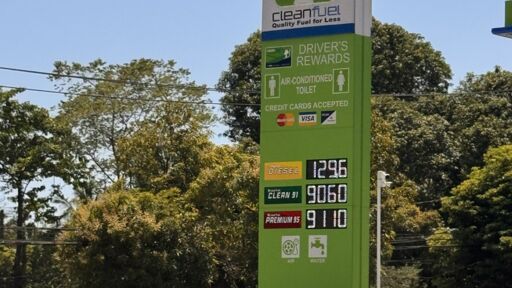
Even without a war and an oil shock, and even in times when oil prices are relatively low or declining, the Filipino people are still being oppressed and exploited by local pump price profiteering, and global monopoly and speculative pricing due to oil deregulation. The US-Israel imperialist war on Iran is magnifying such oppression and exploitation many times over.
By Arnold Padilla
Bulatlat.com
Because of the Oil Deregulation Law (ODL), oil companies are likely raking in massive additional profits from the global oil shock. Taking advantage of unregulated weekly price adjustments, oil companies appear to have implemented price hikes far higher than warranted by global price movements.
Based on estimates, oil companies today could be earning an extra P367 million in daily profits from diesel on top of their regular profits due to abusive pricing practices amid the ongoing global oil shock. From gasoline, oil firms could be reaping an additional P159 million in daily profits. Petron Corporation, owned by close Marcos ally Ramon Ang and the country’s biggest oil company, could be earning more than P44 million in extra profits from gasoline and more than P102 million from diesel every day.
Because the 12 percent value-added tax (VAT) is inclusive in these unjustifiable oil price increases, the Marcos Jr. regime is also reaping windfall tax revenues from overpriced petroleum products. The Marcos regime could be collecting an additional P44 million in daily VAT revenue from diesel and an extra P19 million daily from gasoline, on top of its regular VAT collections from these petroleum products. VAT itself, as a form of taxation, is already oppressive. The government collecting additional VAT on overpriced oil is oppression twice over.
Domestic profiteering
The amounts are based on estimated price adjustments using the Mean of Platts Singapore (MOPS) benchmark, which oil firms are said to use to determine how much their pump prices should change in a given week. The estimates also factored in foreign exchange rate fluctuations to determine the adjustments oil companies should implement at the pump. The results are then compared with the actual adjustments in pump prices implemented by oil companies.
Using this method, let us look at the adjustments announced by the oil companies on March 10, March 17, and March 24. MOPS and forex data for March 31 adjustments are not yet available as of writing. On March 10, the oil companies announced adjustments of P7-13 per liter for gasoline or a simple average of P10 per liter. For trading days March 2-6, the period that oil companies referred to when calculating their adjustments for March 10, MOPS gasoline increased by only P9.06 per liter, computed as VAT-inclusive. For diesel, the announced adjustments ranged from P17.50 to P24.25 per liter (an average of P20.88 per liter), while the MOPS diesel adjustment (VAT-inclusive) was only P18.95 per liter.
Following the same process, we can calculate the discrepancies between the March 17 and March 24 adjustments in domestic gasoline and diesel pump prices and the expected adjustments based on MOPS. MOPS gasoline increased by P11.29 per liter during the March 9-13 trading days, while MOPS diesel spiked by P17.14 per liter. But oil companies announced price hikes of P12.90 to P16.60 per liter for gasoline (average: P14.75 per liter) and P20.40 to P23.95 per liter for diesel (average: P22.18 per liter) on March 17.
For the March 16-20 trading days, MOPS gasoline jumped by P6.74 per liter and MOPS diesel by P11.38 per liter. However, oil firms announced pump price increases of P8 to P11.50 per liter for gasoline (average: P9.75 per liter) and P15 to P18.45 per liter for diesel (average: P16.73 per liter) on March 24.
The cumulative amount from the discrepancies in MOPS adjustments and actual pump price adjustments during the reviewed period reached P7.41 per liter for gasoline and P12.31 per liter for diesel. These amounts can be considered profiteering because the oil companies implemented pump price increases far higher than justified by increases in the benchmark MOPS prices. Using these figures and actual domestic diesel and gasoline consumption data, we can approximate how much oil firms are raking in through profiteering from weekly price changes.
| MOPS adjustments vs. actual adjustments, gasoline and diesel (P per liter) | ||||||
| Trading days | MOPS adjustments | Actual adjustments (ave.) | Difference | |||
| Gasoline | Diesel | Gasoline | Diesel | Gasoline | Diesel | |
| Mar 2-6 | 9.06 | 18.95 | 10.00 | 20.88 | 0.94 | 1.92 |
| Mar 9-13 | 11.29 | 17.14 | 14.75 | 22.18 | 3.46 | 5.04 |
| Mar 16-20 | 6.74 | 11.38 | 9.75 | 16.73 | 3.01 | 5.35 |
| Total | 27.09 | 47.47 | 34.50 | 59.79 | 7.41 | 12.31 |
| *Actual adjustments announced on Mar 10 (for trading days Mar 2-6), Mar 14 (for trading days Mar 9-13), and Mar 21 (for trading days Mar 16-20)*Based on data from the Department of Energy (DOE) Oil Monitor |
The latest available data (June 2025) from the Department of Energy (DOE) shows that the country’s demand for petroleum products was about 78.35 million liters per day. Of the total demand, 30.57 percent is gasoline (about 23.95 million liters per day) and 42.67 percent is diesel (about 33.43 million liters per day). Based on the country’s daily gasoline consumption, we estimate that consumers pay P177.47 million more at the pump stations than they should if oil companies were simply reflecting MOPS adjustments; for diesel, they pay P411.52 million more daily.
Extra profits, VAT revenue
These additional amounts that drivers of jeepneys, TNVS, and tricycles, as well as other motorists, unjustly bear when they refill at gas stations are split between oil companies (as extra profits on top of their regular profits) and the Marcos government (as additional VAT revenue on top of its regular VAT collections). For gasoline, the oil companies are taking P158.46 million per day, and the government is taking P19.01 million per day. For diesel, the split is P367.43 million for the oil companies and P44.09 million for the government.
Based on market share (June 2025), we can further estimate how much each oil company is likely to be raking in from such profiteering. Petron earns P44.03 million in daily extra profits from gasoline and P102.11 million from diesel, based on its 27.79 percent share of total domestic petroleum product demand. Transnational oil giant Royal Dutch Shell’s local unit, Pilipinas Shell, rakes in an additional P22.41 million from gasoline and P51.95 million from diesel each day, based on its 14.14 percent market share. Another local unit of a global oil company, Chevron Philippines, which has a 3.07 percent market share, earns P4.86 million in daily extra profits from gasoline and P11.28 million from diesel.
Unioil, which is 25 percent owned by the world’s largest oil company, Saudi Aramco, corners an estimated P15.66 million in additional profits from gasoline and P36.30 million from diesel each day, based on its 9.88 percent share of domestic demand. Seaoil, 20 percent owned by Ampol (formerly Caltex Australia) and with 6.32 percent market share, collects an extra P10.01 million in daily profits from gasoline and P23.22 million from diesel.
| Estimated extra profits of oil companies and additional VAT revenue of the Marcos government due to profiteering | ||
| Indicator | Gasoline | Diesel |
| Estimated profiteering (P per liter) | 7.41 | 12.31 |
| Consumption (million liters per day) | 23.95 | 33.43 |
| Estimated amounts collected due to profiteering (P million per day) | 177.47 | 411.52 |
| Of which: | ||
| Oil companies’ profits | 158.46 | 367.43 |
| Petron | 44.03 | 102.11 |
| Shell | 22.41 | 51.95 |
| Chevron | 4.86 | 11.28 |
| Unioil | 15.66 | 36.30 |
| Seaoil | 10.01 | 23.22 |
| Other players (~43 companies) | 61.49 | 142.57 |
| Government VAT revenue | 19.01 | 44.09 |
| Estimates based on data from the Department of Energy (DOE) |
All these estimates of additional profits for oil companies and extra VAT revenue for the Marcos government are just snapshots of how much the oil industry is earning excessively at the great expense of Filipino consumers. The hundreds of millions of pesos in profiteering that we have estimated cover just three weeks of price adjustments since the US and Israel launched their unprovoked imperialist war against Iran. Oil companies and the government have subjected the Filipino people to this grave abuse since the country deregulated the industry 30 years ago, in compliance with conditionalities imposed by the International Monetary Fund (IMF) on its $1 billion loan to the country in 1995. The accumulated profiteering from unregulated pump price adjustments over the years could already have reached hundreds of billions of pesos, if not trillions.
Global monopoly, speculative pricing
What is mind-boggling is that these massive amounts of profiteering at the pump are still just the tip of the iceberg. Remember that the largest oil companies in the Philippines are structurally part of monopolies that have dominated the global oil industry for the past century. As mentioned, Pilipinas Shell and Chevron Philippines are local units of the so-called Supermajors of the global oil industry, Royal Dutch Shell (UK/Netherlands) and Chevron (US), while Petron maintains long-term supply contracts with ExxonMobil (US), another Supermajor. In collaboration with the national oil companies (NOCs) of oil-producing countries, such as Saudi Aramco (Saudi Arabia), the world’s largest oil company, which also influences major local players like Unioil, the oil monopolies effectively control and set prices from the oil fields to the gas stations.
Transactions within this supply chain are covered by long-term contracts (lasting up to 10 years), and prices are set outside of the spot market that determines MOPS prices. Globally, 70-85 percent of physical oil trade is covered by long-term contracts. In other words, most of the oil sold in the country is actually not affected by weekly MOPS fluctuations.
Compounding monopoly pricing is speculative pricing. Global oil prices are already artificially high due to monopoly control, and speculation further inflates them. Outside of the physical oil trade is the “paper oil” trade, or the futures market of crude oil. About 80-90 percent of futures market trading is done by hedge funds and other financial firms that speculate on the future price of crude oil to make billions in profits. While they do not actually drill and deliver, or buy, crude oil, these paper transactions, often financed by capital that is also behind the Supermajors and even the NOCs, influence price setting in the physical crude oil market and, ultimately, the prices of petroleum products in global or regional benchmarks like MOPS. The US-Israel war on Iran has caused major disruptions in global oil supply and has fed enormous speculation in the future price of oil.
Global or regional spot or benchmark prices, such as MOPS or Dubai crude, that the Philippines uses are therefore arbitrary, and adjustments based on these international prices are artificial. To illustrate, Dubai crude has recently been trading at around $128 per barrel. Based on estimates, the cost of finding, developing, and producing a barrel of crude oil (full-cycle cost), on average, is about $42 per barrel. Royalties, on average, are ~12.5 percent of the price or around $16 a barrel (based on $128 per barrel). This implies that at $58 per barrel, crude oil is already viable for trade, $70 per barrel lower than the current global price. Even if profit margins and other costs are added, the current global price, where pump prices and price adjustments in the Philippines are supposedly based, is still very much artificially bloated.
Oppressed and exploited
As mentioned, oil companies are even profiteering from the deregulated weekly adjustments, further arbitrarily inflating the pump prices. Filipinos thus absorb the full extent of monopoly and speculative pricing in the global market, as well as profiteering in the domestic market, because of the oil deregulation regime.
All these show that even without a war or an oil shock, and even in times when oil prices are relatively low or declining, the Filipino people are still being oppressed and exploited, as the government has abandoned its mandate to determine reasonable oil prices to protect the public and the economy. Such oppression and exploitation are magnified many times over when global crises erupt, such as the ongoing crisis driven by US imperialism and Israeli Zionism.
Oil prices will continue to skyrocket as tensions in West Asia show no signs of easing soon. US President Trump, in his most recent address to the nation, warned of more US attacks against Iran in the next two to three weeks, targeting its oil and energy infrastructure. The global oil price shock that the US-Israel imperialist war against Iran has fully exposed how deeply problematic the oil deregulation policy is. Policymakers could no longer ignore this reality; the country must effectively regulate the oil industry.
The post Oil shock profiteering? Oil firms, Marcos regime rake in hundreds of millions amid crisis appeared first on Bulatlat.
From Bulatlat via This RSS Feed.