

Bullets:
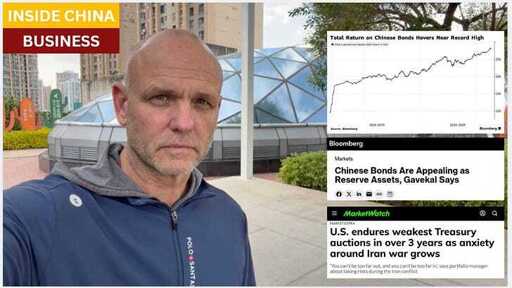
On a total return (inflation-adjusted) basis, bonds issued by the Chinese government is one of the highest in the world.
Fixed-income investors are shunning US capital markets, and liquidating Treasury bond holdings. Auctions for new debt issuance are performing poorly, with buyer interest at the worst levels in years.
Chinese bonds are backed by its massive manufacturing and trading sectors, and its economy is far better insulated from supply-side shocks in energy markets.
Investors now perceive Chinese government bonds to be the preferred “safe-haven” for risk aversion and total returns.
Inside China / Business is a reader-supported publication. To receive new posts and support my work, consider becoming a free or paid subscriber.
Report:
Good morning.
It is amazing, how fast the economic systems of the Western world are snapping apart. These come from Bloomberg, in early February. They’re less than two months old, and already read like something from Medieval times.
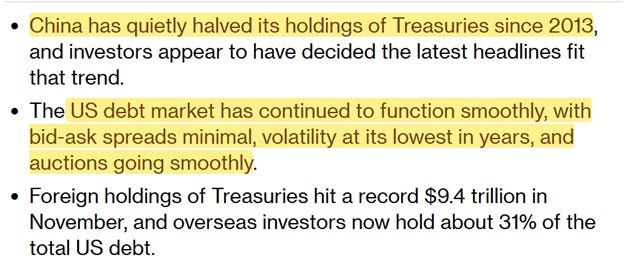
Chinese regulators had just instructed their banking system to cut their holdings of US Treasury bonds. China’s banks are to limit new purchases of US government debt, and for banks that have large positions, to sell them off.
Bloomberg got to work right away, trying to assess the impact of that move by China, and note in the beginning that the Chinese have been selling Treasury bonds for years, and everything is just fine: The debt market is functioning smoothly, spreads are narrow, volatility is the lowest in years, auctions are also going smoothly. They even said “smoothly” twice.
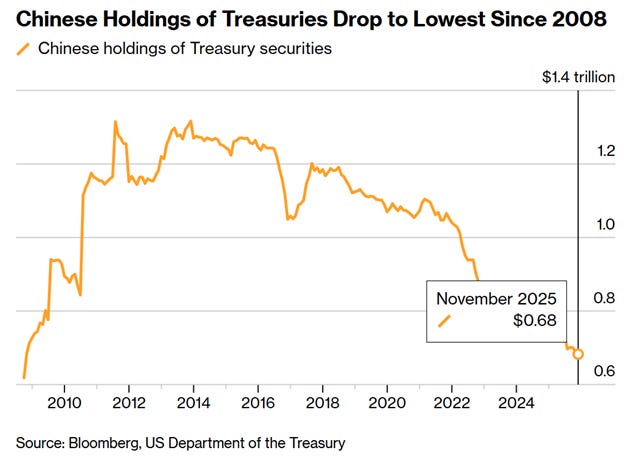
So investors who see this chart of how China is dumping their Treasury bonds, and wonder about what the Chinese are worried about, it’s no problem. The situation with China is “more the exception than the rule”.
Back in February, fixed-income investors were focused on jobs reports, and what the Federal Reserve might do, and knew that if the Fed cuts rates that would be even better for bond buyers. The head of fixed income investments at JP Morgan was on his way to the airport, jetting off to Australia to meet with bond investors there, and all he was seeing – at the time – was interest in buying US bonds. And this from Goldman Sachs: As long as the United States runs a trade deficit and sends dollars abroad, foreign countries will send those dollars back and buy Treasures. So, ignore what the Chinese or the Japanese are doing. If they’re selling, someone else is always a buyer. 10-year yields – at the time – were 4.13%.
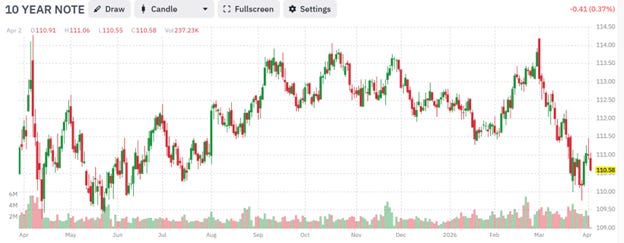
Fast forward just six weeks. There’s a hot war in the Middle East, which is one of those events that is supposed to result in safe-haven money flowing in to buy US Treasuries. But the money is leaving, going the other way. 10-year Treasury yields today are up, now over 4.3%, and rising:
The prices for these bonds are falling, because of all the selling. Here is the one-year chart for 10-year Treasury notes:
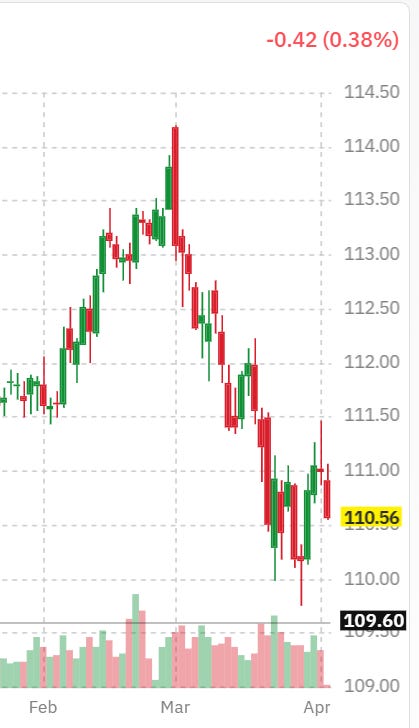
Here it is since February, when Wall Street’s best and brightest from JP Morgan and Goldman were telling everyone that everything is fine, that there will always be buyers. If China and Japan go away, don’t worry, the Australians can’t wait to jump in:
The Treasury auctions that were going so “smoothly” in February, fell apart in March. They saw the lowest buyer interest in over three years, and Marketwatch leads their piece by saying that investors are second-guessing the world’s most important safe-haven investments:
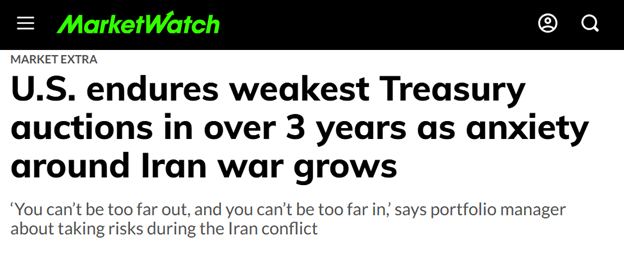
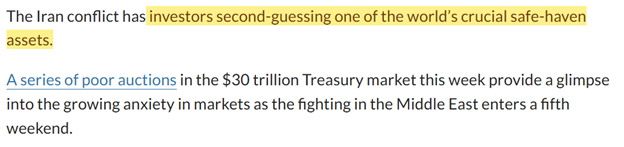
So in February the Chinese banks increased their selling of Treasuries. Then in March other central banks were selling. Where did the money go, then? These are safe-haven capital pools. The most important concern for regulators of these sovereign holdings is safety. And China offers that safety. The conventional wisdom until about 10 minutes ago, is that US government bonds, and the US dollar, are “shelters in a storm”. However, it is Chinese government bonds that are holding their value.
Chinese bonds are backed by its massive industrial base and trading systems. And China is also insulated from disruptions in energy markets. They have over a billion barrels of crude stashed away in reserve. China also enjoys stronger relationships than anyone, with Russia and Iran, and those flows continue despite the wars in the Ukraine and the Persian Gulf. And China’s mind-boggling production of electricity at low prices is a giant moat around its factory sectors and households, no matter what happens in energy markets everywhere else.
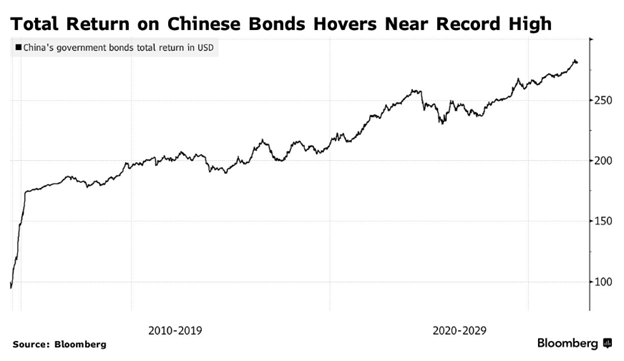
Since 2012, Chinese bonds have beaten US inflation—there’s no inflation here. “Total return” means inflation-adjusted, and the inflation-adjusted return on Chinese government bonds is at a record high, and it continues to rise. Fixed-income investors focus on “total return”—they look these bond yields from across the world and see that China government bonds pay a lot less in interest than they would get by lending the money to the United States, or the UK, or just about anywhere else:
But after inflation, they were better off buying the bonds in China, and that was true BEFORE whatever the inflation rates in Europe and North America are going to be from now on.
Be Good.
Resources and links:
Bloomberg, China’s Years-Long Retreat From US Treasuries Flags Bigger Risks
https://www.bloomberg.com/news/articles/2026-02-11/china-s-years-long-retreat-from-us-treasuries-flags-bigger-risks
China Urges Banks to Curb Exposure to US Treasuries
https://www.bloomberg.com/news/articles/2026-02-09/china-urges-banks-to-limit-holdings-of-us-treasuries-citing-market-volatility
U.S. endures weakest Treasury auctions in over 3 years as anxiety around Iran war grows
https://www.marketwatch.com/story/u-s-endures-weakest-treasury-auctions-in-over-3-years-as-anxiety-over-iran-war-grows-fb9a20a8
Chinese Bonds Are Appealing as Reserve Assets, Gavekal Says
https://www.bloomberg.com/news/articles/2026-03-25/chinese-bonds-are-appealing-as-reserve-assets-gavekal-says
10-year government bonds yields by country, most recent
https://tradingeconomics.com/bonds
Inside China Business, Now everyone is dumping US government bonds
Inside China / Business is a reader-supported publication. To receive new posts and support my work, consider becoming a free or paid subscriber.
From Inside China / Business via This RSS Feed.