

The term “hostage” is broadly understood to be the illegitimate capture of a civilian in order to extract concessions from a government or military actor. A “prisoner of war” is broadly understood to be a combatant captured by an adversary in the course of a battle. The former conveys innocence on the part of the captured and illegitimacy, terrorism and criminality on the part of the capturer. The latter conveys a lawful and reasonable response to being attacked by another military actor. Thus, how and why our media is framing Iran’s response to the unprovoked attack by the US is of tremendous importance: any potential “hostage crisis” could be used to further escalate the conflict and rally public support behind increased military aggression on the part of the US-Israeli coalition.
So it’s noteworthy that the mere potential of a single American being captured by Iran is immediately being framed by western media as an illegitimate act of aggression on the part of the country he or she was bombing. Indeed, several major Western media outlets are already rushing to frame the capture of a prisoner of war as a “hostage”:
- Times of London: “US fighter pilot feared to have been taken hostage by Iran”
- BBC: “If the airman is taken hostage and images circulated, it will be a propaganda victory for Iran”
- ABC News Australia: “If the missing pilot is taken hostage…” “A US pilot taken hostage…”
“US fighter pilot… taken hostage by Iran.” Let us stew in that Orwellian phrasing for a bit. Though they do not explicitly call the downed pilot is a “hostage,” the New York Times dutifully orients his capture squarely in the context of Iran’s repeated use “of hostage-taking as a tactic against its adversaries.”:
The possibility that Iran could capture the airman raises the specter of a replay of the 1979 Iran hostage crisis, a traumatizing event in American history that laid the foundation for nearly five decades of hostile U.S.-Iranian relations.
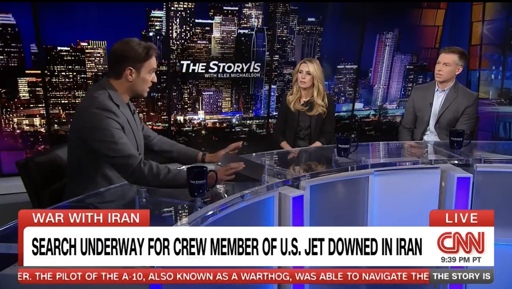
In this breakdown, the Times does not use the term “prisoner of war” once, but does evoke “hostage” six times and, of course, uses the obligatory “Woman in Chador Walks by Anti-US Mural” stock photo to convey extra evilness. Other pundits and reporters would join in on the framing. In addition to Paul Rieckhoff on MSNOW, this framing was used by PBS’s Iran Bremmer, CNN’s Abby Phillip, CNN’s Elex Michaelson.
really really hope this doesn’t become a hostage situation.
— ian bremmer (@ianbremmer) April 3, 2026
.@abbydphillip also calls the downed pilot a “hostage” pic.twitter.com/dcXh1nurCj
— Adam Johnson (@adamjohnsonCHI) April 4, 2026
ostensibly straight reporter @Elex_Michaelson also refers the downed pilot as a potential “hostage” pic.twitter.com/gvLqPiZBBf
— Adam Johnson (@adamjohnsonCHI) April 4, 2026
But any potential US jet fighter pilot shot down meets no definition of “hostage.” The US launched an unprovoked attack and US-Israeli pilots have bombed schools, apartment complexes, energy and sanitation infrastructure, and hospitals. In no universe is a military combatant engaging in these hostilities a “hostage.” Even using the term “prisoners of war” is being generous since the war itself has zero legal or moral justification, but Western media is allergic to this already conservative phrasing, so the language is that of victimized “hostages” in urgent need of “rescuing” from the evil “regime.”
Meanwhile—likely in response to the downed pilot—the Trump administration today abducting the niece and grand-niece of late Iranian military commander Qassem Soleimani, detaining them indefinitely and revoking their green cards, is something far more akin to hostage-taking than capturing a combatant. But we can rest assured no one in Western media will frame it this way.
An “escalation” by Iran
In addition to the civilizian-ization of a military actor engaging in a war of aggression, Iran’s shooting down of the American pilot was painted as an “escalation” by Iran in several major outlets. Bloomberg News wrote in their headline, “Downed US Jet, Second Crash Mar New Escalation in Iran War,” and the Economist handwrung, “A captive American in Iran could lead to further escalation.”
In no universe is a military combatant engaging in these hostilities a “hostage.”
“[The shooting down of the pilot] would mark the first time the U.S. has lost aircraft in Iranian territory and marks a dramatic escalation in the war since it began five weeks ago,” added the Associated Press.
The New York Times editorialized in its straight reporting that the shooting down of US planes was somehow the first example in a long list of recent “escalations” by Iran. “Augmenting people’s anxiety,” the Times’ Farnaz Fassihi wrote, “are the recent escalations from Iran’s leadership. On Friday, Iran shot down an American fighter jet in the southwest part of the country.”
If your country is invaded, thousands of your people are killed, your infrastructure destroyed and your leadership is wiped out in a sneak attack, anything short of you retaliating with greater force cannot, by definition, be an “escalation.” That is how the language should work: escalations are when one side increases beyond their adversary’s actions. Simply Shooting Back is not an escalation—but not for a Western press eager to paint people dropping bombs as passive victims illegitimately targeted by those they are bombing.
It’s clear what’s being primed here: A Jessica Lynch-style “rescue” misson of a smol American pilot Simply Doing Their Job when a terrorist “regime” illegitimately shot them down only to use them as a pawn in a devious game of media manipulation. Iran defending its sovereign territory from bombing raids that have already killed over 3,500, including over 150 girls in a school bombing, are “escalating” and “taking hostages” when they manage to actually shoot down one of the planes decimating their country. The US and Israel must always be cast as perpetual victims, the Iranians always the aggressor. Calling those captured in pursuit of this bombing campaign “prisoners of war” would remove this manipulative ‘victim’ narrative from the readers’ and viewers’ minds. So, to maintain the narrative fiction, routine acts of self-defense are put in sinister and aggressive terms even if doing so violates the most basic laws of English and grammar.
From The Real News Network via This RSS Feed.