

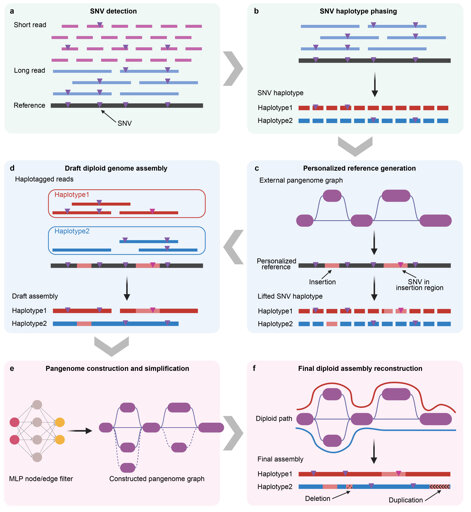
A research team led by Zhen-Xing Endowed Professor Jian Yang at the School of Life Sciences, Westlake University, has developed a pangenome-informed genome assembly (PIGA) method. By combining a cost-effective hybrid sequencing strategy of long and short reads, the team successfully constructed a pangenome for more than 1,000 individuals. This achievement breaks through the limitations of previous small-sample pangenomes and provides a critical foundational infrastructure for medical and population genetics research. The study is published in the journal Nature.
From Biology News - Evolution, Cell theory, Gene theory, Microbiology, Biotechnology via This RSS Feed.
You must log in or # to comment.