

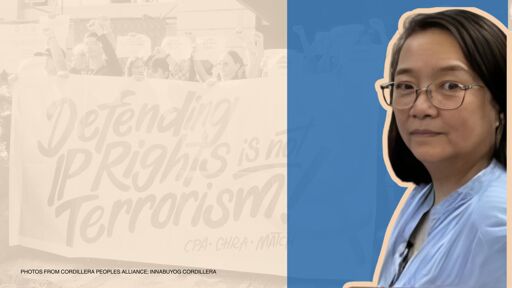
“There is strength in continuing the struggle.”
BAGUIO CITY – Life was busy but simple for a plantita like Sarah Abellon-Alikes, 66. Her day would start by attending to the needs of her family in Ifugao province. After all her household chores and gardening in her backyard were done, the rest of her time would be dedicated to her work in the church and the local organic farmers’ group where she is an officer.
But this was disrupted after the government had piled up cases against her.
“Now, I am often in the (Baguio) city attending hearings,” she said in Filipino. The shift has taken a toll. She can no longer attend to family responsibilities as she once did, missing school meetings, helping less with farm work, and stepping back from income-generating activities. “Our income has decreased, but our expenses have increased,” she adds.
Alikes also suffered a stroke recently.
Alikes and four other leaders of the Cordillera Peoples Alliance (CPA) were designated as terrorists by the Anti-Terrorism Council on June 7, 2023. Aside from this, Alikes is also facing allegations of violating the Terrorism Financing Prevention and Suppression Act of 2012. Prior to this, Alikes also faced trumped up charges such as arson, robbery, and rebellion, which were later on dismissed by the court.
Uncertainty and fear
Before Alikes and others were designated, her routine would be around both family and the Indigenous community.
Aside from attending meetings, she would also visit members who are in need, and help produce goods like taro chips and peanut butter as part of their organization’s livelihood projects. She also took part in providing training on organic farming, especially for new members, and joined broader activities of farmers’ alliances and church networks.
Alikes is a Kankanay who hails from the Mountain Province. She is a former member of the Regional Development Center – Kattinulong Dagiti Umili ti Amianan (RDC-Kaduami), which delivers development services to marginalized communities in Northern Luzon. She is also a pioneer of the Cordillera Peoples Alliance.
She is also active in their church, the Episcopal Church of the Philippines where her father, the late Bishop Richard Abellon, Sr. served.
Aside from this, Alikes has organized Indigenous communities for the protection of their ancestral lands and the environment against destructive projects, such as large-scale mines and dams. She is also a peace advocate and has been actively campaigning against human rights violations, the intense militarization of Cordillera communities, and political repression.
Even though Alikes believes in the justness of her cause, the designation and the financing terrorism case against her have caused fear and uncertainty.
“We knew the state could do this,” she said, referring to what activists see as efforts to silence dissent. “But when it happened, there is still anxiety.” The law, she said, is new and even lawyers are still studying it. For her, the most alarming aspect is the lack of clear safeguards for those accused—and even for those associated with them. “You can be judged before you even present your side,” Alikes said.
As a result, Alikes said she limited her engagements not only to focus on her legal battles but also to lessen the stress. She finds it stressful that even those who may not fully understand the law were swayed by the government narrative that they are “terrorists.”

Sarah Abelllon Alikes (left side in front) with Windel Bolinet, Jennider Awingan and Stephen Tauli with their counsels during a filing in court. (Photo by Sherwin De Vera)
Pushing back
For Alikes, it is necessary to push back against attempts of silencing those who are questioning the status quo. Through the help of human rights in the Cordillera and the National Union of Peoples Lawyers, Alikes and three others have questioned their designation by the Anti-Terrorism Council at the level of the local court in Baguio City.
Read: 4 Cordillera rights defenders challenge ‘terrorist’ designation in court
She also questioned charges of financing terrorism against her in 2025 by filing a motion to quash before a local court in Pangasinan. In a report by the Northern Dispatch, Alikes is asking the court to invalidate the indictment, citing the lack of a preliminary hearing, the use of defective information, and double jeopardy.
Double jeopardy means that if the court has already made a final decision about a case, whether guilty or not, the person cannot be charged again for the same offense. In Alikes’ financing terrorism case, the Department of Justice used again the 2017 case against her which is arson and robbery. This case was already junked by the court due to lack of evidence.
A local court in Abra also cleared Alikes and five others of the rebellion case in 2023 due to lack of probable cause.
Women rights defenders as targets
In the past years since the administration of former president Rodrigo Duterte, several activists and non-government organizations were slapped with financing terrorism charges because it aims to be delisted from the Financial Action Task Force’s “grey list” or list of countries under increased monitoring due to “weaknesses in fighting financial crimes, like money laundering and terrorism financing.”
The Financial Action Task Force (FATF) is an international body that sets standards for these crimes. In 2025 the National Union of People’s Lawyers (NUPL) and the Council for People’s Development and Governance (CPDG) released a study that looked into the impacts of the government’s compliance to the FATF to be delisted from the grey list.
According to the study entitled Playbook of Repression: Civil Society Report on the Misuse and Abuse of Combating the Financing of Terrorism (CFT) Measures in the Philippines, the enactment of the Terrorism Financing Prevention and Suppression Act of 2012 and the Anti-Terrorism Act of 2020 are actually a result of the FATF recommendations on anti-money laundering and counter-terrorism financing. The NUPL decried the weaponization of these laws against members of civil society organizations, like the case of Alikes and other leaders of CPA, which they said, “undermining the positive role of CSOs in protecting and uplifting marginalized communities and promoting human rights and social justice in the Philippines.”
The study showed that the majority of terrorism financing cases were filed against women activists.
Based on Bulatlat reports there are 37 women were charged with financing terrorism charges:
- Four nuns from the Rural Missionaries of the Philippines-Northern Mindanao Region with 55 counts of financing terrorism.
- Union of People’s Lawyers in Mindanao Secretary General Czarina Musni
- Hanelyn Cespedes, Jhona Stokes, Mary Louise Dumas, and Aileen Villarosa of “RMP-NMR 16”
- Community journalist Frenchie Mae Cumpio and church worker Mariel Domequil;
- Estrella Flores-Catarata, Geraldine Labradores, Ester Delfin, Evelyn Abella, Nancy Ugsad Estolloso, Rebecca Quimada-Sienes, Dulce Pia Rose, Maria Ira Pamat, Dr. Petty De Castro, Crescenciana Labitad, Cristina Muñoz (deceased), Teresa Claire Alicaba (deceased), Alma Ravacio Garcia, and Katrina Genturales Coloso of “CERNET 27”;
- Alaiza Mari Lemita (financing terrorism case dismissed due to lack of evidence);
- Marcylyn Pilala;
- Perla Pavillar of Paghida-et sa Kauswagan Development Group, Inc. (financing terrorism case dismissed);
- Petronila Guzman and Myrna Zapanta of Kaduami (financing terrorism case dismissed for failing to establish probable cause) ;
- Sarah Abellon-Alikes of CPA;
- Jazmin Aguisanda-Jerusalem, Leyte Center for Development and Empowerment (LCDE) executive director;
- Cagayan Valley women human rights defenders Cita Managuelod of Kilusang Magbubukid ng Pilipin as, Karapatan human rights worker Jackie Valencia, and Makabayan-Cagayan Valley coordinator Agnes Mesina;
- Lieshel Mendoza, Liezel Merchales, and Yulesita Ibañez:
Note: Names were aggregated from Bulatlat’s Archives | PH Terror Law’s Impacts on Human Rights and Democracy
While the Philippines was officially removed from the Financial Action Task Force grey list in February 2025, the NUPL said civil society in the country continues to face constraints, as freezing of bank accounts of individuals facing designation and terrorism financing charges has limited both organizational operations and personal activities.
“Financial sanctions are not aimed at disrupting terrorism but at shutting down legal aid, humanitarian work, and human rights advocacy. What FATF calls ‘compliance’ has become cover for repression,” NUPL Secretary General Josalee Deinla said in its submission to the United Nations last June 2025.
Solidarity
Alikes said it was in college when she decided to dedicate her life in this path that she chose. She said growing up, she has witnessed inequalities. “Yes, I aimed for a better life because that is what my parents also told us,” she said.
But over time, her understanding of systemic injustice deepened.
“I realized that justice and a good life for all cannot exist while a few exploit the many,” she said.
“So I made a choice. I chose to respond by raising awareness, organizing, and mobilizing my fellow citizens, and together with them, to fight for our welfare, even if it takes a long time before the results of our efforts are felt,” she added.
Alikes admitted that the path that she has chosen is not easy. “It’s exhausting. Sometimes painful, especially when we lose people along the way. But it’s a path I have chosen.”
This is why, she said, support from fellow women human rights defenders has been crucial. She said that even as some face legal challenges, others continue organizing, attending hearings, and sustaining campaigns against unjust designations and other forms of human rights violations.
“There is strength in continuing the struggle,” she said.
While it is the government that filed cases against them, Alikes still sees hope in the legal battle she and other women human rights defenders are facing. She said it remains part of the process, and as long as there are positive aspects in the legal arena, they will continue to pursue justice.
“We know the system is flawed,” she says. “But we also believe there are still people within it who are doing their work with integrity.”
Amid the weight of legal battles and public scrutiny, Alikes still finds grounding in simple joys. She describes herself as a “plantita,” someone who loves growing both edible and ornamental plants, a hobby she has had little time for lately. She also enjoys caring for animals and crocheting when she can. (RVO)
Author’s note: This interview was conducted before Sarah Abellon Alikes suffered a stroke. The Cordillera Peoples Alliance are calling for support for her treatment and other medical needs.
DISCLOSURE: Bulatlat produced this article through a grant from the Asia Pacific Forum on Women, Law and Development – Feminist Media Fund for Alumni.
The post Sarah Alikes, a mother and human rights defender appeared first on Bulatlat.
From Bulatlat via This RSS Feed.
You must log in or # to comment.