

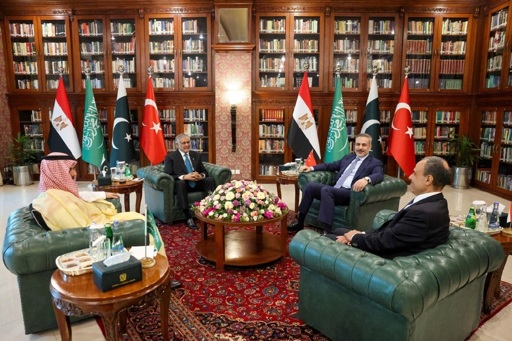
On March 29, Saudi Arabia, Turkey, Egypt, and Pakistan met to discuss the ongoing U.S.-Israel War on Iran. More than a mere diplomatic initiative, this meeting points to a military-strategic alliance in formation. It is not a formal organization or a treaty, but something more unstable: a coalition of necessity.
The stated objective of the meeting is to reduce the intensity of the conflict with Iran, move toward a ceasefire, and build a negotiating framework that can be presented to both Tehran and Washington. In the best-case scenario, they could even act as guarantors of a potential agreement and prevent further escalation.
But these stated goals are only part of the plan. To interpret this meeting solely in diplomatic terms would be a mistake. The truth is a bit more complicated: these countries are in fact attempting to redefine the regional balance and simultaneously contain Iran’s power and Israel’s expansionist momentum.
A Delicate Balance
The war has reduced the capacity of Iran to project power in the Arab world and has limited its influence in theaters like Syria, Iraq, and the Gulf. But this same weakening carries a greater risk: a disorderly collapse that could unleash uncontrollable dynamics. Turkey’s position clearly summarizes this dilemma. Ankara would prefer an Iran weakened enough to withdraw in the Levant, but not so weakened as to open unstable fronts in the Kurdish world or on the Caucasus border.
Saudi Arabia shares this logic, albeit from a different perspective. Riyadh seeks to reduce Iranian pressure on the Gulf, but cannot afford a systemic disruption that affects the global energy flow upon which its own stability depends. It is from this shared calculation of interests, that the Islamabad coalition was born.
An Alliance Defined by its Absences
The absence of the United Arab Emirates, Kuwait, Bahrain, and Oman — all members of the Gulf Cooperation Council — reveals a silent fracture in the regional system.
The Emirates are wary of any initiative involving dialogue with Tehran and maintain a stance more aligned with the United States and Israel. Meanwhile, Oman, the traditional mediator between Washington and Tehran, has been sidelined for a structural reason: its discreet diplomacy works in localized crises, but not in a regional war. The center of gravity has shifted.
Qatar, for its part, was also absent. Although it favors an end to the war, it has chosen not to assume an active mediating role following the Iranian attack on key infrastructure such as Ras Laffan. Doha’s caution reflects the extent to which even the most dialogue-minded actors are recalibrating their positions.
Pakistan: Mediator by Necessity
Unlike these other state actors, Islamabad is much more structurally obligated to attempt to stabilize the conflict. Its energy dependence on the Middle East, the weight of remittances from the Arab world, and the internal pressure generated by the war — rising prices, protests, and sectarian tensions — make the crisis a direct threat to its stability.
In fact, instability has already seeped within its borders. Attacks against Iran and the death of Ayatollah Ali Khamenei triggered violent riots in cities like Karachi, leaving dozens dead and causing a sharp deterioration in internal order. For Islamabad, war is not an external scenario, but a vector of domestic destabilization.
Hence, its role has extended beyond traditional mediation. Pakistan is not only transmitting messages between the combatants in the war, but also attempting to preserve the very conditions of the negotiation. According to various reports, it has even intervened to prevent the elimination of key figures in the Iranian leadership, recognizing that diplomacy is impossible without interlocutors.
A Block with Internal Stresses
The coalition has a shared goal, but it is far from homogeneous. Turkey and Egypt have competed for influence in Libya, although they have recently begun a rapprochement. Ankara and Riyadh hold differing visions of the regional order. Egypt is financially dependent on Saudi Arabia, but resists any strategic subordination.
However, they all share one constraint: none can afford for the war to continue. Egypt depends on the Suez Canal, Saudi Arabia on the flow of energy through Hormuz, Turkey on the regional energy balance, and Pakistan on the stability of the Gulf. They are not united by a common project, but by the need to avoid a catastrophic outcome.
The urgency of this fear was laid bare on Monday when Egyptian President el-Sisi implored Trump to end the war. The armed conflict has caused “two shocks: the scarcity of supplies and the rise in prices,” something that, he added, “rich countries could absorb, but whose repercussions would be very harsh on nations with developing or fragile economies.”
As Yasmine Farouk, a specialist at the International Crisis Group, points out, the region has entered a particularly dangerous phase: the risk is no longer just the continuation of the war, but its transformation into a systemic crisis, capable of affecting critical infrastructure and unleashing irreversible consequences in the Gulf.
The End of an Illusion
For years, Israel promoted the idea of an “Arab NATO” aligned against Iran. At times, especially under Joe Biden’s presidency, that project seemed viable.
But the war has altered that scenario. Today, much of the Arab world seems to believe that the conflict has exceeded any logic of containment and has opened the door to widespread destabilization.
The result is paradoxical: instead of consolidating a pro-Israeli bloc, the war is accelerating the formation of a more autonomous security architecture, where the priority is not alignment, but avoiding regional collapse.
An Opportunity for Turkey?
The existence of the Islamabad coalition does not automatically guarantee an end to the war. Nor does it ensure the long-term sustainability of the region. However, it has already produced some concrete results: limited confidence-building agreements, such as the passage of Pakistani ships through the Strait of Hormuz, and the consolidation of the Quartet as the main channel of dialogue with Iran.
But its significance runs deeper. The Middle East is entering a phase in which regional powers are attempting to manage the strategic balance themselves, following the failure of the U.S. security umbrella. At the same time, it is significant that, after the meeting, Pakistan’s Foreign Minister flew to China to brief Beijing on the crisis. Within Iran, the role of China as guarantor of any agreement has been raised, a scenario difficult for the United States to accept.
In this context, Turkey seeks to position itself as a stabilizing power. Faced with the Gulf monarchies’ fears of Iranian destabilization — and, simultaneously, of an uncontrolled escalation fueled by Israel — Ankara presents itself as an actor capable of forging a relatively stable regional balance. And the warnings from their top foreign policy officials point in that direction.
Before the meeting, İbrahim Kalın, head of Turkish intelligence, stated: “Among the intended goals of this war is not only the elimination of Iran’s nuclear capabilities, but something far more dangerous: laying the groundwork for a conflict that could last for decades among the region’s founding nations — Turks, Kurds, Arabs, and Persians. This would pave the way for a protracted civil war and bloody reprisals.” He added: “We know very well that those who started this war are trying to create new realities on the ground in Lebanon, Syria, the Palestinian territories, and elsewhere through policies of destruction, annexation, and occupation. Iran’s attacks on the Gulf states are unacceptable. But we must never forget who started the war.” For his part, Hakan Fidan, Turkey’s foreign minister, argued in a lengthy television interview that “The Gulf states must not fall into Israel’s trap.”
In this sense, Turkey’s strategy is not merely defensive. It is also an opportunity. The combination of Iran’s weakening, Israel’s strategic aggression, and the United States’ diminished role as arbiter is creating a space that Ankara is attempting to fill. The struggle for control of the Gulf has begun, reigniting the ambitions of a Turkey that once again envisions itself as an imperial power.
Originally published in Spanish on March 31 in La Izquierda Diario.
The post The Coalition Seeking to Contain Chaos in the Middle East appeared first on Left Voice.
From Left Voice via This RSS Feed.