

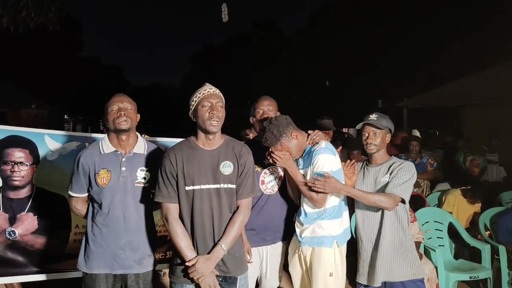
Vigário Luís Balanta, activist and President of the Pó di Terra Revolutionary Movement, was killed in what political organizers and activists consider to be a politically motivated assassination, deepening concerns over the deterioration of basic rights and rule of law in Guinea-Bissau.
Balanta’s body was discovered abandoned on the outskirts of Bolanhas de N’Dam on Tuesday, approximately 30 kilometers from the capital, Bissau. Images circulating from the scene show the activist without shoes, with torn clothes, visible injuries, and bloodstains, suggesting he was tortured and violently assaulted.
The killing has caused widespread condemnation, including from the African Party for the Independence of Guinea and Cape Verde (PAIGC), which described the incident as a “barbaric and cowardly act”. In a statement, the party said it was “deeply saddened and shocked” by the killing, noting that Balanta had been “on the front line in the fight and defense of freedom of expression and the rule of law and democracy.”
Warnings of growing repression
The PAIGC further warned that such acts reflect a troubling pattern of repression, calling for the “respect of plurality, opinion and preserving peace and human life.” The party also expressed solidarity with Balanta’s family and urged citizens and activists to remain steadfast “in the fight against attempts to implement tyranny.”
Balanta was known as a vocal critic of what opposition groups describe as constitutional violations by the current regime. His death comes against the escalating political tensions following a disputed electoral process and a broader climate of institutional instability.
Read more: Election results withheld after “staged” coup in Guinea-Bissau; opposition cries foul
Analysts claim a coup was carried out Guinea-Bissau to safeguard the outgoing president, Umaro Sissoco Embaló, after he faced defeat in the elections. Since then, members of the opposition have increasingly been targeted.
Read more: Guinea-Bissau: A coup staged to protect the neocolonial order?
According to Don Kyller Jano, Deputy Coordinator of the Association of Revolutionary Pan-Africanist Youth of Guinea-Bissau and organizing member of the All-African People’s Revolutionary Party (A-APRP), the country has been experiencing “a spiral of degradation of the rule of law,” characterized by weak oversight institutions, growing mistrust among political actors, and increasing reports of intimidation and repression.
Jano linked Balanta’s killing to a wider pattern of violence targeting dissenting voices and civil society actors. He told Peoples Dispatch, “This act goes beyond conventional political violence, constituting a deliberate message of terror directed at all those who dare to organize, think, and act outside the lines imposed by the ruling power.”
Recent months have seen mounting allegations of arbitrary detentions, surveillance, and attacks on members of the opposition and civil society organizations, particularly those associated with initiatives such as the Social Pact for the Return to Constitutional Legality. These developments, he says, point to a shrinking civic space and a normalization of political violence.
“I myself have been a direct target of these actions, which has forced me into constant relocation and the abandonment of spaces for personal safety,” Jano says.
He argues that Balanta’s killing is aimed at silencing opposition and weakening organized resistance. His role in grassroots mobilization and political education, particularly through youth and Pan-Africanist initiatives, had made him a prominent figure in movements advocating structural change in the country.
“I recall, with deep emotion and political clarity, the last conversation we had about the educational and ideological project being developed by the Association of Young Pan-Africanist Revolutionaries of Guinea-Bissau (AJOPAR). Upon learning of the initiative, he responded enthusiastically, calling it great progress,” the PAIGC activist added.
A call for continued struggle and unity
Nevertheless, Jano affirms that the brutal killing of Balanta marks what he described as the beginning of “a new phase of revolution and political consciousness.” Reiterating that “his death will not be in vain,” but would instead serve as fuel to intensify the struggle and deepen commitment to the emancipation of the people of Guinea Bissau.
“This is a moment that demands organization, strategic clarity, and unity among all progressive forces,” he emphasized, and also issued a call to progressive organizations worldwide to support efforts toward political education and internationalist solidarity, anchored in social justice and the liberation of peoples.
He described the current moment as “extremely difficult and painful,” citing reports of increased detentions of civilians, some whose whereabouts remain unknown, as well as a growing number of bodies being discovered on the outskirts of Bissau, particularly in riverside areas. These developments, he says, reveal the repressive and dangerous nature of the current political environment.
“It is precisely at times like these that history demands greater awareness, stronger organization, and more decisive action. The struggle continues,” Jano emphasized.
As the call for investigations into the killing of Balanta, and for justice and accountability continue to grow.
At a vigil held on the evening of April 1, a comrade of Vigário affirmed: “The struggle does not stop here…he is with us, he is with us in spirit, through the vision he had.”
The post Political activist in Guinea-Bissau found beaten to death appeared first on Peoples Dispatch.
From Peoples Dispatch via This RSS Feed.