


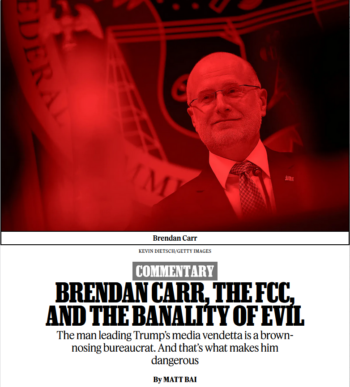
Matt Bai (Rolling Stone, 3/17/26): “Carr’s crackdown on news outlets and tech platforms has drawn comparisons to some of history’s notorious repressive movements.”
It’s not exactly breaking news that President Donald Trump endlessly attacks the media, or that his administration lapdogs quickly echo his gripes. But there’s one official who has stood apart, and he’s done so by not only mimicking Trump, but by remaking the US media in his boss’s image, most recently by rushing through local TV broadcast giant Nexstar’s takeover of Tegna.
“Unlike his predecessors, Carr isn’t just another corporate lawyer,” Rolling Stone’s Matt Bai (3/17/26) wrote about Brendan Carr, Trump’s Federal Communications Commission chair:
He is a cultural claims adjuster, a pasty-faced, soft-spoken agent of Trump’s retribution. If you were going to single out the most dangerous functionary in Trump’s little circle of Hell, you’d have plenty of candidates…. But don’t sleep on Brendan Carr. His legacy of awfulness may yet prove more durable.
Trump, unsurprisingly, is a big fan. Carr is “perhaps the most powerful man in this room,” Trump said at a recent White House event honoring the US Naval Academy football team (Guardian, 3/27/26). “He’s trying to make the fake news real and respected again, which is not an easy job.”
‘Results so far’
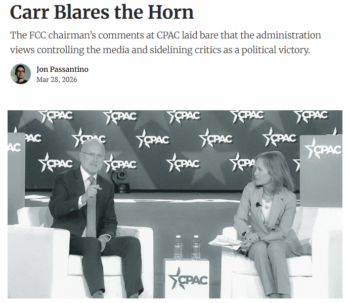
Jon Passantino (Status, 3/28/26): “The FCC chairman made clear that the ‘free speech’ he claims to protect is being wielded as a tool in a partisan battle over who controls the nation’s most powerful media platforms.”
Carr is more than happy to list for you what he’s done to earn such high praise. “Look at the results so far,” Carr crowed late last month at the Conservative Political Action Conference in Texas:
PBS, defunded. NPR, defunded. Joy Reid, gone from MSNBC. Sleepy-eyes Chuck Todd, gone. Jim Acosta, gone. John Dickerson, gone. Stephen Colbert is leaving. CBS is under new ownership, and soon enough, CNN is gonna have new ownership as well.
Carr’s comments marked a departure from the norm. Wrote Status’ Jon Passantino (3/28/26):
For a sitting FCC chairman—an official tasked with overseeing the nation’s communications infrastructure in an even-handed manner and upholding the agency’s independence—the remarks to a partisan political conference amounted to saying the quiet part out loud. The administration views the news media not as an institution to be protected, but as an enemy to be silenced and controlled—and that’s exactly what they’re doing.
‘GET THAT DEAL DONE!’
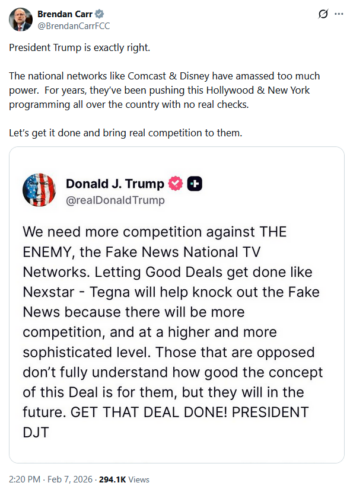
Brendan Carr (X, 2/7/26): Trump was “exactly right” when he said that the Nexstar/Tegna merger was a blow against “THE ENEMY.”
Carr’s comments at CPAC, while in line with the swashbuckling persona he’s adopted ever since Trump elevated him to FCC chair last year, were indeed jarring. So much so, that I initially missed what he’d left off his list of accomplishments.
Just a week earlier, Carr had approved a merger creating “the largest broadcast conglomerate in US history” (Free Press, 3/26/26). And he’d done so at the behest of his boss.
“We need more competition against THE ENEMY, the Fake News National TV Networks,” Trump posted in February on Truth Social (2/7/26), his social media platform:
Letting Good Deals get done like Nexstar–Tegna will help knock out the Fake News because there will be more competition, and at a higher and more sophisticated level…. GET THAT DEAL DONE!
Hours after Trump came out in support of the merger, reversing his earlier position, Carr dutifully reposted his boss’s message on Twitter (2/7/26), adding: “President Trump is exactly right…. Let’s get it done.”
Unprecedented—and illegal
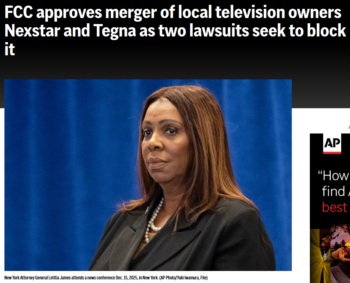
New York Attorney General Letitia James (AP, 3/19/26): “If this merger moves forward, cable prices will spike for consumers in New York and across the country.”
Carr’s gung-ho public statement may have pleased Trump, but it came as Carr’s agency was purportedly reviewing Nexstar’s $6.2 billion takeover of Tegna. And there was plenty to review, since Nexstar was already the country’s largest local TV network, and post-merger would grow to 265 stations in 44 states and DC (AP, 3/19/26)—a size that wouldn’t just be unprecedented, but illegal.
No local TV network can reach more than 39% of US households, according to the law. In its new configuration, Nexstar would reach 80% of American homes, more than double the legal limit.
Nevertheless, Carr did as Trump instructed, and his agency, after exempting Nexstar from the legal cap on ownership, approved the deal.
While legally problematic, Carr’s move would make for political catnip at CPAC. Yet as he beat his chest at the conference, Carr didn’t highlight his most recent, and possibly most significant achievement. Why not?
Like his father—who represented former President Richard Nixon—Carr is an attorney. And as he looked out at the CPAC attendees, Carr may have worried that gloating over the Nexstar merger might place the deal in further legal jeopardy—and it was already in more than enough.
‘You are going to lose’
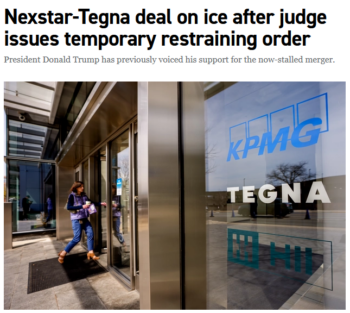
Judge Troy Nunley (Politico, 3/28/26) ruled that Nexstar and Tegna‘s “integration efforts” would “eliminate competition, and result in newsroom layoffs and shutdowns.”
Indeed, only hours after Carr spoke, the hammer came down when a federal judge issued a temporary restraining order, pausing the merger. “A judge just held up a middle finger to Trump FCC chair Brendan Carr,” wrote anti-trust expert Matt Stoller (Big, 3/29/26), who noted the judge’s order “pretty much called out…Carr for corruption, and essentially told the two companies, ‘You are going to lose this merger case.’”
It’s not hard to see why. Before Carr approved the merger, the attorneys general from eight states filed an antitrust lawsuit to block it, as did DirecTV. “But just hours later,” Politico (3/28/26) reported,
the Federal Communications Commission approved the merger, bypassing a longstanding cap on the number of viewers a broadcaster can reach nationwide.
The FCC’s approval was also suspect, as it came “without a full commission vote, and in tight coordination with the merger applicants themselves, who purported to close the deal mere minutes after the order’s appearance,” wrote Matt Wood (Pressing Issues, 3/31/26), an executive at the media advocacy group Free Press, which is part of a public interest coalition that has also sued to stop the Nexstar/Tegna merger.
Even Sen. Ted Cruz, a Trump ally, said the merger should have received a full commission vote (Guardian, 3/27/26).
“I can’t describe how corrupt and crazy that sequence of events is,” wrote Stoller, the antitrust expert. “You simply do not run roughshod over processes like that.”
But Carr was willing to do so for Nexstar, because it had proved its loyalty to Trump.
‘The easy way or the hard way’
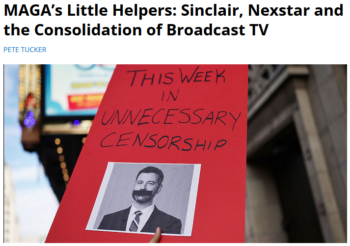
FAIR.org (10/8/25): “Nexstar’s announcement came only hours after Trump FCC chair Brendan Carr publicly threatened ABC stations if they didn’t yank Kimmel.”
In the wake of right-wing activist Charlie Kirk’s September assassination, late-night host Jimmy Kimmel’s (innocuous) comments angered the right. Sensing an opportunity to silence Kimmel, a Trump critic, Carr sprang into action, publicly threatening ABC affiliates if they didn’t yank Kimmel’s show. “We can do this the easy way or the hard way,” Carr famously threatened.
Hours later, Nexstar became the first network to heed Carr’s call and cancel Kimmel’s show on its ABC affiliates. Carr promptly praised the company “for doing the right thing” (X, 9/17/25), adding, “I hope that other broadcasters follow Nexstar’s lead.” And Sinclair, the second-largest local TV station network, did just that.
Ultimately, the networks relented in the face of public pressure and resumed airing Kimmel’s show, with Nexstar the last to buckle.
While Carr applauded the networks, others were alarmed at their actions. “If you suspended a late-night comedian’s show in part to seek regulatory favors from the administration,” Elizabeth Warren and three fellow Senate Democrats wrote to the CEOs of Nexstar and Sinclair (which had also lobbied the FCC), there was “the appearance of a possible quid-pro-quo arrangement that could implicate federal anti-corruption laws.”
‘Pro-Trump garbage’
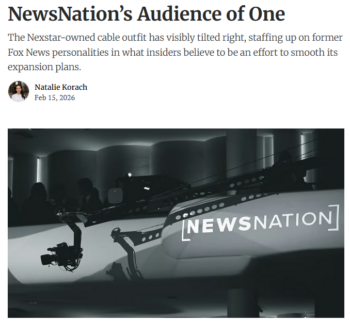
Natalie Korach (Status, 2/16/26): Nexstar‘s “NewsNation has increasingly leaned on a roster of hosts with conservative bonafides,” and “the network has repeatedly hired former Fox News talent.”
The Kimmel saga was far from the only instance in which Nexstar had demonstrated its loyalty to Trump. Status’ Natalie Korach (2/16/26) reported:
Current and former employees say the network, long marketed as an “unbiased” alternative to traditional cable news, has pivoted rightward in what some view as a transparent effort to curry favor with Trump’s FCC.
The change has been hard to miss over at NewsNation, Nexstar’s news channel, which has served as a landing pad for former Fox News hosts, like Katie Pavlich, who secured a primetime slot, much to Carr’s liking. Pavlich’s first guest was none other than Donald Trump—which fits nicely with her tendency to promote what a NewsNation staffer characterized as “pro-Trump garbage.”
While Pavlich’s ratings are poor, when Trump alone holds the keys to the network’s desired expansion, “how much do ratings matter to Nexstar executives?” Status (2/15/26) asked in a story headlined “NewsNation’s Audience of One.”
Nexstar’s approach has borne fruit. As company CEO Perry Sook noted on a February earnings call in which he saluted Trump, “Having the endorsement of the nation’s chief executive doesn’t hurt in the regulatory agencies.”
A successful fusion of Nexstar and Tegna would further erode the need for actual viewers. As the advocacy group Free Press (3/23/26) pointed out,
“One of Nexstar’s stated goals for this merger is to extract higher fees from pay-TV providers—which are ultimately paid by subscribers.” Free Press added:
In addition to costing viewers more, Nexstar wants to serve them less. After past mergers, in market after market, Nexstar has closed newsrooms and cut reporters. Nothing stops it from doing the same here.
‘Great wins from presidents’
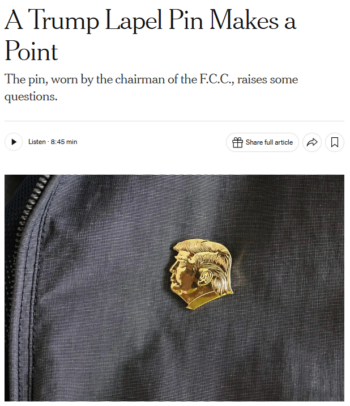
Republican strategist Ron Bonjean (New York Times, 4/22/25): Carr “wearing this new pin communicates a higher level of commitment to President Trump.”
Even if the Nexstar/Tegna merger is permanently stopped in court, Carr’s tenure atop the FCC—only 15 months and counting—will be felt for years to come, as the US media rapidly consolidates in the hands of Trump loyalists.
The scope of Carr’s project could be glimpsed on his lapel. A couple months into his chairmanship, Carr “decided to swap out his usual American flag lapel pin,” the New York Times (4/22/25) reported. “Instead of the stars and stripes, he pinned a gold medallion in the shape of President Trump’s profile, about the size of a quarter, to his blue suit.”
Such a move has little precedent, at least in America. The Times compared it to “China under Mao Zedong, where wearing a lapel pin in the form of Mao’s profile became a widespread sign of commitment.”
And now Carr is demanding similar commitment from US networks, as he launches his Pledge America campaign to celebrate the country’s 250th birthday. To celebrate the occasion, broadcasters should “run patriotic, pro-America programming,” Carr told CPAC:
You can start the day with a Pledge of Allegiance, you can run all sorts of programming highlighting the great wins from presidents from George Washington all the way up through President Trump.
But for Matt Wood, “the FCC calling for propaganda while labeling it as ‘patriotism’ does nothing to disguise the ugly, chilling impacts.”
From FAIR via This RSS Feed.