

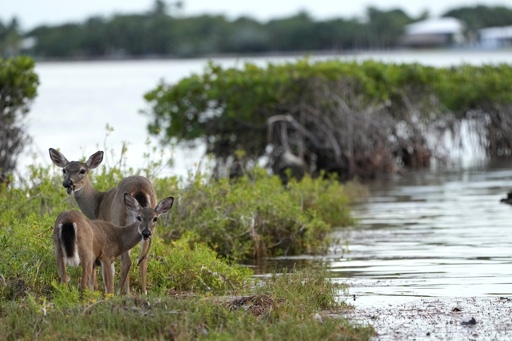
With their dense mats of submerged roots, mangrove forests hold down shorelines worldwide like a coastal Swiss Army knife. They’re a nursery for juvenile fish and a home for important species in and out of the water. They’re also a filtration system for pollution, a holdfast against erosion, and a speed bump that slows incoming waves. But even the best of tools could occasionally use backup. A new study in the Proceedings of the National Academy of Sciences examines how combining mangrove restoration with water-directing dikes might multiply these ecosystems’ protective abilities even further, particularly as climate change worsens storm surges and raises sea levels. As a hydrologist by training, Timothy Tiggeloven, lead author and environmental researcher at Vrije Universiteit Amsterdam, is particularly interested in how to manage unruly water by combining natural defenses (“green” infrastructure) with manmade creations (“gray” infrastructure) like dikes and levees. Though mangroves naturally reduce the height and power of waves, they don’t stop all of the water from a storm or flood from moving inland. “So here comes this synergy of combination,” Tiggeloven said. “If you have a dike behind a mangrove, it will prevent the water from flowing over [onto land]. While if you only have dikes, they will be hit by the waves and there will be an overtopping. Having those two together is actually a very smart idea.” So, Tiggeloven and his colleagues developed a computer model to assess where this combination would be most effective, and how the hybrid defenses might…This article was originally published on Mongabay
From Conservation news via This RSS Feed.