

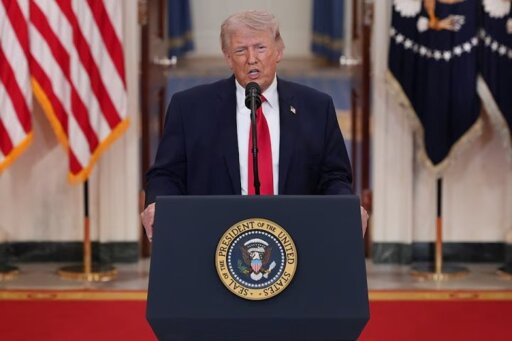
Donald Trump’s speech delivered Wednesday night was surrounded by anticipation (and also some anxiety) as rumors circulated in the days leading up to it regarding its content: would the president announce a U.S. withdrawal from Iran under the pretext that his administration had already achieved its military objectives? Or would he announce a new escalation that could lead to a ground invasion? The reality is that Trump’s speech was neither.
In his speech, Trump tried to convince the American people (yet again) that the war is practically won and that Operation Epic Fury is a resounding success. He reiterated that the U.S. military had destroyed Iran’s ability to pose any kind of threat to the United States: that they had completely destroyed Iran’s fleet and air force, and that it had few missiles left with which to launch attacks in the Middle East. This claim might have been more credible were it not for the fact that earlier that day Iran launched a missile attack on Israel, considered by various media outlets to be the largest since the start of the war. In addition, Iran continues to attack infrastructure in Gulf countries.
However, Trump went on to say that the objectives of Operation Epic Fury had almost all been achieved and that, despite claiming that his administration hadn’t sought to change the Iranian regime — an obscene lie considering the numerous statements by U.S. officials who expected the Iranians themselves to overthrow their government after the initial attacks — they had effectively succeeded after the assassination of key figures and the installation of officials “more willing to negotiate” with the United States. Nevertheless, Trump said the war would continue “for two or three weeks” and again threatened to destroy Iran’s energy infrastructure if it continued fighting. The president warned the United Dtates would bomb Iran “back in the Stone Age where they belong.” A display of the pure and simple arrogance of U.S. imperialism.
Regarding the Strait of Hormuz, whose closure by Iran is causing fuel price increases and generating a supply crisis whose effects are already being felt worldwide, Trump practically chose to ignore it: he claims the United States doesn’t need the oil and gas transported through the strait, since it is basically “self-sufficient,” and now has Venezuela’s reserves. However, Trump alluded to European imperialism, suggesting those countries have to take on the task of reopening the strait and “protecting their oil.”
It goes without saying that the United States is not self-sufficient and that the oil it steals from Venezuela is not enough. But this declaration has two clear objectives: to punish NATO allies who have refused to actively participate in the war against Iran by shifting the blame for the reopening of the Strait of Hormuz onto them, and also to disguise the fact that the United States is unwilling to undertake a military operation of such scale, fearing it could have an unacceptable cost for the American people, for whom the war is already extremely unpopular.
Regarding the economic effects of the Strait of Hormuz closure, Trump said the price increases were “short-term” and proceeded to praise his economic program, claiming he had eliminated inflation and that the American economy was stronger and more prosperous than ever. This is difficult to believe for average Americans who are seeing the price of a gallon of gasoline climb to $4 ($6 on the West Coast) and are facing the specter of rising inflation that will further erode purchasing power. This is a politically dangerous situation for Trump, whose approval ratings are at an all-time low, with midterm elections in a few months. Trump also seemed to ignore the recent No Kings mobilizations, some of the largest protests in U.S. history, whose main slogans included “no war.” It’s unlikely that the 8 million people who took to the streets will be appeased by Trump’s rhetoric.
Furthermore, if Trump sought to calm the markets with his national address, he achieved the opposite: the price of oil rose by 4 percent immediately after his speech, while the stock markets of Japan and South Korea also experienced declines.
Trump’s message was a true reflection of his administration’s current situation and the United States’ position in the Middle East: with the possibility of a swift victory thwarted, lacking clear strategic objectives, and facing a self-inflicted fuel price and supply crisis, Trump and his administration are desperately searching for a way out of the mess they created, while their allies prefer to turn their backs on them (not for humanitarian reasons, but to preserve themselves), and the American people are clearly demonstrating their weariness with this imperialist adventure. If the possibility of a genuine U.S. victory still exists, it becomes less likely with each passing day.
Originally published in Spanish on April 2 in La Izquierda Diario.
The post Trump’s National Address Can’t Mask the Crisis His War is Causing appeared first on Left Voice.
From Left Voice via This RSS Feed.