


Miles Morrisseau
ICT
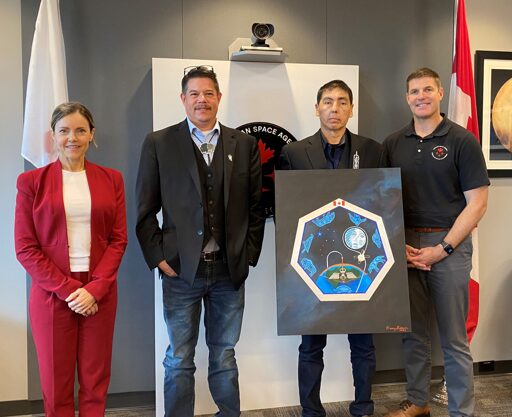
Canadian astronaut Jeremy Hansen is wearing a badge on his flight suit that represents the Anishinaabe seven sacred teachings. The badge was designed by artist Henry Guimond in consultation with David Courchene of the Turtle Lodge, located on the Sagkeeng First Nation.
The badge features the wolf, the bear, the turtle, the eagle, the beaver, the buffalo and the sasquatch. Each creature represents the values that define the seven sacred laws.
Hansen is the first Canadian to make a trip to the moon and the first time a NASA mission has made the journey in over 50 years.
The Canadian Space Agency detailed the importance of the patch in an astronaut’s mission.
“Patches are an integral part of space culture. When a crew is assigned to a mission, NASA creates a patch for them,” the agency stated in a news release. “Usually, when an astronaut belongs to a space agency other than NASA, that agency also creates a personal patch for its crewmember. The patch reflects the mission objectives and some personal preferences of the astronaut who wears it proudly both on Earth and in space.”

Original painting of Jeremy Hansen’s mission patch by Henry Guimond. Credit: Canadian Space Agency
Guimond, Courchene and Hansen — the three who contributed to the design — discussed the symbolism of the patch in an interview posted to the Canadian Space Agency’s website.
“Grandmother Moon has always been like, just so connected with the Earth, with life. And seasons. It’s just to say that she’s sacred. So sacred,” Guimond said. “Everything that’s living on the Earth, all connected with her.”
Courchene stated that the patch represents an opportunity for Indigenous people’s knowledge and teachings to be shared with the world and beyond.
“As Indigenous people, we’ve never been given an equal opportunity to contribute or seen as equals within our own homelands. By saying that though, our elders will say we have yet to give our greatest contribution to the world. And part of that to me is what we, we’re referring to as the seven sacred laws,” Courchene said. “These seven sacred laws or values offer us an opportunity to be able to create a foundation of unity.”
Hansen talked about the patch, the teachings represented and how it has helped him prepare for the mission.
“This is a big journey going around the moon, and I just feel ill-prepared as a human to do it and am looking for advice. And so this is – this is represented here in these Indigenous teachings,” Hansen said. “This is a reminder for me on how to walk as I get ready to go on this journey. I am reminded by your artwork on how I need to walk to represent humanity and as I go on this journey around the moon.”
He also reflected on his relationship with Indigenous peoples and ceremony in a video blog posted to the agency’s website.
“Every time I am invited to participate in an Indigenous ceremony, I often feel a little bit uncomfortable showing up. And I’m not sure if I really belong there, but every time I am overwhelmed by how welcomed I am and how loving they are,” Hansen said. “The Turtle Lodge has certainly been one of those great examples of a group of people with an open heart, a loving heart, just adding deep and meaningful value to the Artemis campaign.”
The first two Native Americans in space took keepsakes on their missions. In 2002, John Herrington, Chickasaw, took an eagle feather and a flute made by a Cherokee flute maker. Twenty years later, the first Native American woman to travel to space, Nicole Mann, Wailacki of the Round Valley Tribes, brought along a dream catcher from her childhood.
Artemis II’s goal is to test the deep spacecraft systems for future missions to the moon and Mars. Artemis II is the second step in the larger Artemis’ mission to allow humans to explore the moon and land an American on Mars.
Artemis II launched on Wednesday, April 1 to begin its 10-day journey to the moon and back.
The post Canadian astronaut carries Anishinaabe 7 sacred laws into space appeared first on ICT.
From ICT via This RSS Feed.