


By MICHAEL SCHREIBER

March 28 at the San Francisco Civic Center. (Jeanne Marie Hallacy / Mission Local)
The No Kings mobilization on March 28 was a powerful outcry against the forces of war and reaction. It was the largest single-day outpouring of street protests in U.S. history. The massive flood of people was fueled by widespread opposition to the U.S. and Israeli war on Iran, as well as by the resistance to ICE’s immigrant roundups shown by the people of Minneapolis in the winter.
The March 28 events signaled that millions of people are ready to go into action against the authoritarian and criminally destructive policies of the Trump administration.
Simultaneously, the No Kings / No Tyrants movement saw rallies taking place in at least 15 other nations. Demonstrators came out not only to resist the spread in their own countries of far-right movements and authoritarian politicians—who are generally allies of the MAGA movement in the U.S.—but to protest Trump’s war on Iran. Some 500,000 marched against racism and the far right in London; protesters also came together in Rome, Paris, Madrid, Mexico City, Amsterdam, Sydney, Tokyo, Berlin, Toronto, and other big cities.
In the United States, the size and geographic spread of the protests were remarkable. Over 8 million people marched and rallied in more than 3300 cities, suburbs, and small towns in every state. No Kings organizers reported that two-thirds of participants who signed their lists lived in small town or rural areas—a 40% increase in this demographic over the last No Kings marches in October.
Leah Greenberg—a founder of Indivisible, the major group in the No Kings coalition—commented on this statistic in an interview with “Democracy Now” host Amy Goodman: “Well, what we’re seeing with this march, and all of our data suggests the same when we look at who is organizing new Indivisible groups or new activist collectives around the country, is that the resistance to Trump and to MAGA is reaching farther and deeper and more significantly into red and rural areas than it ever has in the past, in the first Trump term or ever before.”
This was the fourth massive nationwide mobilization since Trump took office for his second term. Each outpouring has been successively larger than its predecessors. Some 3 million people took part in the “Hands Off” protest in April 2025; that was followed by “No Kings” rallies in June 2025 (5 million) and October 2025 (7 million)—surpassed once again by this past Saturday’s over 8 million people.
Indivisible, the major nationwide coordinator of the No Kings rallies, called for “No ICE, no wars, no kings” as the themes of the day—and each of those issues was prominent on the hand-drawn signs that people brought to the marches. Indivisible came together in 2016 by people that had been associated with the campaign of Bernie Sanders and the so-called “progressive” wing of the Democratic Party; since then, it has grown to encompass thousands of local affiliates. Other major forces in the No Kings Alliance include 50501, MoveOn, the ACLU, Public Citizen, and dozens of other organizations, including some national unions. Nationally, some 500 groups sponsored and organized actions.
Huge crowds in the big cities
The turnouts in major cities were immense. According to the organizers, about 200,000 joined the flagship event in St. Paul, Minn.—despite the bitter cold and a sharp wind. It was the largest in Minnesota history, Indivisible co-founder Ezra Levin announced from the stage. The rally took place outside the Minnesota State Capitol in solidarity with the many people from the state who mobilized against ICE several months ago.
The chair of the rally, comedian Liz Winstead, co-creator of “The Daily Show” and founder of Abortion Access Front, stated, “You chased out of this state pure evil. … You chased out the fun-sized fascist Greg Bovino. You chased out that evil Kristi Noem. She’s so evil, I’m starting to think that her dog took his own life.”
Bruce Springsteen performed his song, “Streets of Minneapolis,” inspired by the January killings of Renée Good and Alex Pretti by federal immigration agents. “King Trump’s private army from the DHS, guns belted to their coats, came to Minneapolis to enforce the law—or so their story goes,” he sang. In his introductory remarks, Springsteen mourned the deaths of Good and Pretti but said people’s continued pushback against ICE has given hope to the rest of the country. He concluded, ”This reactionary nightmare, and these invasions of American cities, will not stand.”
Joan Baez and Maggie Rogers sang Bob Dylan’s “The Times They Are A-Changin’.” Baez told the crowd that she first sang it at the 1963 March on Washington with Martin Luther King Jr. “I am honored to be standing in resistance with all of you today in this city on this day in this moment,” Baez said. “Thank you, Minneapolis.”
Large marches were held in all five boroughs of New York City; the major one in Manhattan stretched for over a mile down 7th Avenue and through Times Square. The organizers claimed that 350,000 people participated in the Manhattan march. About 180,000 filled Boston Common, according to estimates by both the police and the rally organizers. An initial count from Indivisible put the crowd in Seattle at from 90,000 to 100,000, and the participants in Los Angeles were expected to top 100,000. Police said that 40,000 marched in San Diego.
Tens of thousands marched in Washington, D.C., crossing the bridge from Arlington Cemetery—where Trump wants to construct a towering victory arch—past the Lincoln Memorial and into the National Mall. Signs read, “Put down the crown, clown!” and “Regime change begins at home!”
Various estimates put the number of marchers in Philadelphia at from 40,000 to 80,000. The total seemed smaller than at the No Kings mobilizations of last year; this was perhaps partly due to the fact that additional marches took place this time in suburban cities and towns—as well as to the unseasonably cold weather. This writer spoke to a woman at the Philadelphia march who told me that her son, a soldier in the Army, had been sent to Bahrain. She was clearly terrified that Trump’s threats to deploy U.S. troops in an invasion of Iranian territory might be carried out and that her son could soon be mobilized in the action.
Several large demonstrations took place in the Bay Area, including 20,000 in Oakland and from 60,000 to 100,000 estimated in San Francisco. Workers’ Voice members in San Jose report that about 10,000 participated in that city’s protest: “We talked with many of them; when we asked what had brought them out, the answer was ‘everything!’ We discussed the cost of the war, and how that could be used for things such as health care and education.”
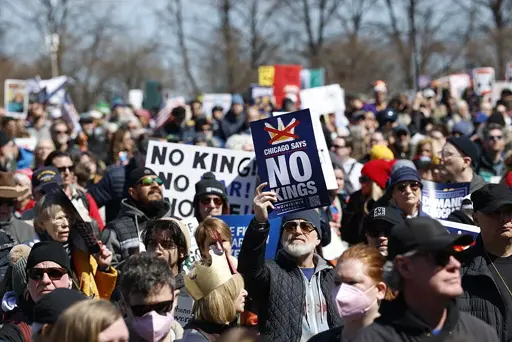
Most sources state that about 200,000 marched in Chicago; the march extended for over a mile. According to a Workers’ Voice reporter in Chicago, the crowd seemed smaller than last October, which took place soon after the National Guard had occupied the city. On the other hand, our reporter wrote, “There were politically sharper signs” than in October, with a younger crowd; “the chants seemed to be largely about abolishing ICE and against war with Iran.”
Around the country, many marchers spoke out for the rights of immigrants. Chants of “ICE out now!” and the earthier “Fuck ICE” were frequently heard on the marches. The necessity to protect civil liberties and democracy—such as the right to vote—was another common theme that was reflected in signs, chants, and interviews.
Many signs addressed the economic problems that working people are facing. Even before the war on Iran, people were increasingly beleaguered by higher prices for food and other necessities, a shrinking job market, and large cutbacks in government spending on social benefits. Signs reminded people: “Gas is over $4!” Another slogan at the rallies was “Money for health care, not for war!” In Atlanta, where a group of trade-union leaders led the thousands who marched toward Georgia’s Statehouse, demonstrators demanded a $25-an-hour minimum wage.
Trump was often the direct target of the slogans that people carried on their signs. This reflected the plummeting poll numbers for Trump as president. A Reuters/Ipsos poll from March 20 to March 23 gave him a 36% favorable rating for his performance in office, compared to a 62% unfavorable rating. The New York Times daily average of polls showed 40% approval and 56% disapproval as of March 27.
Many blasted Trump’s corruption, narcissism, warmongering, lying, sexual assaults and association with pedophiles (i.e., with Epstein), actions against trans people, and racism. A sign in St. Paul had a little square mustache scrawled on a Trump face and proclaimed, “Heil Trump!” Another in Indianapolis demanded, “Maybe next time, don’t let a child molester start WW IV.” A woman in Atlanta held a sign that pointed out, “A felon married to an immigrant is telling us that the problem is immigrants and felons.” Others stated, “Make America kind again!” and “Make the guillotine great again!” “No faux king way!” said one. A number of signs merely stated, “Shame!”
The Democratic Party
Democratic Party politicians frequently appeared as speakers in the No Kings actions. The flagship rally in St, Paul, for example, featured at least six elected Democrats—including Gov. Tim Walz, Lt. Gov. Peggy Flanagan, and Rep. Ilhan Omar—plus Senator Bernie Sanders, who is an “independent” who supports and caucuses with the Democrats. The prominence of Democrats at the rallies is not coincidental. The major organizational sponsors of the No Kings mobilization are now turning their attention to the midterm elections; they hope to work for Democratic Party candidates in order to “win back” both houses of Congress.
Indivisible, for its part, encourages its chapters to endorse and work for candidates “who align with your values” in elections, and prints a guide to help instruct people how to do that. Of course, these candidates are generally Democrats, since undemocratic restrictions allow few candidates other than the nominees of the two major parties to get on the ballot. Moreover, only candidates with a large amount of money behind them can usually win elections, making the overwhelming majority of politicians—Democratic or Republican—beholden to wealthy capitalist donors.
But supporting Democratic or other big-party politicians places limits on how far a struggle can proceed with its demands and strategies. The Democratic Party, which like the Republicans represents the interests of the U.S. capitalist class, will resist any demands that upset the regular workings of U.S capitalism. For example, most congressional Democrats voted for the almost $1 trillion war budget and have regularly approved measures to deport and “close the border” against immigrants. They have rejected demands to abolish ICE, merely calling for minor reforms like body cameras, judicial subpoenas, and removing the masks. The Democrats will only bend to important and fundamental demands when the power of a mass movement or an aroused working class forces them to make concessions.
The role of labor
The AFL-CIO and the the National Education Association, the Service Employees (SEIU), the American Federation of Teachers, and AFSCME (government workers)—all actively endorsed No Kings Day, as did Unite HERE, UE (Electrical, Radio, and Machine workers), the Postal Workers, Communication Workers of America, and a number of city and state labor councils and union locals.
In January, at the height of the ICE raids and violence in Minnesota, National Education Association President Becky Pringle said: “Educators know ICE does not belong in our schools—its presence creates fear and trauma for students and communities. As educators, we have a moral and professional duty to protect every student, no matter where they were born. That is why the 3-million-member National Education Association is partnering with the No Kings Coalition, standing with parents, neighbors, and faith leaders to mobilize against the brutality we are witnessing in Minneapolis and across the country.”
At the same time, AFL-CIO President Liz Shuler issued a statement supporting the No Kings movement and blasting Trump’s “Anti-Worker Agenda.” She pointed out: “The Trump administration has committed the single biggest act of union-busting in history, attacked good jobs across the country, launched a brutal assault on immigrants, ripped health care from millions, jeopardized the essential services that working families rely on, and threatened our fundamental freedoms.”
Last month, Schuler reissued her statement, which concluded: “The Labor Movement is taking action, speaking up and fighting back! Union Members across the country will be in the streets on Saturday, March 28th, for No Kings Day to powerfully say that our government doesn’t answer to a king—it answers to Working People.”
Despite the endorsements and ringing testimonials by top labor officials, however, just a few unions put any effort into organizing their members to participate in the No Kings marches. AFSCME promoted No Kings on its website and included a downloadable flyer advertising the March 28 events, but most unions did not even do that. And major industrial unions, such as the Steelworkers, Auto Workers, Transport Workers, and Teamsters appear to have generally ignored No Kings—at least, on the national level.
In most cities, groups of workers marching in organized contingents behind their union banners were rare or non-existent. For that reason, the power of the organized working class, which could provide real muscle for the movement against the Trump administration’s reactionary policies, still remains muted.
Building for May Day Strong
The groups in the No Kings coalition are urging people to now mobilize for May Day Strong, a nationwide event of “collective action” (see maydaystrong.org). The May 1 action is being organized under three pledges: “No work, no school, and no shopping.”
In addition to Indivisible, several large unions, including the AFT, AAUP, NEA, Starbucks Workers United, and the UE say that they are mobilizing. According to Payday Report, “Dozens of local union groups, including the North Carolina AFL-CIO, the Milwaukee Labor Council, and UFCW 3000, have signed on to support the May Day actions.”
The Chicago Teachers Union is pushing to have the mayor and the Board of Education declare May 1 as a “Day of Civic Action.” CTU Vice President Jackson Potter said in a statement, “If we still want to have democracy in the midterms this November, public schools that provide our students with quality education, and unions to defend workers’ rights, then it is up to every Chicagoan to stand up for what we believe in and show the authoritarian billionaire in Washington that when he breaks every rule, we will not go along with business as usual.”
May Day Strong is inspired by the Jan. 23 action by Minnesota residents to skip work and school in protest of ICE. The event had support from major unions and labor federations across the state. Some 75,000 to 100,000 marched through Minneapolis on that day. The upcoming action also recalls the May 1, 2006, work stoppage by immigrants, which involved millions of working people across the country.
Speaking on March 31 at a No Kings online follow-up session, Neidi Domínguez, the executive director of Organized Power in Numbers, stated that over 1300 actions were scheduled last year on May Day. This year, she said, will be even bigger. The activities will stress themes such as “Expand democracy, not corporate power,” as well as “No ICE!” “No war!” “Tax the rich!” “Hands off our vote!”
Indivisible leader Ezra Levin addressed the March 28 rally in St. Paul with a similar message: “The next major national action of this movement is not going to be just another protest. It is a tactical escalation. It is an economic show of force inspired by Minnesota’s own [Jan. 23] Day of Truth and Action. We all saw this—thousands of teachers and nurses, community leaders and faith leaders, showing up in sub-zero temperatures and showing that they were not going to put up with business as usual while a secret police goon squad was murdering Americans in the streets. We need to do that nationally, y’all. We need to do that all over the country.
“So on May 1, on May Day, across the country, we are saying, ‘no business as usual! No work, no school, no shopping!’ We’re going to show up and say, ‘we’re putting workers over billionaires and kings!’”
The need for democratic coalition building
Following the last No Kings mobilization in October, we wrote: “The organizers appear to be taking a step forward in looking to form partnerships with local grassroots activist organizations around the country. However, true coalitions are built when people feel that they have a real voice in decision-making, and when the course of action is agreed upon democratically.
“Moreover, the leaders of coalitions should be representative of and accountable to the participants. Unfortunately, at this point, the national leadership of the No Kings Alliance still seems rather obscure (nobody elected them), and their decisions on what, when, and how to conduct activity seem to be made from the top down.”
Today, the proliferation of chapters of Indivisible, 50501, and other groups is a sign that democratic planning and organization is continuing to take place on the local level around the country. However, these chapters are most visible in smaller communities and are mainly active in planning relatively small local activities. To all appearances, the larger marches and rallies in major metropolitan centers are still planned in a predetermined and top-down manner.
When building for May Day Strong and subsequent marches, rallies, and strikes, activists should realize that the value of mass mobilizations takes place in part during the planning stage. That is the period of coalition building, when alliances can be made among activists and organizations, and when the participants have the opportunity to democratically discuss and determine key items such as the movement’s goals and demands. These coalitions should aim at including a broad range of groups, trade unions, and communities, while organizing meetings and assemblies that ensure the ability for all participants to have a voice and a vote.
All out on May Day! Into the streets!
Top Photo: March 28 in Chicago. (Kamil Krzaczynski / AFP / Getty Images)
The post No Kings rallies brought millions of protesters into the streets first appeared on Workers’ Voice/La Voz de los Trabajadores.
From Workers’ Voice/La Voz de los Trabajadores via This RSS Feed.