

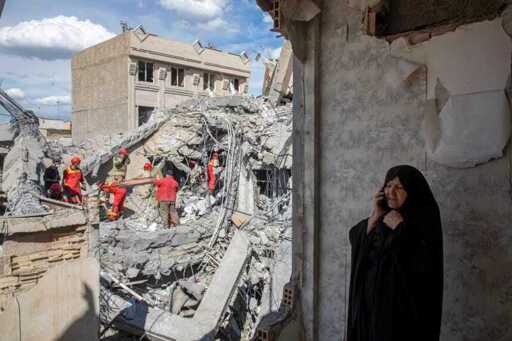
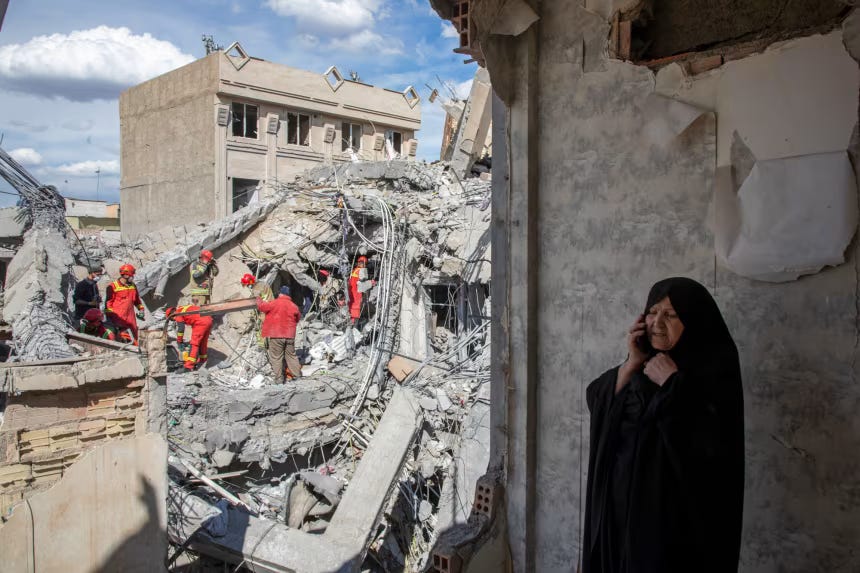
Tehran, Iran. March 2026. Majid Saeedi/Getty Images
The Globe and Mail recently published an opinion piece by Tony Keller titled“Trump’s first mistake was starting the war. His next mistake may be to let Iran win.” In a nutshell, Keller makes the case that if the U.S. doesn’t endlessly bomb Iran, then Iran will inevitably gain nuclear weapons, and of course, this is presented as a guaranteed outcome without offering an iota of evidence. In fact, Keller presents many, many assumptions as facts and inevitabilities while choosing not to examine them at all. Throughout the article, the tone remains calm, but it ultimately amounts to a feeble attempt to normalize prolonged war while calling it a reluctant necessity — a neat rhetorical trick if nothing else. It’s a classic example of jingoism wrapped in tactful political correctness.
CODEPINK Substack is a reader-supported publication. To receive new posts and support our work, consider becoming a free or paid subscriber.
With its calculated omissions, this piece asserts that the only viable option is to continue this war on Iran, a country that never presented an imminent threat to the U.S. Keller treats the war as an unfortunate but now irreversible reality, while sidestepping the more fundamental issue that this is an illegal war initiated without Congressional authorization, despite indications that negotiations with Iran were progressing. By leaving out that context, the argument frames an act of aggression that has affected millions of lives merely as a whoopsie.
Keller briefly concedes that starting the war was a mistake, and sure, we can thank him for that. Credit should be given where it is due, as most politicians in Canada lack the moral courage to even say this out loud. But he then quickly reframes that very mistake as justification for continuing it, vaguely citing a “forever changed landscape” and conveniently leaving out the actual lived consequences of bombs falling.
As a whole, the article neatly avoids the human cost this war has already caused. The massacre in Minab, the toxic air that millions will likely have to breathe for years due to the U.S. bombing of oil facilities, and the displacement of 3.2 million people within weeks are not even mentioned in passing. The recent airstrikes by the United States and Israel have once again shown an utter disregard for civilian life, yet this reality is also conveniently left unexplored.
What Keller does mention, however, is how Trump “blinked” and did not follow through on his threat to bomb Iran’s power plants. His phrasing gives the game away — Keller writes that Trump’s hesitation is “in one respect” a good outcome, since lives were spared and gas prices did not spike. But this framing quietly implies that restraint is, in another respect, a failure. When he follows this by saying that “simply downing tools now would compound the initial error,” he is effectively reducing human lives to entries in a kind of balance sheet, while casting continuation as the responsible choice. Civilian harm is not treated as a limit. It is treated as an acceptable cost of continuing the conflict, a cost that must be absorbed in the name of persistence.
We should all be alarmed by the suggestion that the United States must now settle into a war of attrition, as though endurance alone is a substitute for a coherent strategy. This line of thinking is not new. In fact, it seems that Tony Keller here is trying to pull a Robert McNamara. One of the central architects of the Vietnam War, McNamara, continued to push the war despite mounting costs to U.S. taxpayers and the lives of countless servicemen. He later admitted what had been evident to most much earlier: “We were wrong, terribly wrong.” But that acknowledgment came far too late, after years of escalation built on flawed assumptions and a reluctance to change course. What McNamara pushed for was not strategy but entrapment, as the commitment deepened with no clear path to success. Millions of lives were lost as a result.
The parallel today is uncanny. There is absolutely no evidence that the United States is going to achieve its goals, whatever those may be, through a prolonged war on Iran. The whole world is watching the catastrophe unfold in 4K, and it is now widely understood that this war has no clear end goal or coherent strategy, only continued mayhem. Yet Keller here unabashedly calls for an endless war, once again falling back on a familiar pattern in which time is expected to resolve what strategy cannot.
On top of everything, Keller warns that withdrawing would empower Tehran to “bully” its Gulf neighbours or accelerate a nuclear breakout, and he presents this as if it requires no explanation at all. “Bullying” is invoked as though its meaning is obvious, and the nuclear threat is treated as an eventuality rather than a claim that needs to be corroborated. It is important to note that Keller asserts these points without forming a true argument, and in doing so, he is rhetorically limiting the range of acceptable choices moving forward. By presenting worst-case scenarios as likely outcomes, the argument neatly pushes escalation as the only possible path.
While Keller takes artistic license to sketch an apocalyptic vision of a nuclear-armed Iran that might “bully” Gulf states, he conveniently overlooks the actual bully in the region — the already nuclear-armed Israel. Equipped with U.S. weapons, Israel continues its genocide of Gaza that has led to over 80,000 confirmed Palestinian deaths, excluding those still buried under rubble; it is meanwhile expanding annexation and settler violence in the West Bank, and its continued attacks on Lebanon have already killed about 570 and displaced 750,000. Keller bypasses a critical question: What assurances exist that, in a prolonged conflict with Iran, Israel would not extend to the use of nuclear weapons? Likewise, he ignores the possibility that in a prolonged escalation, Saudi Arabia could also potentially seek access to nuclear warheads through its recent defense arrangements with Pakistan.
If Keller wants to act as a war propagandist, so be it. But he should not insult the audience’s intelligence by assuming they are unaware of, or will simply forget, what Israel has been doing for over two years. By floating the notion that only Iran poses a nuclear threat and is the sole aggressor in the Middle East and expecting the public to accept it, Keller illustrates just how disconnected such opinion makers are from reality and how they operate within their own echo chambers.
The way open-ended war is sold here is so casual and underdeveloped that reading it almost feels like a cognitive downgrade. There is a remarkable absence of seriousness in how the case is presented, as though the costs, risks, and consequences simply do not merit mention. There is no acknowledgement of de-escalation, renewed negotiations, and diplomatic engagement as viable paths forward. If war is being proposed, the very least one would expect is some accounting as to how much it is going to cost the taxpayer. Instead, it is framed as an indefinite subscription package to your security, where the terms are vague, and the billing is completely open-ended.
But if Mr. Keller genuinely believes that prolonging the war is necessary to prevent a nuclear catastrophe, then he should put his money where his mouth is and enlist to help “save the world.” It is easy to argue for endurance when the costs are borne by others. Talk is cheap, especially when you or your children do not have to bear the consequences. Calls for prolonged war sound very different when those making them are far removed from the realities on the ground.
But perhaps more importantly, the publication of such arguments reflects a broader problem. It is not just the author who bears responsibility for what he has written, but also the platform that chooses to publish it. As a whole, this piece appears as The Globe and Mail’s somewhat lazy attempt to position itself as a poor man’s version of The New York Times, proliferating jingoist nonsense through opinion pieces for which it is not willing to take any responsibility. It is high time that the editors understand that after two years of the Israeli genocide in Gaza, the jig is up, and the public is very much aware that what is presented as measured, responsible commentary is in fact a carefully curated repeat telecast of war propaganda.
Take Action for Iran!
Umer Azad is a software engineer by profession and a volunteer with CODEPINK and the Palestinian Youth Movement (PYM). He previously served as the Regional Social Media Expert for Pakistan Tehreek-e-Insaf (PTI), where he worked on digital outreach, exposing voter fraud, and documenting human rights violations.
From CODEPINK Substack via This RSS Feed.