

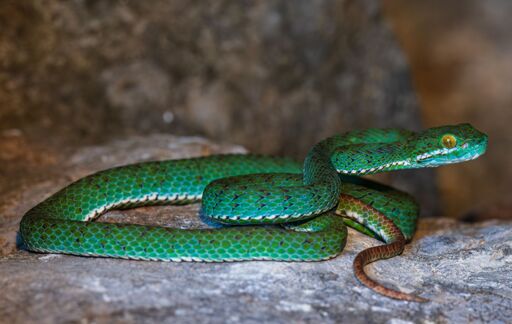
Scientists have discovered at least 11 new species in the caves and rocky outcroppings of northern Cambodia’s Battambang and Stung Treng provinces. The findings were compiled into a new biodiversity report. Seven new species have already been formally described and another four are in the process. To map the biodiversity in the nation’s karst ecosystems, dramatic landscapes of caves and large protruding rocks on both land and water that create isolated habitats, researchers surveyed 64 caves and 10 hills over the last three years. “The survey uncovered a treasure trove of extraordinary creatures,” wrote Fauna & Flora, the conservation nonprofit behind the report. “Surrounded by a sea of inhospitable, human-made landscapes, many of these creatures are, in effect, trapped. Over time, they have continued to evolve in complete isolation.” Among the new species is a turquoise-colored pit viper (Trimeresurus sp. nov.) which is still being formally described after it was spotted in Phnom Prampi, a protected natural heritage site, in July 2025. A terrestrial micro snail (Clostophis udayaditinus) is a new species smaller than 2 millimeters (0.1 inches) wide and is the first of its genus recorded in Cambodia. And a dark orange millipede discovered in a cave was just one of three new species in its genus. “Each one of these isolated karst areas act as their own little laboratory,” Lee Grismer, a biology professor at La Sierra University, U.S., said in a statement. “The results are species that exist nowhere else — not just nowhere else in the…This article was originally published on Mongabay
From Conservation news via This RSS Feed.