

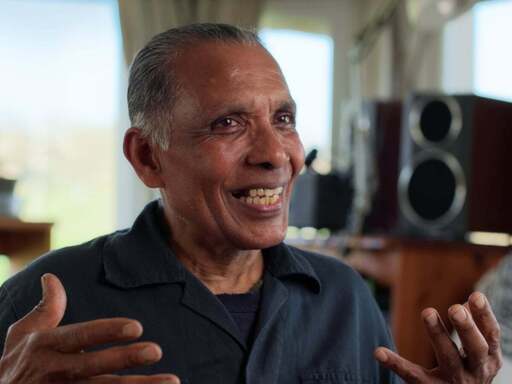

An ex-sheep farmer who once raised animals for slaughter is speaking out ahead of Easter. He’s urging the public to reconsider eating lamb. This comes as new data highlights how demand continues to drive the killing of young animals.
Animal Justice Project is releasing a new video interview with Devon-based farmer Sivalingam “Kumar” Vasanthakumar. He gave up sheep farming and took his entire flock to sanctuary, before transitioning to a plant-based livelihood.
BBC News previously featured Vasanthakumar when he made the decision to leave farming behind. He now grows vegetables on his land and runs a vegan street food business, Kumar’s Dosa Bar, using largely home-grown produce.
Animal Justice Project is releasing a new film, A Change of Heart: From Sheep Farmer to Vegan, over the Easter weekend. It tells Vasanthakumar’s story. He says in the film that he saw his sheep “as individuals”:
Once you see that, you can’t continue as before.
Data reveals demand-led lamb killing – including around Easter
New analysis of 2025 slaughter figures from the Food Standards Agency shows that 11.5 million lambs were killed last year and of those, 893,336 were killed in April, coinciding with Easter demand. This means almost 8% of annual lamb slaughter, or 1 in 13 lambs killed last year, happened in April for the bank holiday weekend.
While this is lower than peak periods later in the year, it remains higher than surrounding months and reflects the continued cultural association between lamb and Easter.
By comparison, June saw 1,106,894 lambs slaughtered, as early-season lambs reach market weight and demand increases. Even higher peaks occur later in the year, driven by large-scale retail demand.
Animal Justice Project says that while Easter does not produce the largest spike, it remains a key moment where consumer choice directly influences the number of animals killed.
Claire Palmer, founder of Animal Justice Project, said:
Easter is often seen as a time of renewal and compassion, yet it’s still associated with eating lambs: animals who are only a few months old when they’re killed.
The data shows that whenever demand rises, more animals are slaughtered. Easter may not be the biggest spike, but it’s one of the most symbolic, because it’s driven by tradition, even though people have a clear choice not to eat animals.
Central London demonstration on Saturday 4 April
To coincide with the Easter weekend, Animal Justice Project will hold a public demonstration in Leicester Square, London. It’ll take place from 12pm to 3pm on Saturday 4 April.
The demonstration will feature a striking visual installation highlighting the reality behind lamb consumption.
A performer portraying a lamb will lie on a table, dressed in a white costume with lamb ears and realistic prosthetic wounds, including a slit throat and severe leg injury. A figure dressed as a butcher will appear to cut into the body. Meanwhile a pile of severed leg props at the end of the table will represent the scale of animals killed.
Alongside the installation, a volunteer will hold a life-size lamb prop, reinforcing the comparison between animals and humans. Other volunteers will hold signs and distribute leaflets encouraging passers-by to “Skip the Lamb”.
Palmer added:
We want people to stop and think. Behind every Easter meal is an animal who wanted to live.
Animal Justice Project is urging the public to choose plant-based alternatives this Easter. And to reconsider the long-standing link between lamb and the holiday. Palmer concluded:
Traditions can change. And when they involve the lives of young animals, they should.
Featured image via Animal Justice Project
By The Canary
From Canary via This RSS Feed.