

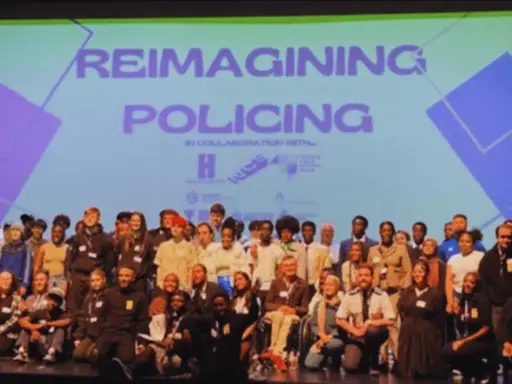

Five years after the implementation of the Police Race Action Plan (PRAP), progress has been patchy, slow, and all-too-easily reversed. Worse still, it’s been overly dependant on “individual goodwill”, rather than a true commitment to change across the force.
That’s according to the final report from the Independent Scrutiny and Oversight Board (ISOB), whose job was to oversee the PRAP. It also marks the end of both the PRAP as a standalone programme, and the ISOB itself.
As ever when we write on police racism at the *Canary,*the report observed that forces used inquiries and action plans as a substitute for real change.
The report drew on 36 interviews with civil organisations, community leaders and policing professionals. It found that, in spite of everything, the very institutional racism of the police is still a point of contention. In fact, just 6 of the 44 individual forces covered by the PRAP had even deigned to acknowledge their institutional racism.
‘That commitment has not yet been met’
Abimbola Johnson, ISOB chair, said:
Five years ago, policing committed to improving outcomes for Black communities. That commitment has not been met. Progress has been slow, uneven and too dependent on individual effort rather than institutional change.
The National Police Chiefs’ Council (NPCC) and the College of Policing established the PRAP back in 2020. It followed the police murder of George Floyd in the US, and the consequential wave of international Black Lives Matter demonstrations.
Ostensibly, the PRAP aimed to improve policing for Black people — both the public and within the police. However, that promise has not materialised. Johnson went on to state that:
Without properly enforced legal obligations, a robust inspection framework and clear consequences for failure, progress on race equity within policing will remain partial and reversible. This mirrors the pattern of previous reforms, dating back to Scarman and Macpherson. Black communities now deserve structural accountability. Government and policing must decide whether to deliver it or allow reform to stall again.
Final findings
As these reports and inquiries have found repeatedly, the single most significant barrier to progress is the racist culture of the police. There’s no external framework or imposed solution that can fix a system that doesn’t want to change.
And make no mistake — this is a systemic problem. Whilst individual police show shocking and flagrant racism, that bigotry is also embedded within the structures of policing. As such, any framework that treats racism as an individual problem in the forces will inevitably fail to make meaningful impact.
Likewise, race and racism cannot be understood within a vacuum. Police understanding of intersectionality remains a “significant and under-addressed gap.” Failure to address this means that the greatest harms will inevitably fall on multiple marginalised individuals.
The report also found that the single biggest driver of real change was the commitment of police leadership. When senior leaders were visibly committed to anti-racism, the forces under them showed greater progress. Conversely, where leaders’ commitment was lacking or clearly performative, nothing improved.
Alongside this, the police have been far better at making plans to tackle racism than actually delivering change. However, and far too often, these plans are spoken about as if they are “the change.” Repeatedly and consistently, actual impact has fallen short of the stated aims.
As such, it’s both unsurprising and appalling that Black communities still can’t trust the police. The report stated plainly that forces can’t built this trust through words and gestures of goodwill. Rather, they must show a real and sustained change in their behaviour before community attitudes can improve.
Progress ‘is now being reversed’
Regarding the ISOB’s final findings, Andy George – leader of the National Black Police Association – stated that:
After more than £10m of investment, it has failed to deliver on its core aim: improving the experience of policing for Black people.
The reality is the environment is becoming more toxic and the progress made since the Macpherson report is now being reversed.
The report itself indicated that any lasting progress is undermined by the utter lack of statutory accountability in making change. It made clear that:
Without legal duties, enforceable standards and independent inspection, progress depends entirely on goodwill and voluntary programs, leading to the PRAP inevitably being de-prioritised and treated as an ‘add-on’.
Both illustrating and compounding this issue, the end of the PRAP and ISOB, leaves absolutely no independent oversight in place. As such, the report urged the Home Office to:
establish and fund independent scrutiny, mandate national data standards, and embed race equity within inspection and performance frameworks.
We at the Canaryhave lost count of the number of times that new reports, new reviews, independent external and internal enquiries, and public bodies have highlighted and exposed institutional police racism, and the utter lack of willingness to change.
Time and again, we’ve watch police trot out their plans to fix racism, then sit back and pretend that the plan was the work itself.
So, we sign off as just as we have before. How many times do we have to write this same article?
UK police are racist because racism is embedded in the very core of their mission. It’s not one bad apple. It’s not one bad barrel. Its root and branch, tree and orchard.
Featured image via NPCC
From Canary via This RSS Feed.