


Bullets:
China’s mass production of artificial diamonds is putting the DeBeers cartel out of business across the world.
Just one small county in Henan province produces over 30 billion carats of natural diamonds, every year.
China’s luxury buyers are now turning away from natural stones, resulting in a collapse in business for India, who supplies most of China’s natural diamonds.
Hundreds of millions of dollars’ worth of diamonds have been returned to India’s diamond exchange, which is today 95% empty. India’s diamond exports to the United States are also plunging.
In Belgium, the industry has shrunk more than half. And Botswana aims to throw out DeBeers entirely.
Inside China / Business is a reader-supported publication. To receive new posts and support my work, consider becoming a free or paid subscriber.
Report:
Good morning.
China is putting the natural diamond industry out of business. Henan province is home to China’s man-made diamond industry. China makes about 70% of the world’s synthetic diamonds, and a handful of cities in Henan produce most of those. That part of Henan used to raise cattle and peppers, and fast forward forty years, it’s putting the global diamond cartel out of business, producing over 30 billion carats of diamonds a year.
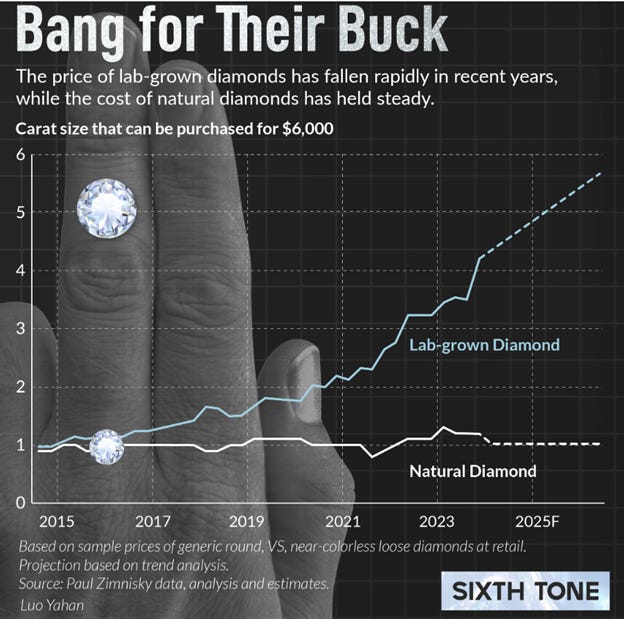
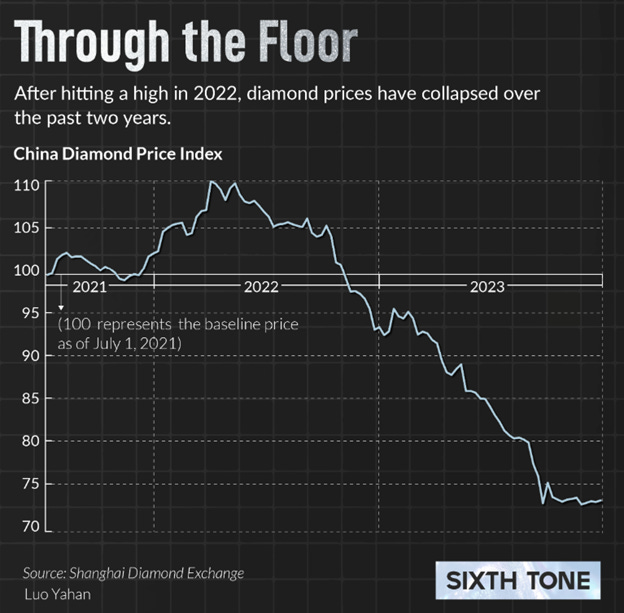
About ten years ago, the cost of a large lab-grown diamond compared to a natural stone was about the same. Today’s buyers can buy synthetic diamonds of nearly six carats for the same money as a one-carat natural stone. Diamond prices are falling, especially in the past two years.
____
DeBeers is the world’s largest miner of diamonds, and DeBeers has controlled the industry for over a century. Stones come out of the ground primarily in Africa, then head to Antwerp or India to be polished, then forwarded on to jewelry stores across the world.
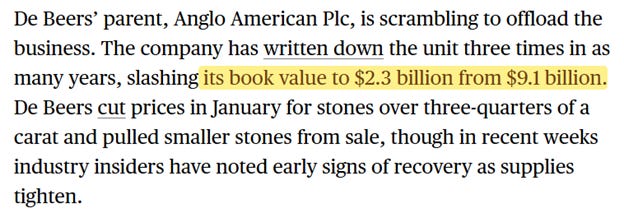
DeBeers today loses over a million dollars a day, because of the boom in Chin’s lab-grown diamond industry. The trend is lower prices, and even though DeBeers has been expert at restricting supply to maintain high prices, this entire business model is falling apart, along with the predatory pricing. DeBeers book value has been cut from over $9 billion to $2.3 billion.
There are still buyers in the luxury segment who insist on natural stones, even here in China. But those Chinese buyers are going away, and that market was one of the last pillars holding up the industry for diamonds out of Africa and through DeBeers. The Chinese market has collapsed, and hundreds of millions of dollars’ worth of diamonds have been sent back to India.
The Surat Diamond Exchange is in West India, cost $350 million to build, and it’s where 90% of the world’s diamonds were cut and polished before heading to markets across the world, and to China. Now business at the bourse is in free-fall, it is 95% empty, the whole place looks like a fancy mausoleum, and it’s emblematic of the diamond industry as a whole:
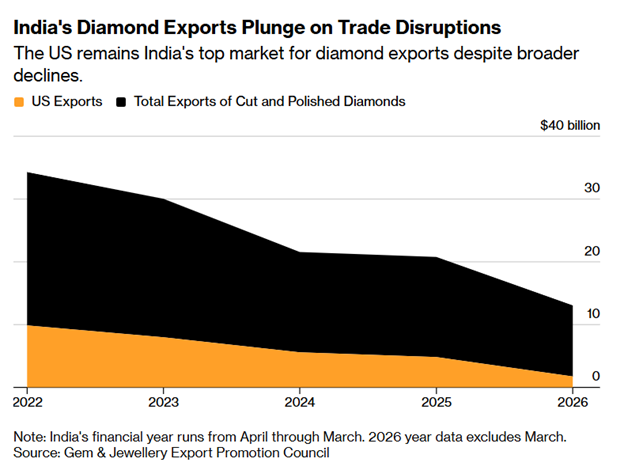
India’s diamond exports are plunging, even to the United States. Botswana’s diamond revenues are down half, and the country is looking to diversity its economy—and their diamond mining industry itself—away from DeBeers. In Antwerp, the industry has shrunk by more than half.
Be Good.
Resources and links:
Behind the Numbers: China’s Diamond Industry
https://www.sixthtone.com/news/1015760
Empty Diamond Trading Hub Mirrors Pain for $80 Billion Industry
https://www.bloomberg.com/news/features/2026-03-18/trump-s-tariffs-and-china-s-luxury-slowdown-pile-pressure-on-diamond-industry
County more than diamond in the rough
https://www.chinadailyhk.com/hk/article/602926
Inside China / Business is a reader-supported publication. To receive new posts and support my work, consider becoming a free or paid subscriber.
From Inside China / Business via This RSS Feed.
Do RAM next!