


Miles Morrisseau
ICT
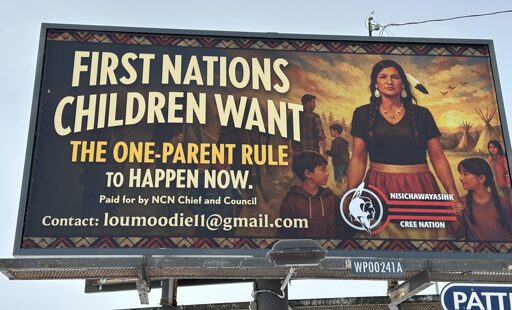
WINNIPEG, Manitoba — Driving west on Marion Street, the billboard stands out dramatically amidst the signs selling insurance and promoting local radio stations.
“First Nations children want the one-parent rule to happen now,” it says.
The billboard is one of 15 placed across the province of Manitoba, and Lou Moodie plans to put up more to spread the word across Canada.
Moodie, Nisichawayasihk Cree Nation, is a man on a mission. He wants the government to pass legislation known as Bill S-2, and he wants them to do it now.
The bill would remove a clause enacted in 1985 in the Indian Act that created two kinds of Status Indians.One group 6(1) could pass their status to their children no matter who they had children with, and the other group 6(2) could not pass their status if they had children with a person who did not have status.
It’s known as the “second-generation cut-off.”
“What they did was they inserted category 6(1) and 6(2),” Moodie told ICT recently. “What that policy basically states is that you cannot have any children with non-status people. If you do, the reprisals are that your child will be categorized or downsized or watered down to a 6(2).”
Children are also being categorized as a 6(2) if the father is not identified on the birth certificate.
“There’s one thing that is talked about, and that is having children with non-status people, but the forgotten one is that if the woman did not identify the father on the birth certificate, that child was watered down to a 6(2). So that’s a forgotten piece.”
Indigenous Services Canada counts 325,024 Status Indians as 6(2) of the total registered population of nearly 1.3 million as of November 2024, which is more than 25 percent of the population.
Bill S-2 was introduced in Canadian Senate by Sen. Paul Prosper, Mi’kmaw. The deletion of the clauses, if approved by Parliament, would allow the children of all Status Indians to be recognized in subsequent generations.

Canadian Sen. Paul Prosper, Mi’kmaw, introduced a bill in Parliament that would allow the children of all Status Indians to be recognized in subsequent generations. The bill received unanimous support from the Senate before moving to the House of Commons, where it had not been scheduled for a vote as of April 1, 2026. Credit: Courtesy photo
For now, however, thousands of First Nations people live in bureaucratic limbo where they don’t have the freedom to fall in love and have children with whomever they want for fear that their children and future generations will no longer be legally recognized as First Nations.
“I truly believe that there is no greater existential threat to First Nations than the second-generation cut-off,” Prosper told ICT in an email. “Ever since the cut-off was introduced in 1985, First Nations have been pushing back; there have been countless consultation sessions. Time and time again, advocates have called for an end to government involvement in determining who our people are.”
Removing people from the registry
The changes enacted in 1985 were part of a long-term plan by the Canadian government to reduce and perhaps eliminate Indian status in the First Nations population using various clauses in the Indian Act. In addition to controlling nearly every aspect of First Nation life from cradle to grave, the Indian Act of 1876 had mechanisms that would remove people from the registry of so-called Status Indians.
In an earlier version of the Indian Act, Indian status would be lost if the person was deemed “civilized” by attending university, becoming a doctor or lawyer, or being ordained as a minister or priest. This was in place until the 1920s.
In decades following, First Nations who joined the war efforts in World War I and World War II would also be subject to loss of status upon their return home to Canada. This was called “enfranchisement” and was at the discretion of the all-powerful Indian agents who ran the communities and its members as their personal fiefdom.
Up until 1985, First Nations women who married a non-Status man would lose her Indian status. It did not matter if the man was Métis or a First Nations man without status, such as a veteran of war who had been enfranchised, she and her children and future generations would all be classified as non-Status.
They would not be allowed to live on the reserve or receive any support provided by the government to First Nations people.
On the contrary, non-Indigenous women who married a status First Nations man would be granted full Indian status.
This was the law of the land for more than a century, until the implementation of Bill C-31 in 1985. Although the bill corrected the gender inequality to a certain degree, it did not eradicate the mechanism that would still rob current and future generations of First Nations people of their legally recognized Indian status. It contained the “second-generation cut-off.”
The Indigenous Services Canada website explains the second-generation cut off.
“After two consecutive generations of parenting with a person who is not entitled to registration (a non-Indian), the third generation is no longer entitled to registration. Entitlement is therefore cut off after the second-generation. In other words, an individual will not be entitled to Indian registration if they have one grandparent and one parent who are not entitled to registration.”
The Indigenous Services website also explains that the cut-off is “mechanical” and there are no means for debate or opportunity to contest; it is a bureaucratic algorithmic reality.
‘That’s just who I was’
For Jeannette Corbiere-Lavell, the fight to protect First Nations status and citizenship started more than 50 years ago. She married her husband, a non-Indigenous man, and a few weeks later she received a letter from the Canadian government telling her she no longer had Indian status and was no longer a member of her home community.
“1970, that’s when I met my husband, David Lavell, and we were in Toronto at the time,” Corbiere-Lavell told ICT. “Two weeks later, I received this letter from the Department of Indian Affairs and it said, ‘Jeannette Corbiere, enclosed please find a check for $35. And you are no longer a member of the Wikwemikong Unceded Territory.’”

Jeannette Corbiere-Lavell, shown here at right in this undated photo, has been fighting for equality for decades in Canada. In 2026, she’s now working for changes to Canadian law that would allow Indian Status to be handed down to future generations. Credit: Photo courtesy of Jeannette Corbiere-Lavell
Although she was aware that this was the law at the time, as she knew other First Nations women who had also lost their status, the reality of it hit her hard.
“I really had that sense of loss,” she said. “Now, what? I’m no longer part of my community. This is the only place I’ve ever known, you know, prior to coming to Toronto, because I went to school there and my relatives, family had the language, everything, aunts and uncles, and that’s just who I was. And so that started that whole big challenge.”
Corbiere-Lavell was acquainted with Clayton Ruby, one of Canada’s most well-known civil rights lawyers, and he agreed to take on her case if she wanted to challenge the law as discriminatory against First Nations women.
The case went all the way to the Canada Supreme Court, where they lost in a close decision. But the advocacy work continued, including forming organizations like the Ontario Native Women’s Association to speak on behalf of Indigenous women’s rights.
The Indian Act was amended in 1985 with Bill C-31, which allowed women who had lost their status through marriage or men such as veterans who had been “enfranchised” to regain their Indian status.
“I got my status back, but unfortunately again, and I don’t know if it’s because we’re women or whatever, but we didn’t get our full status,” Corbiere-Lavell said. “We were still being discriminated against. And this is what I’m leading up to when we’re talking about the current second-generation cutoff, because the Indian Act then in 1985, it still treated us, as women, secondary. We didn’t get our full rights back. It was designed so that our communities were losing more and more people. We were shrinking and we have statistics to show that.”
Corbiere-Lavell continues to fight the system that denies status to First Nations as the citizenship commissioner for the Anishinaabek Nation in Ontario.
‘Colonial legacies’
Bill S-2 must go through three readings in the House of Commons before it can be officially adopted into law.
The bill was introduced into the Senate on May 29, 2025. At the time, Canada’s Indigenous Services Minister Mandy Gull-Masty, Cree, said the bill was a priority for the government of the new Prime Minister Mark Carney.
“As Minister of Indigenous Services, eliminating gender-based inequities and colonial legacies in the Indian Act is a responsibility I take seriously,” said Gull-Masty. “This is one of the first bills proposed by this government because we understand the urgency of these measures for those impacted. I look forward to thoughtful study and discussions about this bill as it moves through the parliamentary process.”
Debate continues in the Canadian House of Commons as the bill moves through the process of becoming law. During proceedings on Feb. 27, Gull-Masty noted that it was illegal for more than a century for a First Nations person with Indian status to be elected to Parliament.

The Canadian Parliament building in Ottawa, Ontario, is shown in this undated photo. Credit: Photo by Benoit Debaix on Unsplash
“I stand here to speak to Bill S-2, a vital step towards addressing inequities in the Indian Act,” Gull-Masty told the House. “It is worth remembering that before 1960, a First Nations woman like me would never have had the opportunity to sit in this chamber as a Member of Parliament unless she first gave up her status. To serve in Canada’s democracy, she would have been required to renounce legal recognition of who she was. That was the price of enfranchisement: participation in exchange for erasure.”
Prosper, who filed the bill, clarified that the bill is not going to assist anyone looking for a connection into a long-forgotten past to claim Indian status.
“S-2 does not seek to restore status to those who had a single First Nation ancestor sometime in their distant past,” he said. “It simply seeks to correct the injustice that was unilaterally imposed on First Nations in 1985. I believe that this bill is all about bringing families {together] that were arbitrarily divided [with] siblings into 6(1) and 6(2) groups based on their date of birth; it’s about recognizing the children that live in our communities, go to our schools, grow up in our traditions but have, sadly, been cut-off.”
Prosper references the treaty signed by his ancestors as proof that his people wanted to protect future generations.
“When Mi’kmaq signed the Peace and Friendship treaties, they specified that these treaty protections applied to their ‘heirs and the heirs of their heirs forever,’ indicating that it would apply to future generations in perpetuity,” he said. “There was never a qualification that these protections would be void due to intermarriage.”
The bill received unanimous support from the Canadian Senate before being sent to the House of Commons for final debate. The bill now has to go through two more readings in the House before a final vote will be made for the amendment to be approved, though no schedule hasa yet been set.
‘Guiding light’
Pressure continues across the country to get the bill pushed through the House of Commons, with First Nations organizations such as the Southern Chiefs Organization hosting online petitions and webinars to educate their citizens about the importance of the legislation.
In Manitoba, Moodie plans to expand his billboard campaign across the country to get the message out.
“I’m really pushing, that’s why you see all those billboards.” he said. “I’m going to Regina, I’m going to Vancouver, I’m going to Calgary, I’m going to Toronto, all along the lifeline of Canada, which is the Trans-Canada Highway. I’m trying to erect as many billboards as possible for the parliamentarians to see and hopefully recognize that this is real.”
In Ontario, elder Corbiere-Lavell continues the fight that started over a half-century ago, inspired by her traditions and spirituality.
“I was given the name North Star,” she said. “I was barely 20, I think, when I was in Toronto. I didn’t realize the significance at the time. My youngest son pointed that out. He said, ‘Mom, did you realize how everyone in the world looks at the North Star? That’s the guiding light.’”
She is willing to retain that responsibility.
“I believe that’s what I have to do … to make sure we don’t lose any of our people, and that we maintain that connection to our land, to those resources, to the water especially, to protect the water,” she said. “And that’s our role as women, and the men have their roles as well, for protection of our people. …We just have to remember it.”
The post The fight to protect Indian Status in Canada inches closer to law appeared first on ICT.
From ICT via This RSS Feed.
They really gotta get this sorted, especially given the changes to the Citizenship Act. Like…as far as Canadian citizenship goes you now can inherit it from one parent as far back as you want.
Well fuck that noise. Good on you for fighting for the one parent rule. Thanks for bringing it to my attention. How can I help pass bill s-2?
