

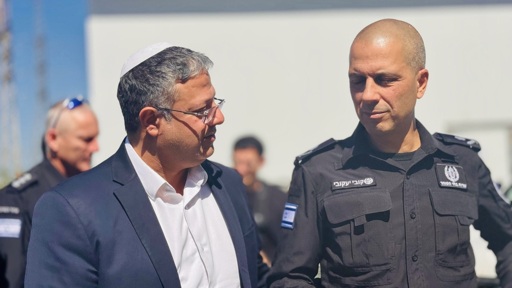
The Israeli Knesset (Parliament) approved on Monday, March 30, the third and final reading of the controversial bill that mandates the death penalty by hanging for Palestinian prisoners convicted of killing Israeli individuals.
Read more: Israeli Knesset advances bill allowing execution of Palestinian prisoners
The bill passed with 62 Knesset members voting in favor, 48 against, and one abstaining. The preliminary reading of the bill, which was sponsored by the far-right Otzma Yehudit party, led by Israel’s National Security Minister Itamar Ben-Gvir, was first approved on March 1, 2023.
Earlier that year, Ben-Gvir unleashed a brutal crackdown campaign against the Palestinian Prisoners’ Movement including increased use of solitary confinement, severe torture, and deliberate medical neglect, making detention conditions unbearable. Even before the October 7 attacks, thousands of Palestinian prisoners were held in inhumane conditions, with many facing the imminent risk of execution.
Following October 7, the crackdown tightened even further, with Israeli authorities taking away the fundamental right of visits with lawyers and family, the denial of basic sanitary conditions like showers and decent food, and increased weaponization of sexual violence against detained Palestinians.
With the Knesset’s approval of the death penalty law, the situation of Palestinian prisoners has reached its most critical point.
What makes the legislation of the bill unlawful and controversial?
The law has raised concerns among international human rights groups for many reasons. First of all, based on international law, the West Bank and Gaza Strip are occupied territories, where Israel as an occupying power has no jurisdiction over the Palestinian population.
Secondly, the provisions of the proposed law apply exclusively to Palestinians, while Israelis convicted of the same “offenses” will not face the same penalty.
In contradiction with international conventions, the bill does not allow clemency. It does not give Israeli military commanders the power to pardon, reduce, or overturn the death penalty.
Furthermore, the execution by hanging would be carried out within a 90-day time frame after the final ruling, with severe restrictions on appeals.
According to Israeli human rights organization B’Tselem, the conviction rate in Israeli military trials held for Palestinians is approximately 96%. Convictions are predominantly based on coerced “confessions” during interrogations.
Many legal restrictions and conditions have also been eased to make the application of the bill broader. A request from prosecutors or a unanimous decision by a panel of judges is no longer required for the death sentence to be issued.
Those sentenced to death will also be subjected to new prison rules including solitary confinement arrangements, and keeping the execution process confidential.
Yet, an amendment was made to the bill, stipulating that the prison authorities would notify the families of the victims of the execution date.
UN calls on Israel to repeal the bill
United Nations High Commissioner for Human Rights, Volker Türk, denounced the passing of the bill in a press statement on Tuesday, March 31, saying that “it raises the unacceptable risk of executing innocent people”.
Turk added that the decision “is patently inconsistent with Israel’s international law obligations, including in relation to the right to life.”
He also described it as “deeply discriminatory”, demanding that it must be “promptly repealed”.
OIC urges the international community to take all the necessary measures against the Israeli Knesset
For its part, the Organization of Islamic Cooperation (OIC) issued a statement in which it strongly condemned the move, considering it “a dangerous and unprecedented step that grants a licence for murder and political execution against the Palestinian people.”
The organization affirmed that the step constitutes a “flagrant violation of international humanitarian law, particularly the Fourth Geneva Convention.”
It further urged “the international community, including the United Nations, international human rights organizations, and the Inter-Parliamentary Union, to take the necessary measures against the so-called Israeli Knesset, to activate mechanisms of accountability against Israel, the occupying power, and to exert pressure to repeal this unlawful law, protect the rights of Palestinian prisoners, and work towards their release.”
People of conscience over the globe rally in protest of the decision
In response to the Knesset’s endorsement of the bill, mass protests erupted in different cities over the globe, including areas that have endured massacres and destruction at the hands of the Israeli Occupation Forces (IOF), such as the besieged Gaza Strip, occupied West Bank and Syrian cities.
Abu Obaida asks Hezbollah to capture Israeli soldiers in response to the bill
Meanwhile, the spokesperson of the Al-Qassam Brigades, the military wing of Hamas, Abu Obaida, responded to the Knesset’s decision by exhorting Hezbollah to maximize its efforts to capture Israeli soldiers during its ground clashes with the IOF in southern Lebanon, in order to free Palestinian and Arab political prisoners held in Israeli jails.
Abu Obaida maintained that resistance “proved to be the shortest path to free the prisoners.”
Read more: Hadeel Shatara: the Palestinian woman who defied her jailors
“That’s not a death penalty law. That’s a genocide law,” says Ofer Cassif
Besides being widely condemned internationally, the approval of the bill was slammed by dissenting voices from within the Knesset as well.
Knesset member Ofer Cassif slammed the move in a video statement, saying:
“It’s so symbolic that on the 50th anniversary of Land Day, the day that symbolizes the looting, the theft, and the confiscation of the Palestinian land by the state of Israel, the Knesset (the Israeli Parliament) enacted a death penalty” against what the bill calls “Palestinian terrorists”.
Cassif criticized the law, which only targets Palestinian prisoners designating them “terrorists” for offenses related to killing Jewish Israelis, while they do not apply to Jews committing the same offenses.
The Israeli lawmaker argued that such offenses are considered “acts of terrorism” on a national basis, which in turn exposes the discriminatory nature of its legislation.
Cassif pointed out that the chair of the Knesset’s interior committee declared a couple of days before the bill was approved, that “there aren’t any innocent people in [the West Bank’s city of] Jenin”, which means that “all Palestinians are terrorists”.
“If this law says that terrorists should be executed, and all Palestinians are regarded by them as terrorists, that means in other words, logically speaking, that all Palestinians should be executed,” he asserted.
“We have to say something very clear. That’s not a death penalty law. That’s a genocide law. All those who supported, let alone proposed, this bill should be tried by the Hague,” Cassif warned.
The post Israeli Knesset mandates death by hanging for Palestinian prisoners appeared first on Peoples Dispatch.
From Peoples Dispatch via This RSS Feed.