

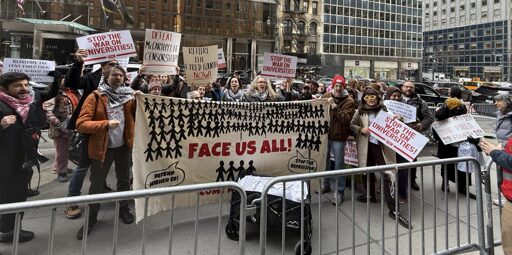
For months, the PSC-CUNY union, student groups, and community allies organized and fought for the reinstatement of the CUNY Fired Four. It was an uphill battle, especially given that the Fired Four were adjuncts with very little job security.
Yet in January, CUNY determined that three of the four adjuncts were once again eligible for employment at Brooklyn College: a victory for the movement and a result of the passionate fight of the CUNY community. This win underscores the importance of sustained collective action in the face of repression.
However, in an effort to divide the movement and try to appease the Zionist Far Right, CUNY has still not reinstated the last faculty member. The “Fired Fourth” has been barred from working at any CUNY campus, where she had been employed for nine years. This amounts to political blacklisting reminiscent of the McCarthy era and should have no place at CUNY, or anywhere. CUNY students and workers must denounce this political repression and organize a fight back that can pave the way for a different kind of university, free of repression and on the side of workers and students who fight for Palestine and against genocide and injustice everywhere.
CUNY Capitulates to the Right and Criminalizes the Movement for Palestine
CUNY has a long history of repressing the Palestine movement, but for the purposes of this article, let’s begin at a May, 2025 protest at Brooklyn College.
That month Brooklyn College students organized a protest in solidarity with Palestine on the main lawn and invited faculty, who were already participating in an action against low adjunct wages, to join them. As one student put it, “Adjuncts, your struggle is our struggle: there is money for Israel to commit genocide, and no money for adjuncts.” Dozens of faculty members joined the protest, many motivated both by opposition to the genocide and the need to protect students. Many faculty were concerned that Brooklyn College might call the police on the overwhelmingly black, brown, and immigrant students, who would likely be brutalized.
PSC-CUNY had aready issued a statement demanding that Brooklyn College keep police off campus. Instead, under President Michelle Anderson, the college flooded the campus with police, who, both on and off campus, brutalized, punched, and tased students. In the aftermath, far-right, gun-toting City Councilwoman Inna Vernikov (who literally brought a gun to Brooklyn College’s campus in October 2024) and other politicians called for “swift action” against those at the protest.Just a few weeks later, four adjuncts who had attended the protest lost their jobs, despite stellar student and faculty evaluations, and several students were suspended, including City College SJP President Hadeeqa Arzoo Malik. This all happened not so coincidentally right before Chancellor Felix Matos Rodriguez was called to testify before the House Education Committee in Washington. These committee hearings, the same ones that led to the ousting of several college presidents, were led by several far-right congrespersons, including Tim Walberg, Elise Stefanik, and Randy Fine.
In the hearing, CUNY Chancellor Felix Matos Rodriguez testified that four faculty members had been disciplined and publicly named one of them, exposing her and her family to attacks from the Far Right.
Three of the “Fired Four” were “non-reappointed” for the Fall 2025 semester, a technicality reflecting adjunct faculty’s lack of job security from semester to semester. In this case, despite the chairs of departments seeking to appoint all four adjuncts, they were told that they could not appoint them — a clear violation of faculty governance. In the case of the fourth, in addition to a non-reappointment letter, she received a formal termination letter on the grounds of “conduct unbecoming.”
For weeks, Brooklyn College refused to disclose what the alleged conduct was. There was no due process. Only after a formal information request filed under public-sector labor law was the justification finally revealed. She was accused of distributing a socialist flyer that included the CUNY name (“unauthorized use of the CUNY name”) and of accepting a five-dollar donation from a fellow CUNY faculty member.
Despite having no prior disciplinary record and being widely regarded as a valued member of the Brooklyn College community, with strong student and faculty evaluations, she was abruptly terminated.
And the repression went further. As the Fall semester started, five Brooklyn College faculty and one staff member were investigated for alleged violations of the Henderson Rules, the rules governing “the maintenance of public order” established after the 1969 student occupation of City College and amended following subsequent campus occupations. It’s clear that Brooklyn College and CUNY more broadly were attacking the Palestine movement, with the epicenter of repression at Brooklyn College.
It is clear that these firings and investigations have nothing to do with job performance. They have nothing to do with keeping students safe. They have everything to do with capitulating to the Far Right and attacking free speech and the right to protest. It has everything to do with maintaining a university with investments in Israel, with a pacified student body, and stopping any unity between workers and students.
The Fired Four: A Rallying Cry
The Fired Four campaign has become a central rallying cry at CUNY and beyond. The PSC, the union representing faculty, graduate assistants, and several staff titles at the university strongly condemned the firings in a social media post that was cross-posted with Jewish Voice for Peace: “While the university refuses to offer an explanation, the PSC sees all appearances of an ideological purge and demands the reinstatement of our affected members. Now more than ever, we must defend free expression. No to the new McCarthyism!”
The PSC, the Palestine movement, and community allies organized a strong movement. Just a glance at the Fired Four Instagram page highlights the kinds of actions taken: several protests, pets for the Fired Four, t-shirts, two mass letters, tabling on several campuses, flyering the joint Zohran Mamdani-Bernie Sanders rally held at Brooklyn College in September, and a joint picket with Starbucks Workers United during their strike. A faculty member wrote a song entitled “Conduct Unbecoming Blues, the Brooklyn College student union held a day to make art for the fired four, and one student walked around campus with a sandwish board that said “Ask me about the fired four.” As a result of this strong movement and pressure from below, candidate Zohran Mamdani opened a rally at Brooklyn College speaking about the Fired Four, and later at that same rally a student asked a question highlighting the importance of reinstating the four adjuncts.
The firings have been covered in The Gaurdian and The Intercept, and numerous other publications. The NYC AAUP wrote a letter to Brooklyn College President, as did the Rutgers- AAUP and the Middle East Studies Association. Academics like Marc Lamont Hill and Robin DG Kelley made videos in solicarity with the fired four.
The fight for the Fired Four and now the fourth, has sparked a collective awareness at CUNY to stand together in defense of our freedom of speech and against injustices such as the genocide of the Palestinian people. Students, professors, staff members — people who aren’t necessarily activists — have taken up the cause of defending free speech. It is a campaign built from the ground up, from within the CUNY community itself.
McCarthyism is Bac****k
These attacks on teachers and professors for their protest and speech are not new. There has long been what many have called a “Palestine exception” to free speech, with scholars and educators facing discipline and termination for their political expression in solidarity with Palestine. And in the aftermath of the mass Black Lives Matter movement we also saw a broader assault on the study of Black struggle and oppression, as well as on LGBTQ+ studies.
When the movement for Palestine swept the country, especially across university campuses, repression intensified. It escalated even further following the encampments. Police were sent in against students, workers, and community members, brutalizing those protesting against genocide. University presidents were hauled before Congress and aggressively interrogated, with some ultimately losing their positions. At the same time, a systematic campaign to suppress the Palestine movement took shape, with universities surveilling students, issuing suspensions, and carrying out expulsions.
With Donald Trump’s return to the White House, this repression deepened further, targeting the Palestine movement, universities, and international students. The detention of Mahmoud Khalil and attempts to impose new political conditions on universities were part of a broader effort to reshape higher education along more conservatie lines. Yet the response was immediate and widespread: hundreds of thousands mobilized across the country to demand Khalil’s release and to oppose federal overreach into universities. In the face of this resistance, the administration was forced to walk back some of its most extreme measures.
Historian Ellen Schrecker, a leading scholar of McCarthyism, has argued that the current moment is worse than McCarthyism. The scope of repression today targets not only individuals, but the broader mission of the university itself, policing curricula, disciplining students, and firing faculty.
The parallels to the McCarthy era are striking. The charge of “conduct unbecoming,” used in the case of the fourth fired adjunct, echoes a long history of vague disciplinary language deployed to punish political dissent.
Brooklyn College itself has a history of making such fabricated charges. In 1950, President Harry D. Gideonse attempted to shut down the student newspaper, The Vanguard. Students responded by continuing publication independently under the name Dragnauv (“Vanguard” spelled backward). In retaliation, six students were suspended for “conduct unbecoming,” and dozens more were reprimanded.
Today, an exhibit documenting this episode stands just outside the office of Brooklyn College President Michelle Anderson, commemorating past attacks on free speech. Yet in the present, an adjunct professor has been fired for distributing a flyer that included the CUNY name and for accepting a five-dollar donation from a fellow faculty member. The parallels are difficult to ignore. History is not just rhyming, it is repeating itself with striking clarity.
We Can Win
While repression today is severe, so too is the solidarity and resistance. In that sense, we are not necessarily in a situation worse than McCarthyism; the fight back is stronger. The vast majority of people do not support this kind of draconian crackdown. It is this collective fightback that helped win the reinstatement of three of the CUNY Fired Four. It is this same pressure that led to the release of Mahmoud Khalil, who was freed after more than three months in ICE detention following a federal court order, and, most recently, to the release of Leqaa Kordia and high schooler Dylan Lopez Contreras after both had spent nearly a year in detention .
We can win the reinstatement of the Fired Fourth. Already 5,000 letters have been sent to call for her reinstatement, and an action of 100 students and workers took place in front of CUNY Central to call for the fired fourth’s reinstatement.
And that reinstatement must be understood as only a first step. Brooklyn College and CUNY have yet to acknowledge, let alone repair, the financial and psychological harm they have caused. Nor have they reckoned with the impact on students, who have been deprived of semesters with dedicated and highly regarded instructors. And the demands of the student movement remain: divestment from Israel, a free People’s CUNY and more.
These firings make clear that the CUNY Chancellor and the Board of Trustees do not act in the interests of CUNY students and workers. They are the ones who call in police to intimidate and brutalize the campus community. They are the ones who remove committed educators from the classroom.
The New York City administration, led by Zohran Mamdani, who ran on a platform of solidarity with Palestine, spoke out in solidarity with the Fired Four and was endorsed by the PSC, bears political responsibility for ensuring that the fourth professor fired gets her job back and is not banned from teaching at CUNY, as this would set a dangerous precedent across the entire university.
At the same time, as we confront these escalating attacks on higher education, we must be clear: defending against repression does not mean returning to the pre-Trump status quo. That status quo was already marked by inequality, precarity, and repression — especially for adjunct faculty and politically active students. And unlike the McCarthy era, many workers and students are questioning the university from the left.
In this context, we want to reimagine the university. We want a people’s university that protects and nurtures the working-class and oppressed youth. We want a university that isn’t run like a business and doesn’t have investments in imperialism, but where the knowledge produced is in the service of its students and workers.
The fight against repression and the fight to reinstate the CUNY Fired Fourth only highlights that the wrong people are running the university. It is those of us who work and study at CUNY that should run the university. With this desire in mind, we call for the end of political blacklisting, and for the CUNY community to rise up to finish the fight, and win the reinstatement of the Fired Fourth.
The post Down with Political Blacklisting: Reinstate the CUNY Fired Fourth appeared first on Left Voice.
From Left Voice via This RSS Feed.