

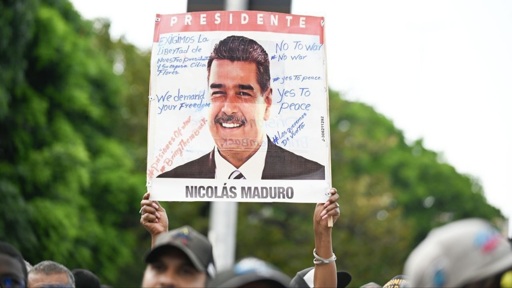
On Wednesday, April 1, the United States lifted sanctions on the acting president of Venezuela, Delcy Rodriguez, according to an update on the US treasury department website. The move marks a major shift in Washington’s decades-long sanctions regime against the Caribbean country. Just a few days earlier, on March 26, Venezuelan President Nicólas Maduro and First Lady Cilia Flores made their second court appearance in New York, where the sanctions on Venezuela became a key point of dispute, drawing fundamental contradictions in the current state of US-Venezuela relations to the surface.
Nearly three months have passed since Maduro and Flores were kidnapped from Venezuela in “Operation Absolute Resolve”. Since then, they have been held in detention in the Metropolitan Detention Center in Brooklyn, New York, as the US government builds its case against them to substantiate charges of narco-terrorism and drug trafficking.
In addition to the illegalities of their capture and of the unilateral US military action against Venezuela, a key irregularity has been raised by the defense of Maduro and Flores: the restriction on the payment of legal fees. Due to the extensive unilateral coercive measures imposed by the United States against Venezuela, the government of Venezuela (the same one which has now established formal diplomatic relations with the government of Donald Trump) is unable to transfer state funds to the US to pay for legal defense.
In the days immediately following their capture, the Office of Foreign Assets Control (OFAC) had granted a license to permit the legal defense of both the president and the first lady be paid by the Venezuelan government, but hours later, the same entity revoked the license for the payment of Maduro’s defense, and just recently revoked the license for Flores. This means that the defense teams of both Maduro and Flores are not currently being paid, and, as argued by their defense, the defendants constitutional right to defense is being undermined by the US government.
The issue had been raised by the Venezuelan president’s attorney, Barry Pollack, in a letter to the court dated February 20. Pollack wrote in the letter, “By its failure to allow the government of Venezuela to pay Mr Maduro’s defense costs, OFAC is interfering with Mr Maduro’s ability to retain counsel and, therefore, his right under the Sixth Amendment to counsel of his choice.”
In the letter, Pollack raised that he had already requested that OFAC reinstate the license and as of the time of publication, the office had refused to do so. As such, Pollack raised a motion to the court that if payment is not allowed, the court should assign a public defender to represent the president and his wife, or dismiss the charges against them given that their rights are being violated.
It was this matter that was before the US District Court for the Southern District of New York on March 26, the second court appearance of Maduro and Flores.
“Things have changed in Venezuela. Why continue to apply sanctions there?”
To some, the March 26 proceedings may have seemed like any other legalese-heavy, technical hearing, with the attorneys arguing to the judge about the similarities and differences of previous court rulings and whether or not the outcomes apply in this case (minus the unique fact that the defendant is the constitutional head of state and was kidnapped in a military operation). “Luis and Stein cases say you should have right to counsel of choice when you have untainted funds available!” declared Pollack, citing a Supreme Court ruling and the ruling of the US Court of Appeals for the Second Circuit, regarding the Sixth Amendment as it relates to legal fees.
But underneath the legal sparring between the defense, prosecution, and the judge, was a debate on US foreign policy and the contradictions and predicament that the US has manufactured in the post-January 3 reality.
It was the 92-year-old Judge Alvin Hellerstein who first questioned the logic of the US government’s approach to Venezuela and accused the government of using alleged foreign policy considerations to violate constitutional rights. “What is the interest of the government now in blocking [Venezuela’s] funds?” he asked US Attorney Kyle Wirshba, who responded, “National security and foreign policy.” The judge continued, “We are doing business with Venezuela…” and asked later, “Things have changed in Venezuela. Why continue to apply sanctions there?” Wirshba seemed perplexed, and insisted that OFAC has the right to make the determinations it sees fit.
Judge Hellerstein insisted again “We do business with Venezuela; the oil is important because of the Strait of Hormuz.” He then made a comment which seemed to completely upend the government’s insistence to keep sanctions in place in the current situation. “I am looking at the Executive Order which set up the sanctions, it was by President Obama [in 2015]. The interests are no longer implicated. Maduro and Flores are here in the US and the situation in Venezuela is different.”
“The US government has a right to sanction to serve national security purposes,” Wirshba retorted, signaling to some that the US government’s ability to unilaterally impose sanctions against foreign leaders and countries would not be challenged.
Still Hellerstein insisted, “The constitutional right to counsel supersedes the government’s right to sanction,” adding that “the Venezuelan government is no longer implicated in those atrocities [outlined in the executive order] … we corrected that … the purpose of the executive order has passed. The current need is the right to defense.”
The back and forth between the judge and the US government’s attorney was heated and though Hellerstein repeatedly declared that the denial of funds in this case would constitute a violation of the Sixth Amendment, he reserved his judgement in the matter. Additionally, as was clarified in this back and forth, the judge does not have the ability to order OFAC to issue the licenses. There was no date set for the next hearing nor clarity on when the judge would issue its opinion.
Washinton’s case against Maduro and Flores unfolds amid a dynamic geopolitical situation. The US-Israeli war on Iran has forced the United States to reconsider hardened positions such as the complete sanctioning of Venezuelan and Russian oil, which in turn compels it to modify its diplomatic relations with those countries. Last week, after Venezuela and the US re-established diplomatic ties, Venezuela re-opened its embassy in Washington DC. The office had been shuttered since 2019, when Trump recognized Juan Guaidó as interim president of Venezuela. Now, the US has removed sanctions on the acting president of Venezuela as the court proceedings exposed contradictions in US policy toward the Caribbean country that threatened the continuation of the trial itself.
The US case against Venezuela’s leaders is not merely constrained to the legal realm, as everything else, it is shaped by the dialectics of history and the ever changing correlation of forces internationally.
The post US sanctions against Venezuela take center stage in trial of Nicolás Maduro appeared first on Peoples Dispatch.
From Peoples Dispatch via This RSS Feed.