

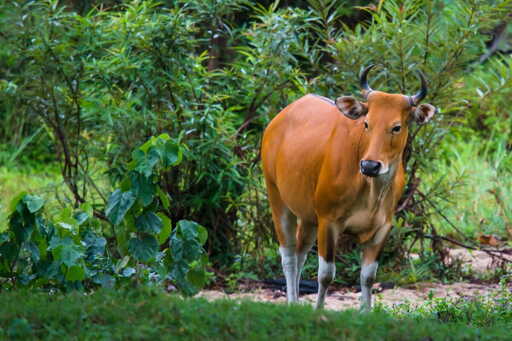
HUAI KHA KHAENG, Thailand — “Five years ago, we’d never have been able to see this,” says Boonlert Tianchang, raising a pair of binoculars to his beaming eyes. “To see just one banteng, we would have had to go deep into the forest. Now, they’re right here.” We’re standing on a wildlife-viewing platform overlooking a roughly 8-hectare (20-acre) grassland in the buffer area surrounding the northeastern boundary of Huai Kha Khaeng Wildlife Sanctuary, a flagship protected area in Thailand’s Uthai Thani province. Russet-colored banteng (Bos javanicus), one of the world’s rarest species of wild cattle, step one by one into the clearing from the cover of the forest. Mothers, calves and adult males browse the vegetation nonchalantly, their stocky bright-orange bodies contrasting almost comically with their spindly white legs and snowy rumps. “This is the only place in Thailand where you can see a lot of banteng like this,” says Boonlert, who lives in the buffer area and leads a community-based ecotourism initiative focused on tours to see this increasingly common sight. “I see them here so often,” he says. “But every time, I’m humbled thinking of all the work that’s gone into protecting them [to] get to this point.” Boonlert Tianchang scans the landscape at a wildlife watching platform in Rabam subdistrict. Image by Carolyn Cowan for Mongabay. Protection prompts recovery As large herbivores, banteng play a vital role in dispersing seeds and cycling nutrients in the dry, open-canopy forests that are their preferred habitat. Their browsing of understory…This article was originally published on Mongabay
From Conservation news via This RSS Feed.