

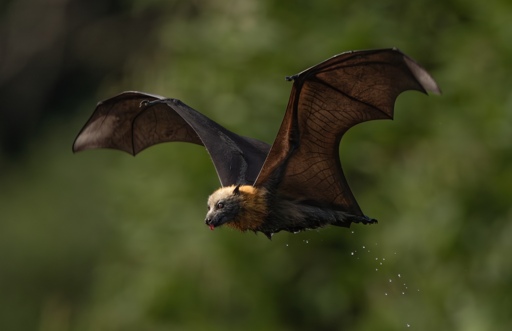
Each night, a dark cloud of flying foxes, or fruit bats, moves through the skies of eastern Australia on their way to gorge on nectar and fruits. With a meter-wide (3.2-foot) wingspan, they transport large quantities of pollen and rain down seeds in their poop, helping establish new trees. A new study in Scientific Reports provides the first economic valuation of the ecosystem services provided by flying foxes in Australia, focusing on their significant contribution to the timber industry. Recent fires and heat stress events have led to colony loss and a dramatic drop in bat numbers; more than 80% of some populations have been wiped out amid extreme heat events. Justin Welbergen, an animal ecology professor at Western Sydney University who was not part of the study, told The New York Times, “A single hot afternoon can result in mortality on a regional scale and in biblical proportions, with tens of thousands of dead flying foxes.” Flying foxes can travel thousands of kilometers per year, spreading pollen and seeds over large distances, making their economic value immense. First author Alfredo Ortega González, a University of Sydney scientist, said in a video interview with Mongabay, “There is no bird that can move the distance, on average, that a flying fox can move in a night.” The study authors calculated the spatial extent of the bats’ nightly foraging, based on the locations of 1,209 roosts of four mainland Australian flying fox species (Pteropus poliocephalus, P. Alecto, P. scapulatus and P. conspicillatus).…This article was originally published on Mongabay
From Conservation news via This RSS Feed.