

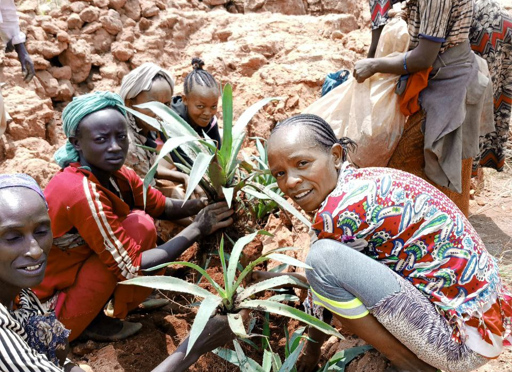
In the southern Ethiopian region of Sidama, unsustainable farming practices and tree cutting for fuel are causing land degradation. In response, members of the Integrated Women’s Development Organization are planting indigenous trees, bananas and vegetables as well as desho (Pennisetum glaucifolium) and elephant grass (Cenchrus purpureus) for cattle fodder in an effort to restore damaged farmland and build more resilient livelihoods. In an email interview, IWDO’s general manager, Ruhama Getahun, told Mongabay that the women and youth who make up the NGO’s membership have planted more than 1,250 hectares (3,080 acres) since 2020. She said these initiatives have begun generating income for community members — particularly women — helping them rely less on forest products such as charcoal and firewood for survival. Negasi Solomon, a land and environment researcher at Tigray Institute of Policy Studies in Mek’ele, Ethiopia, told Mongabay that rapid population growth means the average size of a household’s land in the Sidama region has shrunk. This has pushed farmers to expand their plots onto fragile and steep hillsides. Solomon told Mongabay in an email that women are — or should be — central to land use and land restoration decisions in Sidama, and in Ethiopia in general, because of the role they play in day‑to‑day farm management. He noted, however, that many women in Ethiopia still face obstacles to taking up leadership roles. “Patriarchal norms and customary systems often concentrate land ownership and key decision‑making in men, while limiting women’s inheritance and control over land even where…This article was originally published on Mongabay
From Conservation news via This RSS Feed.