

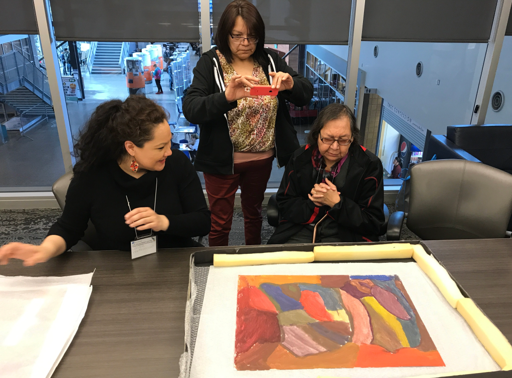

The late Amelia Wavey Saunders, right, views a painting she made at MacKay Indian Residential School decades before. Beside her sits Lorilee Wastesicoot, whose parents also attended MacKay; she now works at the University of Victoria as Curator of Indigenous Art and Engagement. Wavey Saunders died in 2020. Photo courtesy Anne MacLaurin/UVic
Content warning: This article contains details about residential “schools.” Please read with care for your spirit.
Nearly 60 pieces of art from six decades ago are a reminder that children’s creativity could not be suppressed by colonizers’ attempts to strip them of their culture.
The rare collection, created by students of MacKay Indian Residential School in the 1960s, resurfaced publicly in March during a presentation at the Indigenous History and Heritage Gathering in Winnipeg.
Survivors of the institution in western Manitoba hold reunions every year at the old building in Dauphin, where they commemorate their time at the school through various projects.
The memories are traumatic for survivors. But some are finding hope in seeing decades-old drawings finally come to light.
“The story still needs to be told,” said Jim Wastasecoot, a member of Peguis First Nation, and a MacKay survivor.
“It was important to participate in the repatriation, because there’s still a lot of Canadians that don’t believe.”

A childhood painting by MacKay Indian Residential ‘School’ survivor James (Jim) Wastasecoot. Courtesy of University of Victoria
Wastasecoot’s art was among those that came to life on a big screen, where it was projected during the Winnipeg gathering.
The collection is impacting multiple generations, including intergenerational survivors like Wendy Saunders.
A Cree woman from York Factory First Nation, her mother Amelia Wavey Saunders was torn from her family more than 50 years ago, taken by train to Dauphin, Manitoba to attend MacKay. (Her mother died in 2020).
The facility, run by the Anglican Church from 1957-69, continued to house Indigenous children attending nearby schools until the late 1980s.

Created at age 11, Amelia Wavey Saunders’ tempera painting depicting Robert Aller, her art teacher in MacKay Indian Residential ‘School.’ Painting by Amelia Wavey Saunders/Courtesy University of Victoria
‘These paintings were supposed to be destroyed’
Saunders recounted how her mother resisted assimilation by holding onto her Cree language and continued to speak fluently throughout her life.
And she vividly remembered her mother’s reaction the day two tempera-on-paper paintings she’d made as a child arrived at her home in Kischewaskahegan (York Factory First Nation), nearly 700 kilometres north of Winnipeg.
“Before she even said anything, she had to sit there for a while,” Saunders recalled.
“She must have sat there thinking maybe about 20 minutes or so. We just gave her space. We didn’t interrupt her time.”
Eventually, Saunders recounted with a mix of tears and laughter, her mom broke her silence.
“After 50 years, way after, I get my paintings,” she remembers Wavey Saunders finally remarking.
And the Elder set off chuckles among her loved ones, as she struggled to remember exactly how her childhood self had painted the bearded man she saw depicted on the page.
Wavey Saunders realized it in fact depicted her art teacher, Robert Aller.

READ MORE: Children’s book tells residential ‘school’ story from a kid’s view
In the 1960s, Cree, Dene and Anishinaabe children who attended the institution made paintings under the guidance of the volunteer instructor Aller, who encouraged the children to paint what was important in their lives.
Aller, born and raised in Manitoba, taught art in the Dauphin facility after previously doing so at Alberni Indian Residential School on “Vancouver Island.”
Decades after both “schools” had closed their doors, Aller had kept the artwork his students had made.
Later, during a repatriation ceremony in “Thompson,” one of his descendants revealed to survivors how the teacher had managed to save the paintings.
“All of these paintings were supposed to be destroyed by the instructions of that priest,” said Eugene Arcand, a MacKay survivor from Muskeg Lake First Nation, who heard the Aller descendant’s explanation.
“But they’ve survived, the same as all of us have survived.”
According to Arcand, one day an Anglican priest came into Aller’s classroom and saw a pile of children’s art piled up in one corner.
“I want those burnt,” the priest instructed him, Arcand said. So Aller pretended to take them to the incinerator.
“But he actually hid them,” Arcand recounted. “And he hid them in his house.
“He stashed all of those paintings.”

Renowned ‘Canadian’ artist Robert Aller, who once taught art at several residential ‘schools,’ is seen at work in 1969 or 1970. Photo courtesy Canadian Museum of History
‘He preserved a record of a painful moment’
Years later, Aller’s family donated his collection for display in exhibitions in “Vancouver” and “Victoria,” titled There is Truth Here: Creativity and Resilience in Children’s Art from Indian Residential and Day Schools.
The exhibitions’ curator, University of Victoria anthropologist Andrea Walsh, launched a community-led research project to repatriate hundreds of the children’s creations from Aller’s collection.
Eventually, the MacKay Residential School Gathering committee partnered with UVic — alongside University College of the North, Manitoba Museum, and National Centre for Truth and Reconciliation — to bring a collection of 59 paintings home to Manitoba.
They returned some of the works to survivors who were still alive.
The rest were preserved by the Manitoba Museum.

MacKay Indian Residential ‘School’ survivors and descendants (from right): Wendy Saunders, Jim Wastasecoot and Clara Kirkness opens with a grandmothers’ song at the Indigenous History and Heritage gathering, where they presented about the children’s art repatriation project in March. Photo by Crystal Greene
“I think he recognized in the moment that what was happening was important,” mused Wastasecoot, a member of the committee.
“And by having children make these paintings, he preserved a record of a painful moment in Canada’s history — in our history.”
Walsh’s decade-long repatriation research, which initially focused on art from Aller’s time at Alberni Indian Residential School, inspired artist Ximena Espinosa Treviño to create an animated film that brought Jim Wastasecoot’s art to life.
The former Concordia University fine arts student’s film Brushstrokes for Resilience, animates art by survivors of both the Alberni and Mackay institutions.
Although the artworks’ public exhibitions ended, their profound impact isn’t over for the aging survivors of MacKay, nor for their adult children like Saunders who is committed to tell her mom’s story through the preservation of the art pieces.
Survivors of MacKay have recounted children often crying at night in the dorms when they heard the train whistle blowing, because it reminded them of home where their families lived along the railway in northern Manitoba.

A painting by a five-year-old child identified only as Patricia, labled ‘U008.38.39,’ created at MacKay Indian Residential ‘School’. Courtesy University of Victoria
Wastesacoot’s daughter Lorilee Wastasecoot is curator of Indigenous Art and Engagement at the UVic Legacy Art Gallery.
She worked with Walsh to curate the exhibitions, including obtaining consent from survivors to display their works.
“For many families, this was the first time they had ever seen something their parents or their grandparents created as children,” the younger Wastasecoot said, “because residential schools disrupted not only language and family connections, they also disrupted memories.”
To her, the paintings offer a very different view from institutional records of the colonially imposed facilities.
“These paintings became something profound — they became proof of imagination, proof of humor, proof of their creativity and proof of their love for who they were,” she said.
“These paintings are proof of that childhood inside an institution that was designed to erase it.”

A painting by Amelia Wavey Saunders at age 11, labeled ‘A29.’ Courtesy of the University of Victoria
The post Residential ‘school’ survivors reunited with childhood art, hidden for decades: ‘They’ve survived, the same as all of us’ appeared first on Indiginews.
From Indiginews via This RSS Feed.