

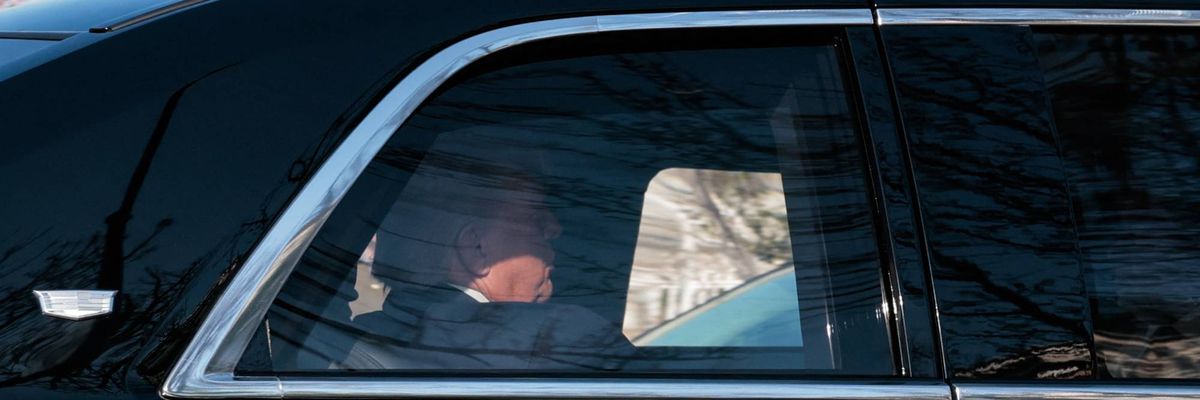
President Donald Trump is being accused of trying to “intimidate” the US Supreme Court as it hears oral arguments on his attempt to kill birthright citizenship.
Trump broke nearly 250 years of precedent as he arrived at the high court on Wednesday morning to personally observe the proceedings, which no sitting president has done.
As Kathryn Watson, a reporter for CBS News, explained, historically, “presidents have avoided attendance in part to honor the separation of powers.”
Trump was in attendance as the justices—three of whom he appointed—mulled what could be their most consequential decision in decades: whether to uphold an executive order that would strip away a fundamental guarantee of citizenship enshrined in the US Constitution.
Making it all the more unnerving were the president’s comments about the high court on Tuesday night in the Oval Office after letting reporters know he was “going” to keep tabs on Wednesday’s proceedings.
He specifically zeroed in on the Republican-leaning justices, describing those he appointed as “disloyal” for ruling against him in previous cases. While describing the liberal justices as rank partisans, who’ll vote against him no matter what, he said the conservatives were “very different.”
“They want to show how honorable they are, so a man can appoint them, and they can rule against him and be so proud of it,” Trump said.
“Some people would call it stupidity,” Trump went on. “Some people would call it disloyal.”
The court is expected to rule this summer on the legality of Trump’s executive order declaring that the children born to undocumented immigrants or those on temporary visas would no longer automatically become US citizens.
A lower court has already ruled against Trump’s order, declaring it in violation of the 14th Amendment, which was passed following the Civil War and plainly states that “all persons born or naturalized in the United States, and subject to the jurisdiction thereof, are citizens of the United States."
The Supreme Court will now hear arguments from the Trump administration seeking to undo that fundamental understanding, including ones advanced over a century ago by a former Confederate officer who also helped to establish the “separate but equal” doctrine that legalized racial segregation for over half a century.
If the court votes to uphold Trump’s executive order, hundreds of thousands of American citizens could become effectively stateless.
Aaron Reichlin-Melnick, a senior fellow at the American Immigration Council, said it could also throw the citizenship of tens of millions more into doubt, as it would effectively require people with legal birth certificates to “prove” their parents’ legal status.
Trump’s effort to strip millions of people of their citizenship comes as his Department of Homeland Security (DHS) has pushed to ultimately deport “100 million people” from the country—a number that far exceeds the population of undocumented immigrants in the US.
DaMareo Cooper explained on Tuesday for Common Dreams that the Supreme Court’s decision will determine “whether a president can rewrite one of the clearest promises embedded in American law”:
If the court strikes down birthright citizenship, it would let the government decide who counts as American based on the circumstances of their birth.
The 14th Amendment’s authors understood the danger of that approach.
Once citizenship becomes conditional, every other right soon follows. Ending birthright citizenship would affect everyone—not just children of immigrants—in a system that has long questioned the belonging of people of color, including Black Americans.
Allowing the Trump administration to determine who counts as a citizen takes on even more weight in light of another likely unconstitutional executive order signed by the president on Tuesday, requiring DHS to create a “citizenship list” to determine who is allowed to vote in the 2026 election.
Given these extraordinary stakes, many observers fear that Trump’s appearance before the Supreme Court’s deliberations on Wednesday is designed to send a message to the justices he’s accused of being “disloyal.”
Historian Ruth Ben-Ghiat called Trump’s arrival at the high court an “intimidation tactic to remind judges of the costs of defying him.”
Josh Sorbe, a spokesperson for the Democrats on the House Judiciary Committee, said, “The separation of powers is pure fiction at this point.”
From Common Dreams via This RSS Feed.