

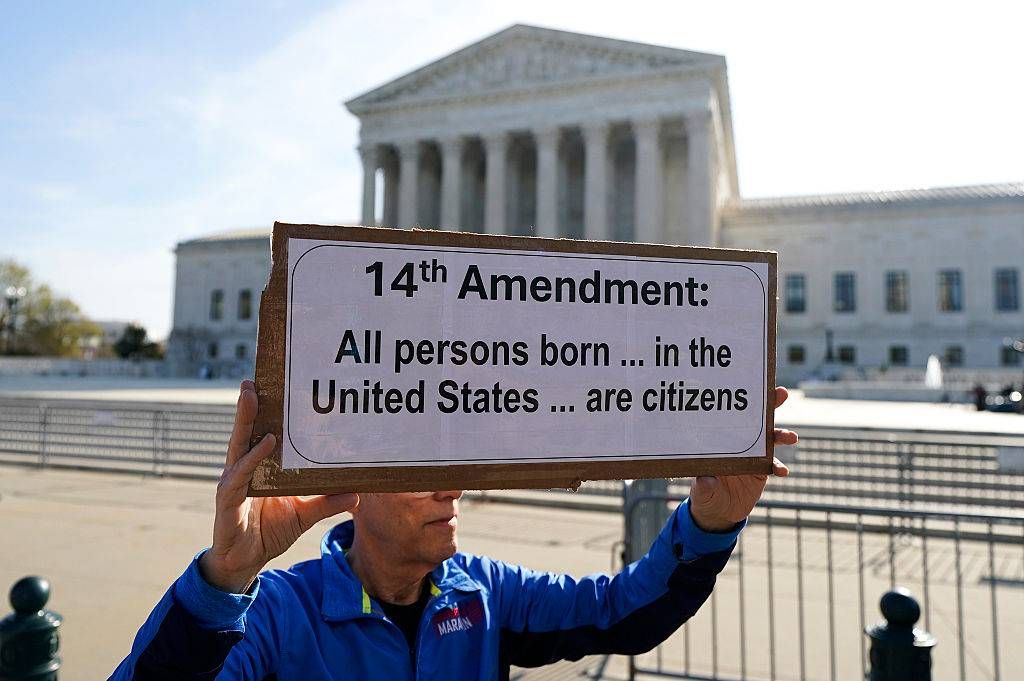
As the US Supreme Court prepares to hear oral arguments Wednesday regarding President Donald Trump’s executive order revoking birthright citizenship, several legal experts, advocacy groups, and commentators warned about the dire consequences that would come from not striking it down.
Michael Waldman, president and CEO of the Brennan Center for Justice at NYU School of Law, published an analysis on Monday explaining that, in an ideal world, the Supreme Court wouldn’t even be entertaining arguments for upholding Trump’s order because it so obviously violates the plain text of the US Constitution’s 14th Amendment.
“Birthright citizenship is in the Constitution,” wrote Waldman. “This has been the law for more than 150 years. The amendment overturned the notorious Dred Scott decision, which said that even free Black Americans could not be US citizens. The Supreme Court in 1898 confirmed the 14th Amendment’s plain meaning. In United States v. Wong Kim Ark, it ruled that children born here are citizens, even if their parents are not.”
Waldman argued that “Donald Trump tried to Sharpie this out of the Constitution” with his executive order, but insisted that the 14th Amendment is “open and shut,” making it easy for the Supreme Court to rule against the president.
The New York Times’ Jamelle Bouie echoed Waldman’s arguments in a Wednesday column, writing that “there are few lines in the Constitution that are as straightforward as the citizenship clause of the 14th Amendment,” whose “explicit aim… was to settle the question of American citizenship for good.”
Bouie also dissected assorted arguments made by right-wing legal scholars in support of Trump’s executive order, finding that they fail to offer “any new evidence regarding the drafting of the 14th Amendment, the intent of its framers, or the public meaning as understood at ratification.”
“The evidence in favor of the traditional view of the citizenship clause is overwhelming,” Bouie added. “To rule otherwise is to say, in essence, that two plus two equals five.”
Virginia Kase Solomón, president and CEO of Common Cause, argued that the Supreme Court must strike down Trump’s order because “the Constitution is not a suggestion, and its guarantees do not shift with the political winds of any one president.”
“When the courts allow one president to change the definition of American citizenship with a stroke of a pen, it puts every American citizen at risk,” Solomón added. “The Supreme Court must reject these unconstitutional overreaches before they cause irreversible harm to our families and our nation’s future.”
Garrett Epps, legal affairs editor at Washington Monthly, warned that failing to uphold the 14th Amendment would create “an exploitable non-citizen class” who would live in the country without any constitutional rights or protections.
Picking apart Trump aide Stephen Miller’s remarks about denying citizenship to children of a “foreign labor class,” Epps argued that the real goal of the Trump administration’s attack on the 14th Amendment isn’t strictly mass deportations, but the elimination of rights to an entire group of US-based workers.
“As a practical matter,” explained Epps, “reinstating a hereditary, lifelong, inferior status—which, after all, is what removing ‘full political rights, including welfare and the right to vote’ would mean—recreates the conditions for the growth of a racialized slave economy.”
TV host and activist Padma Lakshmi, writing in a Wednesday New York Times column, also pointed to the horrific impact that eliminating birthright citizenship would have on families across the country.
“If the Supreme Court doesn’t block this executive order, it would create a mess of legal and logistical consequences,” Lakshmi argued. “Confusion would replace certainty, opening the door to discrimination and a patchwork of rules governing noncitizens’ access to our society. Hundreds of thousands of children born in the United States would be thrown into legal limbo every year.”
The end result, Lakshmi said, “would create a permanent underclass of people born in the country but cut off from the rights that citizenship provides.”
From Common Dreams via This RSS Feed.