

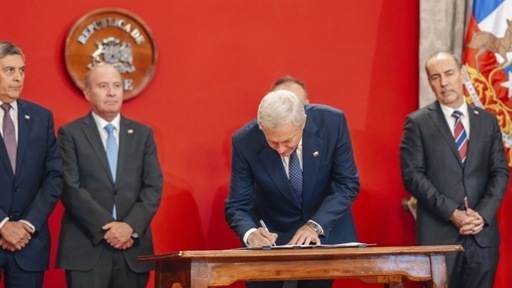
Some political analysts believed that the government of José Antonio Kast would distance itself from the rhetoric that, while thrusting him into the public spotlight as a radical right-wing politician, had undermined his ability to win a runoff election. After all, political moderation tends to be appealing in Chile, which suffered a bloody dictatorship through the years 1973–1990.
Moreover, Kast himself seemed poised to adopt a more moderate stance when, in his victory speeches, he invited Chile’s center-right to join his project for an “emergency government” – as he himself described his future administration.
However, such assumptions are fading as power is being decisively exercised by a Washington ally who appears to be embracing the style and political practices of the Trump administration, with which presidents such as Milei in Argentina, Noboa in Ecuador, Bukele in El Salvador, Paz in Bolivia, and others are also aligning themselves.
A blow to migrants
Following Trump’s violent immigration enforcement policy, Kast had promised that his government would tackle “illegal” immigration by building barriers along the country’s northern border. Yet his commitment to harsh immigration policy went further and his government repealed a decree signed by former President Boric that legalized the immigration status of nearly 182,000 foreigners. “We are not going to carry out a mass regularization as proposed by the Boric administration,” said Frank Sauerbaum, director of the Immigration Service.
At the same time, Kast, who has promised to deport more than 300,000 migrants from Chile, has moved to introduce two bills in Congress aimed at preventing undocumented individuals from entering the country. The first seeks to punish anyone who helps migrants enter Chile irregularly; the second aims to make the act of entering the country illegally a criminal offense. “Chile has been undermined by illegal immigration, drug trafficking, and organized crime,” said Kast.
The decision will affect thousands of undocumented workers in Chile’s various sectors; the government constantly repeats that the decision will lower crime rates.
A blow to the environment
On another front, although following the same neoliberal logic, Kast has single-handedly repealed nearly 50 environmental decrees that were approved during the previous administration. The decrees aimed to enhance environmental quality standards, establish limits on industrial pollution, promote decontamination plans, develop public policies to address climate change, and regulate the implementation of the Biodiversity and Protected Areas Service.
“We were surprised because, of all the marine protected areas we have established and proposed from 2008 to the present, we had never experienced a new government administration revoking these decrees,” Julio Chamorro, president of the local management council for the network of marine protected areas in the Juan Fernández Archipelago and Desventuradas Islands, told DW.
The revoked decrees also sought to protect the lives of animals such as the Humboldt penguin and Darwin’s frog, as well as to create new protected natural areas in various marine and terrestrial territories. The Kast administration stated that it intends to review the decrees more closely. The advocacy director for Greenpeace Chile told DW: “This is a serious and unprecedented event in Chile. Never before in a government transition has there been such a massive suspension of measures that had already gone through technical, administrative, and participatory processes.”
According to environmental biologist Domingo Lara, Kast’s objective has nothing to do with a technical decision, but rather seeks to benefit economic groups: “His withdrawal effectively means postponing the protection of territories that are currently at the center of extractive expansion, especially due to the lithium boom.”
Furthermore, Lara clarified: “By suspending these decrees, it allows for expanded intervention in areas where high ecological value and high economic interest converge, particularly regarding minerals considered critical – such as lithium, which is currently being targeted by the interests of Donald Trump’s US imperialism, to which the Kast government has already given clear signals of subordination and surrender of these natural common goods, by signing a joint declaration with Washington to establish bilateral consultations on strategic resources, within the framework of its dispute with China.”
The Kast administration’s decision sparked major protests against what appears to be the new administration’s environmental policy. Nearly 250 organizations participated in the protests, which drew more than 100,000 people, all of whom demanded that Kast change his stance on environmental protection in the South American country: “The environmental marches turned into a general call to defend the environment and water,” said Cristóbal Sepúlveda, president of No + Zonas de Sacrificio Chile.
A blow to Chileans’ economy
True to neoliberal doctrine, Kast has opted to raise fuel prices to align them with international market prices, as mandated by the International Monetary Fund. Consequently, prices have skyrocketed in light of the US-Israeli war on Iran. The price of gasoline has risen by 30% overnight. The price of diesel has jumped 60%. The decision has already triggered the onset of inflation, which the government is downplaying.
Read more: Iran reiterates its conditions for ending the war
The promise of economic and financial austerity once again confirms that such sacrifices, despite being cheered on by economic and political elites, are borne primarily by ordinary citizens. This was expressed by Valentina Ortega, a Chilean driver who, upon learning of the high price of fuel, told Reuters: “It feels like I’m buying gold … Honestly, I find this terrible. It’s been so few days, and he’s already doing things that affect the entire middle class and lower class – but nothing is known about what he’s going to do with the upper class.”
A blow to bureaucracy and memory
Added to these decisions are others of a labor and cultural nature. Recently, the Kast administration fired a senior official from the Ministry of Women who is battling cancer, which has caused a major controversy in Chile due to the apparent disrespect for that person’s health situation, although the presidency claims the decision was made because “there was no trust.”
In addition, Kast has overturned the expropriation of a site intended to serve as a memorial to the military dictatorship that operated at the infamous Colonia Dignidad, where dozens of political prisoners were tortured and murdered. The decision, which was supposedly made to safeguard public finances, has quickly revived the image of Kast as a defender of the dictatorship – an image he himself helped foster when he said that if Pinochet were still alive, he would certainly vote for him.
Finally, in this short time, Kast also decided that Chile would not endorse the LGBTIQ+ rights declaration proposed by the Organization of American States because, according to the government, “the text, rather than uniting the region, created division.” This decision, widely condemned by social organizations that defend the rights of sexual minorities, clearly demonstrates that the “culture war” is at the heart of Kast’s objectives as a mechanism for conservative political action.
The political Blitzkrieg of the new right
In this way, Kast joins the wave of the right’s new approach to politics, namely, the rapid imposition of various controversial measures that often contradict other legal frameworks accepted by these countries.
Read more: The Angry Tide has washed into Chile
And although many of these decisions may be reevaluated later, the political impact of right-wing governments in Latin America is powerful, like a gale that leaves no time to catch one’s breath or, more importantly, to reflect and devise the right strategies. It is a sort of institutional “Blitzkrieg” (“lightning war”), namely, a frenetic wave of political reforms that leaves society in shock.
Surely the German Blitzkrieg strategy is no stranger to Kast, whose father served in the military during the war waged by the Third Reich and whom some accuse of having belonged to the National Socialist German Workers’ Party (NSDAP), even though the current president of Chile denies such affiliation.
As history clearly shows, the problem with such a strategy of rapid, coordinated attacks is that it quickly loses steam, along with the support it had built up. This is already evident in polls showing early dissatisfaction with the new administration.
In less than three weeks in office, the government’s approval rating has fallen below 50%. Some pollsters even claim that approval has dropped as low as 37%, which demonstrates that those who act quickly without political and social capital soon plummet in the sacred numbers of modern politics.
The post Kast’s ultra-conservative political blitzkrieg: migrants criminalized, protections repealed, prices soar appeared first on Peoples Dispatch.
From Peoples Dispatch via This RSS Feed.